
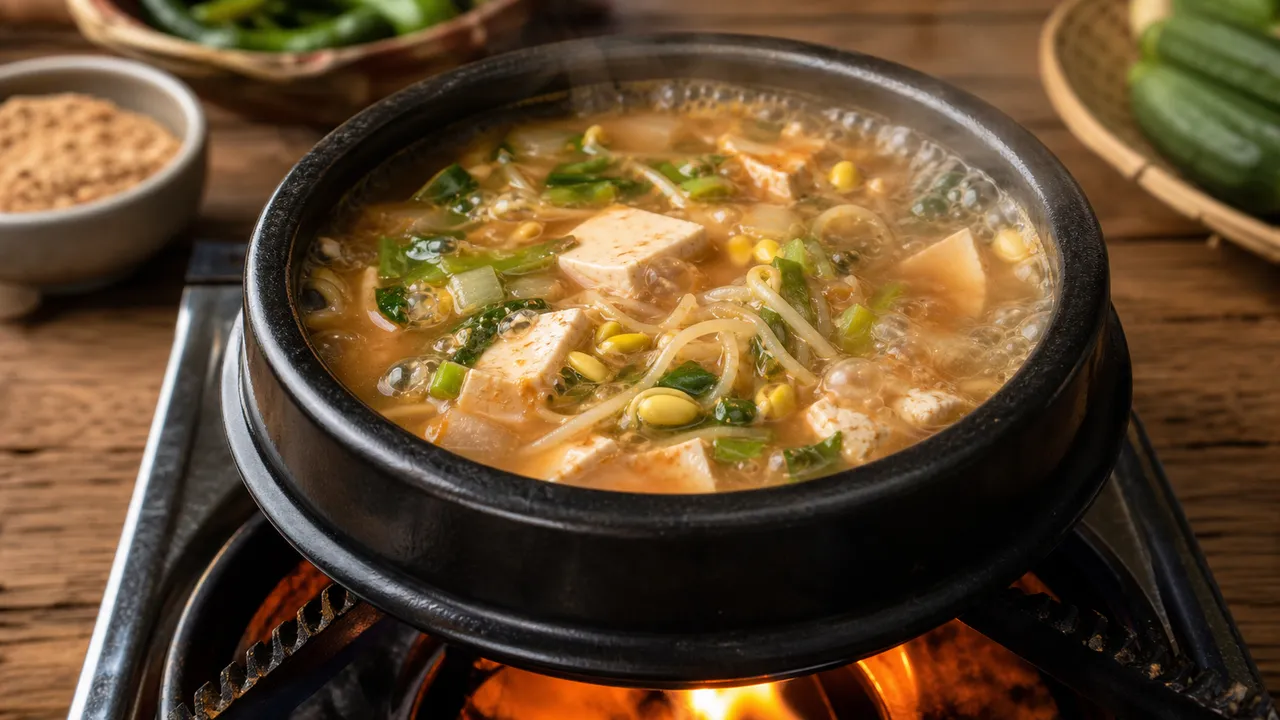
Easy Classic Korean Soybean Paste Stew Recipe
* 이미지는 AI가 생성한 참고 이미지로, 실제 조리 결과물과 다를 수 있습니다.
Korean soybean paste stew is a simple everyday Korean dish made with savory Korean soybean paste (doenjang/된장), dried anchovies for broth, and Korean zucchini. For the deepest, richest flavor, let the water come to a full boil and the broth develop before stirring in the soybean paste. This is an easy, reliable recipe you can make at home.
📝 Editor's Notes
With tofu, Korean zucchini, and anchovy broth, this deeply savory Korean soybean paste stew comes together in under 30 minutes.
It requires less prep than kimchi stew and is hard to mess up, making it perfect for anyone new to Korean cooking.
The earthy depth of Korean soybean paste (doenjang/된장) and the spicy kick of Cheongyang chili peppers (cheongyang-gochu/청양고추) make it the kind of stew that disappears quickly with a bowl of rice.
It is a dependable everyday Korean dish for chilly days, empty-stomach days, or whenever you want to cook with simple vegetables from the fridge.
🛒 Ingredient Tips
For the best broth, use traditional Korean soybean paste (doenjang/된장) or homemade-style paste that is not overly salty and still has visible soybean pieces.
Choose Korean zucchini with smooth, firm skin and a fresh-looking stem; it is sweetest and most tender in summer.
For tofu, look for a package with a generous expiration date and clear soaking water.
For broth anchovies, large silvery dried anchovies with intact bellies will taste less fishy and give a deeper savory flavor.
🔄 Substitution Guide
If you do not have dried anchovies for broth or find the flavor too fishy, you can use beef broth, pork broth, or anchovy bouillon instead.
The savory flavor will be similar, though the broth may taste richer and slightly oilier.
If you avoid tofu or prefer not to use it, add more potato or Korean zucchini; the stew will be less delicate but more filling.
Oyster mushrooms can be swapped with shiitake or enoki mushrooms.
Shiitake gives the broth a stronger aroma and deeper flavor, while enoki adds a crisp texture.
For a milder stew, use regular green chilies instead of Cheongyang chili peppers (cheongyang-gochu/청양고추).
🥘 Ingredients
👨🍳 Cooking Points
The most important point is when to add the soybean paste.
Wait until the water is fully boiling and the broth has developed before dissolving it in; this brings out the nutty, savory flavor.
If you add the paste from the beginning and boil it too long, the broth can taste muddy.
Be sure to remove the heads and guts from the anchovies to prevent bitterness and fishiness.
Adding onion early releases sweetness and helps balance the anchovy flavor.
Add the tofu at the very end and simmer for only about 1 minute so it stays soft instead of firming up.
Keep the heat around medium-high.
👨🍳 Directions
Cut the Korean zucchini, onion, and tofu into bite-size cubes.
Tear the oyster mushrooms into bite-size strips.
Slice the Cheongyang chili peppers, red chili pepper, and green onion into pieces about 1/2 inch thick.
Remove the heads and guts from the dried anchovies, then tear each anchovy into about 3 small pieces.
Put the prepared anchovies, water, and diced onion in a pot and bring to a boil.
Once the broth is boiling, add the torn oyster mushrooms, diced Korean zucchini, minced garlic, and Korean soybean paste (doenjang/된장). Stir to dissolve the paste.
When the soybean paste broth comes back to a boil, add the sliced green onion, Cheongyang chili peppers, and red chili pepper. Continue boiling.
When the stew boils again, add the cubed tofu and simmer for about 1 more minute to finish.
💡 Tips
You can replace the anchovy broth with beef broth, pork broth, beef bouillon, or anchovy bouillon. Using rice-rinsing water will give the broth even better flavor.
If you dislike anchovy bones, grind the anchovies in a blender and add them as a powder to make the broth faster.
Cutting the Korean zucchini, onion, and tofu into bite-size cubes gives the stew a better texture. Tear the oyster mushrooms by hand instead of cutting them for a more natural texture.
Adding onion and green onion early while making the anchovy broth helps reduce any fishy smell and adds savory depth.
For extra fragrance, add seasonal greens such as shepherd’s purse or Korean wild chives at the end. Add them right before serving and watch carefully so the stew does not boil over.
📦 Storage & Reuse
Let the finished stew cool slightly, then transfer it to an airtight container and refrigerate for 2 to 3 days.
Freezing is not recommended because the tofu can turn crumbly and dry.
To reheat, add a small splash of water and simmer over medium heat to bring the flavor close to freshly made.
Leftover stew can be simmered with rice to make a soybean paste rice soup, or reduced until thick and used like a chunky ssamjang-style sauce for wraps.
🥢 Who This Is For
Serve it with rice for a satisfying family meal.
It is especially good for students, people living alone, or beginner cooks because it is simple and forgiving.
Add a few humble side dishes such as rolled omelet, roasted seaweed, or seasoned vegetables for a balanced Korean table.
It also pairs well with spicy stir-fried pork or grilled fish.
Because it is easy to digest, it is a good choice on days when you want something warm but not heavy.
🔥 Nutrition Info
Based on 3 servings, each serving is estimated at about 130 to 160 calories.
It provides roughly 9 to 11 g of plant-based protein from tofu and Korean soybean paste (doenjang/된장), about 6 g of fat, and around 10 g of carbohydrates from the Korean zucchini and onion.
Fermented soybean paste is rich in beneficial compounds and isoflavones, while the anchovy broth adds calcium and the zucchini and mushrooms contribute fiber and vitamins.
Because soybean paste is naturally high in sodium, season lightly for a healthier bowl.
💬 Frequently Asked Questions
- Q. What ingredients do I need for Easy Classic Korean Soybean Paste Stew?
- Main ingredients include Korean soybean paste (doenjang/된장), water, minced garlic, dried anchovies for broth, Korean zucchini. For the best broth, use traditional Korean soybean paste (doenjang/된장) or homemade-style paste that is not overly salty and still has visible soybean pieces. Choose Korean zucchini with smooth, firm skin and a fresh-looking stem; it is sweetest and most tender in summer. For tofu, look for a package with a generous expiration date and clear soaking water. For broth anchovies, large silvery dried anchovies with intact bellies will taste less fishy and give a deeper savory flavor.
- Q. What are the key tips for making Easy Classic Korean Soybean Paste Stew?
- The most important point is when to add the soybean paste. Wait until the water is fully boiling and the broth has developed before dissolving it in; this brings out the nutty, savory flavor. If you add the paste from the beginning and boil it too long, the broth can taste muddy. Be sure to remove the heads and guts from the anchovies to prevent bitterness and fishiness. Adding onion early releases sweetness and helps balance the anchovy flavor. Add the tofu at the very end and simmer for only about 1 minute so it stays soft instead of firming up. Keep the heat around medium-high.
- Q. How should I store leftover Easy Classic Korean Soybean Paste Stew?
- Let the finished stew cool slightly, then transfer it to an airtight container and refrigerate for 2 to 3 days. Freezing is not recommended because the tofu can turn crumbly and dry. To reheat, add a small splash of water and simmer over medium heat to bring the flavor close to freshly made. Leftover stew can be simmered with rice to make a soybean paste rice soup, or reduced until thick and used like a chunky ssamjang-style sauce for wraps.
- Q. How many calories are in Easy Classic Korean Soybean Paste Stew?
- Based on 3 servings, each serving is estimated at about 130 to 160 calories. It provides roughly 9 to 11 g of plant-based protein from tofu and Korean soybean paste (doenjang/된장), about 6 g of fat, and around 10 g of carbohydrates from the Korean zucchini and onion. Fermented soybean paste is rich in beneficial compounds and isoflavones, while the anchovy broth adds calcium and the zucchini and mushrooms contribute fiber and vitamins. Because soybean paste is naturally high in sodium, season lightly for a healthier bowl.
- Q. Can I substitute ingredients in Easy Classic Korean Soybean Paste Stew?
- If you do not have dried anchovies for broth or find the flavor too fishy, you can use beef broth, pork broth, or anchovy bouillon instead. The savory flavor will be similar, though the broth may taste richer and slightly oilier. If you avoid tofu or prefer not to use it, add more potato or Korean zucchini; the stew will be less delicate but more filling. Oyster mushrooms can be swapped with shiitake or enoki mushrooms. Shiitake gives the broth a stronger aroma and deeper flavor, while enoki adds a crisp texture. For a milder stew, use regular green chilies instead of Cheongyang chili peppers (cheongyang-gochu/청양고추).
💬 Comments
No comments yet. Be the first to comment!