
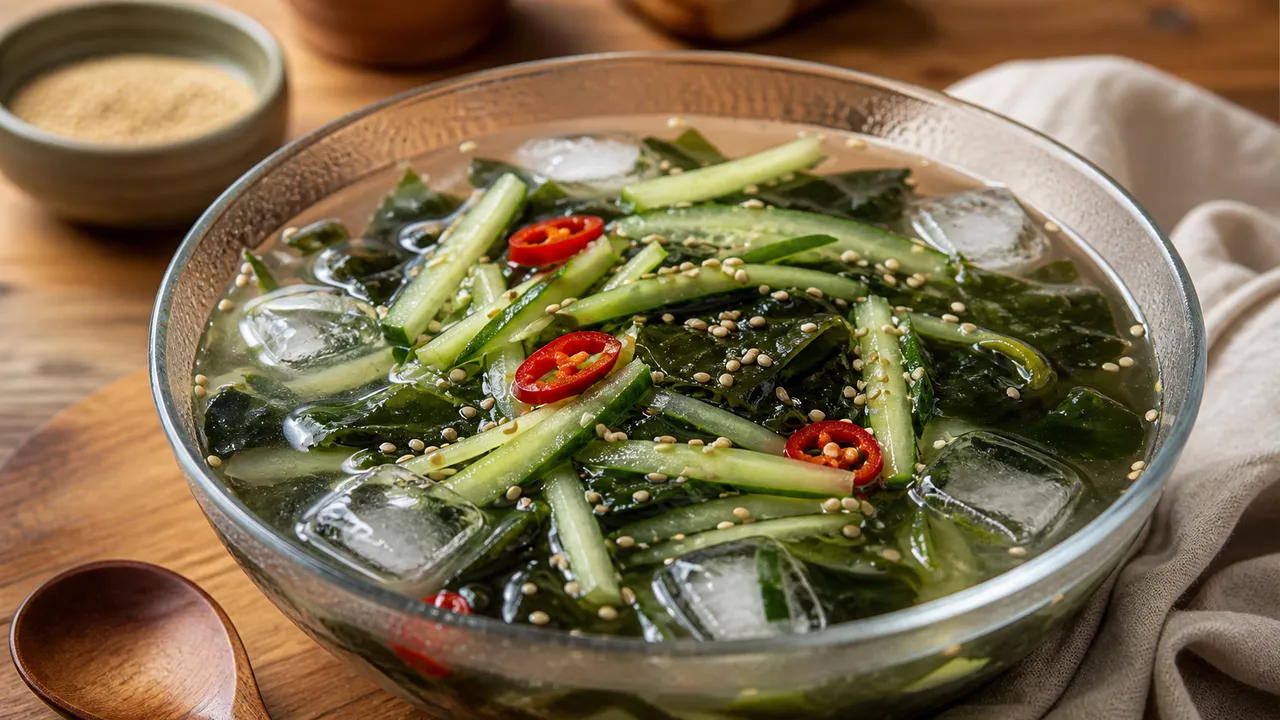
Chilled Cucumber and Seaweed Soup for Summer Recipe
* 이미지는 AI가 생성한 참고 이미지로, 실제 조리 결과물과 다를 수 있습니다.
This chilled cucumber and seaweed soup is a refreshing summer dish made with crisp cucumber, tender dried miyeok seaweed (미역), and sweet Korean pear, served ice-cold with water and ice. The key is to fully dissolve the seasonings in the water before adding the vegetables, which keeps the broth clear, clean, and well balanced.
📝 Editor's Notes
This refreshing summer cold soup comes together in about 20 minutes if you have cucumber and seaweed on hand.
There is barely any cooking involved: just dissolve the seasonings in cold water and add the vegetables.
The tang of vinegar, sweetness of sugar, and savory depth from Korean tuna sauce and Korean soup soy sauce, guk-ganjang (국간장), are nicely balanced, while the pear adds a subtle sweetness and fruity finish.
It is especially good in the heat of summer, served with hot rice or noodles.
🛒 Ingredient Tips
Choose firm, straight cucumbers with prickly bumps and no wrinkling; they will be the crispest.
For dried miyeok seaweed (미역), 0.6 oz expands generously after soaking, so look for dark brown pieces without debris.
A good Korean pear should feel heavy for its size and have smooth skin, which usually means it is juicy.
Cucumbers are at their best and most affordable from June through August.
🔄 Substitution Guide
If you do not have Korean tuna sauce, use 2 tsp anchovy fish sauce or sand lance fish sauce instead.
The savory depth will be similar, but the aroma may be stronger, so start with less.
Korean pear can be replaced with apple; it adds sweetness and tartness, but it browns quickly, so add it right before serving.
If using fresh soaked miyeok seaweed (미역) instead of dried, about 3.5 oz is appropriate, with a softer texture and milder aroma.
Fine sea salt can be replaced with sea salt, but saltiness varies, so adjust to taste.
🥘 Ingredients
👨🍳 Cooking Points
The most important step is dissolving the seasonings completely in the water before adding the vegetables.
If the salt and sugar are not fully dissolved, the seasoning will be uneven and the broth can turn cloudy.
Soak the miyeok seaweed (미역) for only about 10 minutes; soaking too long can make it mushy and intensify its ocean flavor.
When seasoning, remember that the ice will melt and dilute the broth, so it should taste slightly strong at first.
Adjust the amount of Cheongyang chili (청양고추) according to its heat level.
👨🍳 Directions
Soak the dried miyeok seaweed (미역) in cold water for about 10 minutes. Gently rub it with your hands to clean it, then rinse twice in fresh water. Squeeze out the excess water and cut into bite-size pieces.
Chill the 12 3/4 cups of drinking water in the refrigerator ahead of time until very cold, and prepare ice. Thinly julienne the cucumbers. Julienne the Korean pear, onion, and carrot. Thinly slice the red chili. Finely mince 1 Cheongyang chili (청양고추), and thinly slice the other. Finely mince the garlic.
In a large container of about 5 quarts or larger, add the cold water first. Add the fine sea salt, sugar, vinegar, Korean tuna sauce, Korean soup soy sauce, guk-ganjang (국간장), and a pinch of black pepper, then stir until the seasonings are fully dissolved. Add the prepared cucumber, miyeok seaweed (미역), pear, onion, carrot, red chili, Cheongyang chilies (청양고추), and minced garlic. Finally, add half of the sesame seeds whole and lightly crush the remaining half before adding. Mix everything well.
Just before serving, add plenty of ice and enjoy well chilled.
💡 Tips
Chill the drinking water in advance for the most refreshing flavor.
Dissolve the seasonings completely in the water before adding the vegetables and seaweed so the flavor distributes evenly and the broth stays clean.
Adding half the sesame seeds whole and lightly crushing the other half brings out a deeper nutty aroma.
Korean pear adds gentle natural sweetness and a cool fruity aroma for a cleaner finish.
For a brighter, fresher flavor, add the juice of 1/2 lemon to taste.
📦 Storage & Reuse
Store in an airtight container in the refrigerator and eat within 2 to 3 days.
The cucumber softens and the broth becomes cloudy over time, so it is best not kept too long.
Freezing is not recommended because the vegetables will lose their texture completely.
When serving leftovers, do not heat them; simply add fresh ice to make the soup cold again.
Leftover broth can also be used with somyeon (소면) noodles or as a seasoning base for a cucumber salad.
🥢 Who This Is For
This is ideal for anyone who loses their appetite in hot weather or wants something cooling after sweating.
It makes a generous 8 to 10 servings, so it is great for summer family meals or entertaining.
You can also add somyeon (소면), thin Korean wheat noodles, or serve it alongside rich foods like grilled pork belly or Korean pancakes to cut through the greasiness.
🔥 Nutrition Info
Each serving is roughly 40 to 50 calories, making it very light.
Since it is mostly vegetables and water, it has less than 1 g of fat and about 1 to 2 g of protein.
Carbohydrates, mainly from the sugar and pear, are about 8 to 10 g per serving.
Miyeok seaweed (미역) provides calcium, iodine, and fiber, while cucumber is high in water and potassium.
Because this recipe contains salt, Korean tuna sauce, and Korean soup soy sauce, guk-ganjang (국간장), it is relatively high in sodium, so it is best to enjoy more of the solids rather than drinking all the broth.
💬 Frequently Asked Questions
- Q. What ingredients do I need for Chilled Cucumber and Seaweed Soup for Summer?
- Main ingredients include cold drinking water, ice, cucumbers, dried miyeok seaweed (미역), Korean pear. Choose firm, straight cucumbers with prickly bumps and no wrinkling; they will be the crispest. For dried miyeok seaweed (미역), 0.6 oz expands generously after soaking, so look for dark brown pieces without debris. A good Korean pear should feel heavy for its size and have smooth skin, which usually means it is juicy. Cucumbers are at their best and most affordable from June through August.
- Q. What are the key tips for making Chilled Cucumber and Seaweed Soup for Summer?
- The most important step is dissolving the seasonings completely in the water before adding the vegetables. If the salt and sugar are not fully dissolved, the seasoning will be uneven and the broth can turn cloudy. Soak the miyeok seaweed (미역) for only about 10 minutes; soaking too long can make it mushy and intensify its ocean flavor. When seasoning, remember that the ice will melt and dilute the broth, so it should taste slightly strong at first. Adjust the amount of Cheongyang chili (청양고추) according to its heat level.
- Q. How should I store leftover Chilled Cucumber and Seaweed Soup for Summer?
- Store in an airtight container in the refrigerator and eat within 2 to 3 days. The cucumber softens and the broth becomes cloudy over time, so it is best not kept too long. Freezing is not recommended because the vegetables will lose their texture completely. When serving leftovers, do not heat them; simply add fresh ice to make the soup cold again. Leftover broth can also be used with somyeon (소면) noodles or as a seasoning base for a cucumber salad.
- Q. How many calories are in Chilled Cucumber and Seaweed Soup for Summer?
- Each serving is roughly 40 to 50 calories, making it very light. Since it is mostly vegetables and water, it has less than 1 g of fat and about 1 to 2 g of protein. Carbohydrates, mainly from the sugar and pear, are about 8 to 10 g per serving. Miyeok seaweed (미역) provides calcium, iodine, and fiber, while cucumber is high in water and potassium. Because this recipe contains salt, Korean tuna sauce, and Korean soup soy sauce, guk-ganjang (국간장), it is relatively high in sodium, so it is best to enjoy more of the solids rather than drinking all the broth.
- Q. Can I substitute ingredients in Chilled Cucumber and Seaweed Soup for Summer?
- If you do not have Korean tuna sauce, use 2 tsp anchovy fish sauce or sand lance fish sauce instead. The savory depth will be similar, but the aroma may be stronger, so start with less. Korean pear can be replaced with apple; it adds sweetness and tartness, but it browns quickly, so add it right before serving. If using fresh soaked miyeok seaweed (미역) instead of dried, about 3.5 oz is appropriate, with a softer texture and milder aroma. Fine sea salt can be replaced with sea salt, but saltiness varies, so adjust to taste.

💬 Comments
No comments yet. Be the first to comment!