
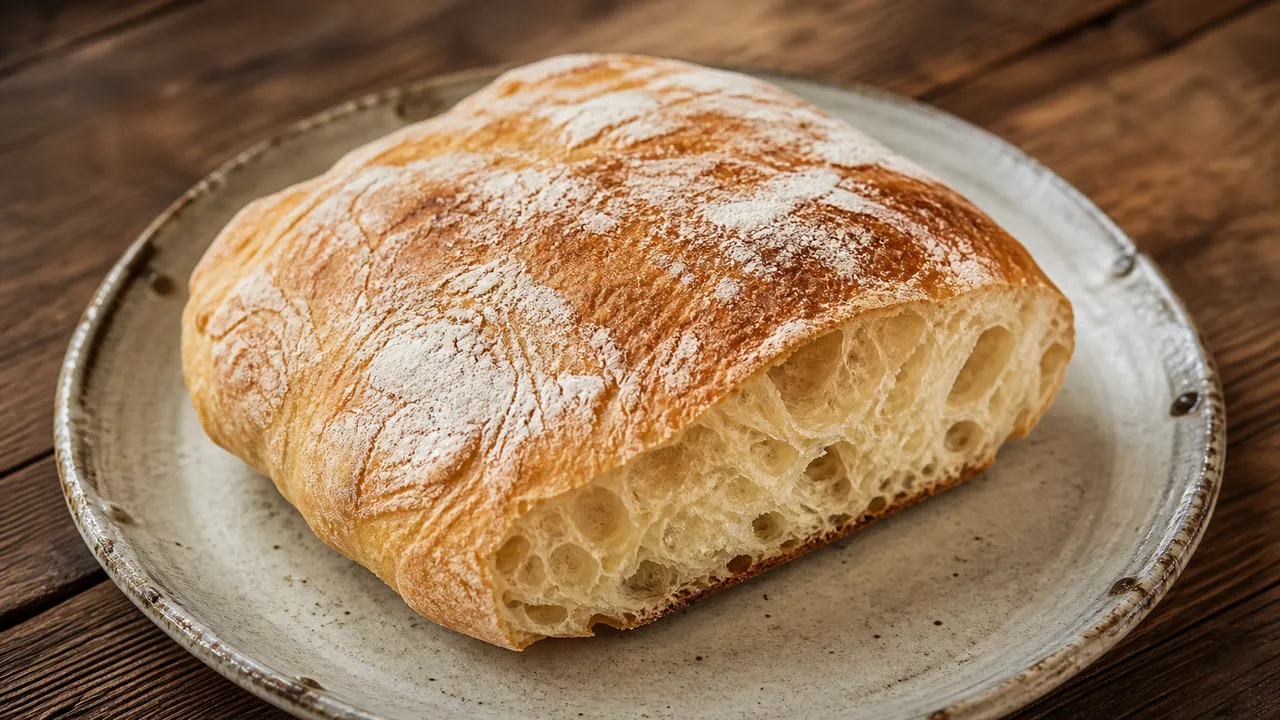
How to Make Chewy and Light Ciabatta at Home Recipe
* 이미지는 AI가 생성한 참고 이미지로, 실제 조리 결과물과 다를 수 있습니다.
A recipe to make chewy and light ciabatta without a poolish starter. Although the fermentation time is long, the method is simple, and it's perfect for making ang-butter (앙버터) or other sandwiches. This recipe yields 4 ciabatta loaves and requires about 15 minutes of baking time in an oven or air fryer.
📋 4 recipes — Select to view
A recipe for making ciabatta with a chewy and light texture, even without a poolish starter. Although the fermentation time is long, the method is simple, and it's great for 'Ang-butter' (red bean paste and butter) sandwiches or regular sandwiches. This recipe yields 4 ciabattas and requires about 15 minutes of baking time in an oven or air fryer.
📝 Editor's Notes
This recipe makes a ciabatta that's crispy on the outside and chewy on the inside, using just 350g of bread flour and 280g of water.
While mixing the dough takes only about 5 minutes, the multiple fermentation and folding steps require approximately 4 hours, placing the difficulty at an intermediate level.
It employs a low-knead, high-hydration method where you only fold the dough, making it less prone to failure.
Characterized by a subtle wheat aroma and plain taste, it pairs wonderfully with Ang-butter (red bean paste and butter), sandwiches, or simply dipped in olive oil.
It's great to bake any time of year, but particularly easy to handle during the cooler spring and autumn months when fermentation is slower.
🛒 Ingredient Tips
Since ciabatta uses simple ingredients, the strength of the bread flour dictates its texture.
Choose bread flour with a protein content of 12% or higher to achieve large air pockets and chewiness.
After opening, seal and refrigerate yeast, and ensure its vitality by dissolving it well in lukewarm water when mixing the dough; it's active if foam appears.
Even a small amount of mild-flavored extra virgin olive oil significantly enhances the taste, and sea salt, which retains minerals, pairs better with the wheat aroma than refined salt.
🔄 Substitution Guide
If bread flour is difficult to find, all-purpose flour can be substituted, but the gluten will be weaker, resulting in smaller air pockets and less chewiness.
For added nutty flavor, you can mix 10-20% whole wheat flour with bread flour.
If you don't have instant dry yeast, use the same amount of active dry yeast, but dissolve it in lukewarm water for about 5 minutes beforehand to activate it.
Olive oil can be replaced with grapeseed oil or canola oil, but the distinct aroma will be milder.
Salt is not related to allergies, so use as is; however, for a low-sodium diet, reducing it to 5g will not significantly affect fermentation.
🥘 Ingredients
👨🍳 Cooking Points
The most crucial point is to absolutely avoid kneading vigorously.
Hard kneading will deflate the air bubbles, making the inside dense and heavy.
Instead, repeatedly fold the edges towards the center with wet hands.
It's essential to visually confirm the dough has risen as instructed—1.5 times after the 40-minute rest, and doubled after the first proof—to minimize failure.
Perform coil folding in all four directions (right, left, front, back) twice.
When shaping, do it minimally, gently stretching the dough in all directions to an appropriate thickness for baking.
The key to fermentation is patience; if the room temperature is high, use cold water to slow down the process.
👨🍳 Directions
In a large square airtight container, combine lukewarm water, olive oil, salt, and instant dry yeast, and mix well.
Add the bread flour and mix with a spatula or dough scraper until no dry flour remains. Scrape down all corners of the container to ensure everything is well combined. Ciabatta dough should be quite wet and sticky, clinging to your hands. Once it's somewhat cohesive, continue to 'knead' it by repeatedly folding and pressing until it's very sticky and shaggy.
Let the dough rest at room temperature for 40 minutes (first rest). Check if it has expanded to about 1.5 times its original size.
Wet your hands to prevent the dough from sticking, then gently pull the edges of the dough towards the center. Flip the dough over, lift it, and roll it outwards to create a smooth surface. This smoothing helps organize the dough's texture during fermentation. Cover to prevent drying.
Let it ferment at room temperature for another 40 minutes (first proof). Check if the dough has doubled in size.
Wet your hands again to prevent sticking. Perform 'coil folding' by gently lifting one end of the dough and folding it halfway over itself. Repeat this 4 times: right, left, front, and back.
Let it ferment at room temperature for 40 minutes (second proof). Check if the dough has expanded to about 1.5 times its original size.
Again, wet your hands and perform 'coil folding' 4 times: right, left, front, and back. Check if the dough has become more elastic and taut compared to before.
Let it undergo final fermentation at room temperature for 60 minutes. (Alternatively, you can cold ferment in the refrigerator for 12 hours.) Check if the dough has doubled in size.
The dough will be very sticky, so generously dust your work surface with flour. Use a dough scraper to carefully loosen only the edges of the dough to help it release. Then, invert the container onto the generously floured work surface. Wait briefly, and the dough will naturally detach.
Dust the dough with flour again. Flip the dough over once and gently stretch it to an even thickness, ensuring it's not too thick.
Divide the dough into 4 equal pieces. Carefully lift each piece with a dough scraper and transfer them to a baking sheet. Handle the dough gently to avoid deflating the air bubbles. You can use the scraper to gently shape them into neat rectangles if desired. It's okay if the pieces are close together, as they will primarily rise upwards.
For an oven: Preheat to 220°C (425°F) for 15 minutes, then bake at 220°C (425°F) for 15 minutes. For an air fryer: Preheat to 200°C (390°F) for 5 minutes, then bake at 200°C (390°F) for 10 minutes, flip, and bake for an additional 3 minutes. Bake until appropriately crispy with a nice golden-brown crust that isn't too hard.
Immediately transfer from the oven to a wire rack to cool completely.
💡 Tips
If you knead the dough vigorously, the air bubbles inside will collapse, resulting in a dense and heavy texture. Instead, only fold the dough without exerting much force to create large air pockets, which will yield a light, crispy, and chewy texture.
Minimize shaping to preserve the air pockets. If the dough is panned too thickly, its weight will prevent it from rising vigorously upwards, leading to a dense interior. Gently stretch the dough in all directions to an appropriate thickness for good expansion, being careful not to pop the air bubbles.
It's best to allow for slow fermentation. Maintain a moderate room temperature or use cold water when mixing the dough. (Cold proofing in the refrigerator for 12 hours during the second fermentation is also an excellent method.)
If you won't consume all the ciabatta on the same day, cool it completely, then seal and freeze to maintain its texture. When ready to eat, reheat directly from frozen at 180°C (350°F) for 7 minutes, or lightly moisten it with water and grill briefly in a pan over low heat until warmed through.
📦 Storage & Reuse
Freshly baked ciabatta is best enjoyed within one or two days at room temperature, wrapped in a paper bag or cloth, after cooling completely.
If storing longer, it will harden, so wrap individual pieces in plastic wrap and freeze for up to one month.
To reheat, lightly spray the surface with water and warm in a 180°C (350°F) oven or air fryer for 3 to 5 minutes to restore its crispy crust and moist interior.
Stale bread can also be diced and used for croutons or bread puddings.
🥢 Who This Is For
This recipe is well-suited for first-time bread bakers and those who prefer to make bread slowly by hand without a stand mixer.
It's perfect for a relaxed weekend baking project, watching the fermentation.
Freshly baked ciabatta is excellent for Ang-butter (butter and red bean paste), sandwiches with prosciutto and arugula, or bruschetta with tomatoes and balsamic.
It also pairs wonderfully with soups and pasta.
🔥 Nutrition Info
One ciabatta (based on a recipe yielding 4 pieces) is estimated to be approximately 350-380 kcal.
Carbohydrates are the most abundant at about 65-70g, protein is around 10-12g thanks to the bread flour's gluten, and fat from olive oil is about 3-5g, making it a relatively lean bread.
A key advantage is its lower calorie and fat content compared to typical pastries, as it contains no butter, sugar, or eggs.
Bread flour provides selenium, small amounts of iron, and B vitamins, while olive oil adds unsaturated fatty acids.
However, since sodium comes from 6g of salt, it's recommended to reduce other salty accompanying ingredients.
💬 Frequently Asked Questions
- Q. What ingredients do I need for How to Make Chewy and Light Ciabatta at Home?
- Main ingredients include Strong Bread Flour (350g), Lukewarm Water (280g), Olive Oil (15g), Salt (6g), Instant Dry Yeast (3g). Since ciabatta uses simple ingredients, the quality of strong bread flour significantly impacts its texture. Choose bread flour with a high protein content, as this creates strong gluten development, leading to large air pockets and chewiness. For yeast, fresh instant dry yeast, stored in the refrigerator after opening, is best; checking if it dissolves well in water can help prevent failures. Using extra virgin olive oil with a subtle aroma will deepen the overall flavor.
- Q. What are the key tips for making How to Make Chewy and Light Ciabatta at Home?
- The most crucial point is to avoid forceful kneading. Vigorous kneading will deflate the air bubbles, leading to a dense and heavy interior. After mixing, simply use coil folding to develop the dough's structure. It's important to visually confirm the dough's volume increase (1.5 times, 2 times) at each fermentation stage. If the room temperature is high, fermentation will accelerate and can easily lead to over-proofing, so use cold water or keep the dough in a cooler spot. When shaping, minimize handling and gently stretch the dough to prevent air bubbles from bursting, ensuring it's not too thick so it can rise powerfully upwards.
- Q. How should I store leftover How to Make Chewy and Light Ciabatta at Home?
- Ciabatta is best enjoyed on the day it's baked, but if completely cooled and sealed, it can be kept at room temperature for 1-2 days. For longer storage, wrap individual loaves in plastic wrap and freeze for up to 2-3 weeks. To reheat, lightly spray the surface with water and bake in an oven or air fryer at 180°C (350°F) for 4-5 minutes to restore its crisp crust and moist interior. Stale bread can also be cut into cubes and baked as croutons, or thinly sliced and used for bruschetta.
- Q. How many calories are in How to Make Chewy and Light Ciabatta at Home?
- One ciabatta loaf (from a total dough of about 650g divided into 4 portions) is estimated to be approximately 320-350 kcal. Primarily composed of strong bread flour, carbohydrates are the most abundant, with about 65g per loaf. Protein, thanks to wheat gluten, is roughly 9-10g, and fat from olive oil is around 3-4g. As no additional butter or sugar is added, it has a simple flavor. Given its high refined carbohydrate content, it's well-balanced when paired with protein-rich side dishes or vegetables. Since it contains 6g of salt, those monitoring sodium intake should adjust the seasoning of accompanying ingredients.
- Q. Can I substitute ingredients in How to Make Chewy and Light Ciabatta at Home?
- If strong bread flour is unavailable, you can use all-purpose flour, but be aware that the weaker gluten will result in smaller air pockets and a slightly less chewy texture. If you prefer a whole wheat flavor, you can substitute 10-20% of the strong bread flour with whole wheat flour; however, this will alter water absorption, potentially making the dough thicker, so adjust the water gradually. Instant dry yeast can be replaced with fresh yeast, using about 2-3 times the amount. If the aroma of olive oil is too strong or undesirable, you can substitute it with a neutral-flavored cooking oil like grapeseed oil or canola oil without a significant difference in texture.
💬 Comments
No comments yet. Be the first to comment!