
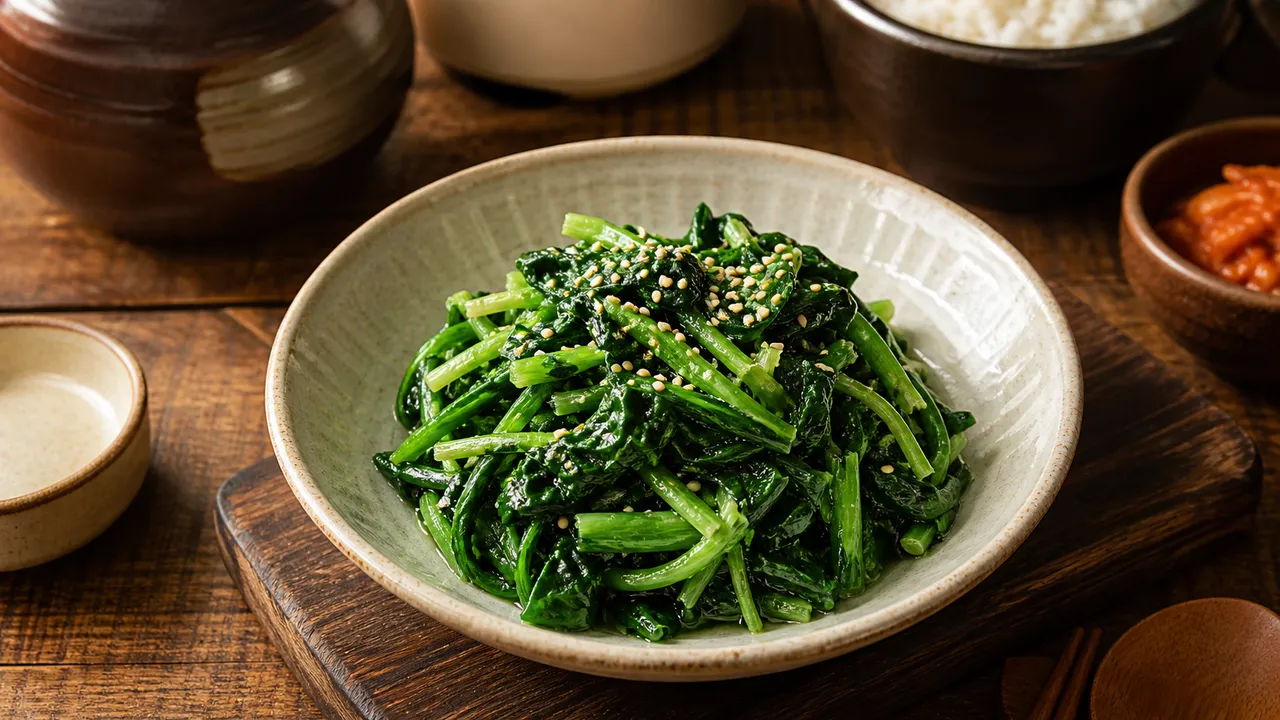
Easy & Savory Spinach Namul (시금치 나물) Recipe
* 이미지는 AI가 생성한 참고 이미지로, 실제 조리 결과물과 다를 수 있습니다.
A savory and healthy spinach namul (시금치 나물) recipe that's easily made with freshly harvested spinach.
📝 Editor's Notes
This is a super simple spinach namul (시금치 나물) recipe that can be made in just 15 minutes if you have fresh spinach.
It's a healthy side dish that brings out the inherent savory and fragrant flavors of spinach with just sesame oil and salt, no other special seasonings.
The taste is doubled when using fresh ingredients, especially spinach freshly harvested from a home garden.
It pairs well with any warm meal, but it's especially perfect for stimulating appetites in spring.
It's easy enough for anyone to make without complicated steps, so it's highly recommended for beginner cooks.
🛒 Ingredient Tips
For this spinach namul, spinach itself is the star.
Choosing good quality spinach is paramount.
Select spinach with vibrant red roots, fresh, dark green, glossy leaves.
Avoid wilted or yellowed leaves.
Seasonal spinach is typically available from winter to spring, and spinach harvested during this period is sweeter and richer in nutrients.
The reddish part of the root is particularly rich in nutrients, so don't discard it; make sure to cook it along with the rest.
As it may have a lot of dirt, remember to wash it thoroughly several times under running water.
🔄 Substitution Guide
If spinach is not available, you can substitute it with other leafy greens like bok choy (청경채) or young napa cabbage (얼갈이배추).
Bok choy has a crispier texture and a slightly bitter taste compared to spinach, but it can be blanched and seasoned in a similar way to enjoy a unique namul.
Young napa cabbage has more fiber than spinach, so it needs to be blanched a little longer to become tender.
Its flavor is milder than spinach, but when seasoned with sesame oil and salt, it offers a savory and clean taste.
If you have a sesame oil allergy, perilla oil (들기름) is a great alternative.
Perilla oil provides a different nutty and aromatic flavor compared to sesame oil and is rich in omega-3 fatty acids, making it a healthy choice.
🥘 Ingredients
👨🍳 Cooking Points
The key to this recipe lies in the blanching process and removing excess water from the spinach.
The first point is to add a pinch of salt to the boiling water when blanching the spinach.
This helps to enhance the vibrant green color of the spinach and adds a subtle seasoning, deepening its flavor.
It's important to blanch the spinach for only about 30 seconds to 1 minute, just until it wilts and turns bright green.
Be careful not to over-blanch, as it can become mushy and lose nutrients.
The second point is to immediately rinse the blanched spinach under cold water to cool it down and then squeeze out as much moisture as possible.
Rinsing in cold water helps preserve a crisp texture and a beautiful color.
Sufficiently removing water prevents the namul from becoming soggy and allows the savory flavors to blend well.
Lastly, when seasoning, don't knead too vigorously; instead, gently mix by hand to avoid damaging the spinach fibers and to maintain its lively texture.
👨🍳 Directions
Trim the root ends of the harvested spinach with a knife, then soak in water and wash thoroughly several times to remove any dirt.
Pour water into a pot, add a pinch of salt, and bring to a boil.
Once the water is boiling vigorously, add the prepared spinach and blanch until it wilts and turns bright green.
Remove the blanched spinach and immediately rinse under cold running water in the sink to cool it down.
Shake off excess water from the spinach, then squeeze firmly to remove as much moisture as possible.
To the squeezed spinach, add salt to your personal preference, and drizzle with sesame oil.
Finally, sprinkle with toasted sesame seeds and gently mix by hand until the seasoning is well combined. Serve immediately.
💡 Tips
It's best to prepare only enough spinach namul for one serving to avoid waste.
Washing and trimming the spinach can be the most time-consuming part.
Rinsing blanched spinach in cold water helps retain its vibrant green color and crisp texture.
📦 Storage & Reuse
It's best to store finished spinach namul in an airtight container in the refrigerator.
While it tastes best when consumed on the day it's made, it can be refrigerated for up to 2-3 days.
Since spinach is a vegetable with high moisture content, it can become watery or mushy over time, so it's recommended to make small portions, just enough for one meal.
Freezing is not recommended as it can alter the texture of the namul.
If you have leftover spinach namul, it's excellent added to rolled omelets (gyeran-mari) or used as an ingredient for gimbap (김밥).
You can also enjoy a different delightful flavor by adding it to bibimbap (비빔밥).
🥢 Who This Is For
This spinach namul is recommended for anyone looking for a healthy meal.
It's particularly excellent as a nutritious side dish for growing children and perfect for those who prefer a light diet.
It's hearty when eaten with warm rice, and absolutely delicious when added to bibimbap (비빔밥).
Serving it alongside other namul side dishes can create a richer Korean set meal (hanjeongsik) experience.
It also effectively cuts through the richness when paired with meat dishes.
🔥 Nutrition Info
A single serving (approx.
80g) of this super simple spinach namul boasts a very low calorie count, roughly 30-50 kcal.
It typically contains about 2-3g of protein, 2-4g of fat (including sesame oil), and 3-5g of carbohydrates.
Spinach is rich in vitamins K, A, and C, and also contains high amounts of calcium and iron, which are beneficial for bone health.
Furthermore, it's abundant in antioxidants like lutein and zeaxanthin, making it excellent for eye health.
Its high fiber content can also aid in gut health.
Sesame oil provides essential fatty acids and vitamin E, not only enhancing the savory flavor but also boosting its nutritional value.
💬 Frequently Asked Questions
- Q. What ingredients do I need for Easy & Savory Spinach Namul (시금치 나물)?
- Main ingredients include Spinach, Water, Fine sea salt, Sesame oil, Toasted sesame seeds. For this spinach namul, spinach itself is the star. Choosing good quality spinach is paramount. Select spinach with vibrant red roots, fresh, dark green, glossy leaves. Avoid wilted or yellowed leaves. Seasonal spinach is typically available from winter to spring, and spinach harvested during this period is sweeter and richer in nutrients. The reddish part of the root is particularly rich in nutrients, so don't discard it; make sure to cook it along with the rest. As it may have a lot of dirt, remember to wash it thoroughly several times under running water.
- Q. What are the key tips for making Easy & Savory Spinach Namul (시금치 나물)?
- The key to this recipe lies in the blanching process and removing excess water from the spinach. The first point is to add a pinch of salt to the boiling water when blanching the spinach. This helps to enhance the vibrant green color of the spinach and adds a subtle seasoning, deepening its flavor. It's important to blanch the spinach for only about 30 seconds to 1 minute, just until it wilts and turns bright green. Be careful not to over-blanch, as it can become mushy and lose nutrients. The second point is to immediately rinse the blanched spinach under cold water to cool it down and then squeeze out as much moisture as possible. Rinsing in cold water helps preserve a crisp texture and a beautiful color. Sufficiently removing water prevents the namul from becoming soggy and allows the savory flavors to blend well. Lastly, when seasoning, don't knead too vigorously; instead, gently mix by hand to avoid damaging the spinach fibers and to maintain its lively texture.
- Q. How should I store leftover Easy & Savory Spinach Namul (시금치 나물)?
- It's best to store finished spinach namul in an airtight container in the refrigerator. While it tastes best when consumed on the day it's made, it can be refrigerated for up to 2-3 days. Since spinach is a vegetable with high moisture content, it can become watery or mushy over time, so it's recommended to make small portions, just enough for one meal. Freezing is not recommended as it can alter the texture of the namul. If you have leftover spinach namul, it's excellent added to rolled omelets (gyeran-mari) or used as an ingredient for gimbap (김밥). You can also enjoy a different delightful flavor by adding it to bibimbap (비빔밥).
- Q. How many calories are in Easy & Savory Spinach Namul (시금치 나물)?
- A single serving (approx. 80g) of this super simple spinach namul boasts a very low calorie count, roughly 30-50 kcal. It typically contains about 2-3g of protein, 2-4g of fat (including sesame oil), and 3-5g of carbohydrates. Spinach is rich in vitamins K, A, and C, and also contains high amounts of calcium and iron, which are beneficial for bone health. Furthermore, it's abundant in antioxidants like lutein and zeaxanthin, making it excellent for eye health. Its high fiber content can also aid in gut health. Sesame oil provides essential fatty acids and vitamin E, not only enhancing the savory flavor but also boosting its nutritional value.
- Q. Can I substitute ingredients in Easy & Savory Spinach Namul (시금치 나물)?
- If spinach is not available, you can substitute it with other leafy greens like bok choy (청경채) or young napa cabbage (얼갈이배추). Bok choy has a crispier texture and a slightly bitter taste compared to spinach, but it can be blanched and seasoned in a similar way to enjoy a unique namul. Young napa cabbage has more fiber than spinach, so it needs to be blanched a little longer to become tender. Its flavor is milder than spinach, but when seasoned with sesame oil and salt, it offers a savory and clean taste. If you have a sesame oil allergy, perilla oil (들기름) is a great alternative. Perilla oil provides a different nutty and aromatic flavor compared to sesame oil and is rich in omega-3 fatty acids, making it a healthy choice.



💬 Comments
No comments yet. Be the first to comment!