
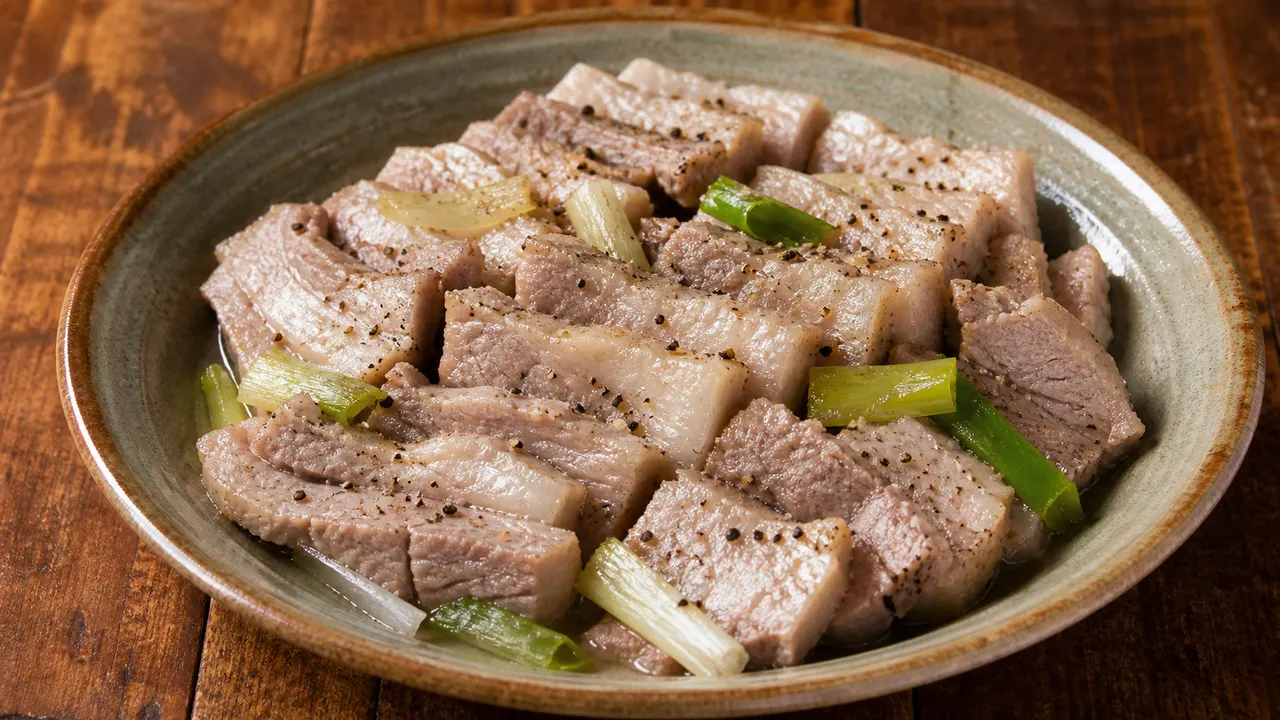
Tender Microwave Samgyeopsal (삼겹살) Suyuk and Buchu-geotjeori
This recipe utilizes a microwave to create tender and moist Samgyeopsal (삼겹살) Suyuk (boiled pork belly) in just 15 minutes. It also introduces a crispy Buchu-geotjeori (부추겉절이) (Korean chive salad) recipe, perfect to serve alongside, along with storage tips.
📋 2 recipes — Select to view
This recipe allows you to make tender and moist pork belly suyuk (수육) in just 15 minutes using only a microwave, without the need for a large pot.
📝 Editor's Notes
Microwave Pork Belly Suyuk is a special recipe that allows you to easily enjoy suyuk at home without the hassle of a large pot or pressure cooker.
You can complete tender and moist suyuk in just 15 minutes, making it an easy challenge for even beginner cooks.
With the excess fat removed, it's light yet retains the unique savory flavor of pork belly, making it a dish loved by all ages.
It's a versatile recipe, especially useful when unexpected guests arrive or when you're craving a satisfying meat dish for a late-night snack.
🛒 Ingredient Tips
The key to this recipe is choosing good pork belly.
You should select thick pork belly, at least 0.8 inches (2 cm) in thickness, to prevent it from shrinking and to maintain a bouncy texture when cooked.
When choosing meat at the supermarket, it's important to select fresh pork belly with a good balance of lean meat and fat, exhibiting a vibrant reddish-pink color.
For green onions (scallions), choose those with firm root ends and fresh leaves.
While cheongju (청주, Korean rice wine) or soju (소주, Korean distilled spirit) can be used instead of mirin (맛술), mirin is most effective at removing gamey odors and enhancing the flavor of the meat.
🔄 Substitution Guide
You can use pork neck (moksal, 목살) instead of pork belly.
Pork neck has less fat than pork belly, resulting in a lighter flavor.
However, since pork neck has a higher lean meat ratio, it might become tough if overcooked.
To prevent this, reduce the cooking time slightly or ensure the plastic wrap is extra tightly sealed to prevent moisture loss.
If mirin (맛술) is unavailable, use cheongju (청주, Korean rice wine) or soju (소주, Korean distilled spirit).
The alcohol will similarly help to remove any gamey smell from the meat, but it may lack the characteristic sweetness and aroma of mirin.
Instead of green onions, you can add sliced onions or garlic to help eliminate gamey odors and enhance the flavor of the meat.
🥘 Ingredients
👨🍳 Cooking Points
There are two most important cooking points.
First, make incisions in the pork belly and season it thoroughly with salt, pepper, and mirin (맛술).
The incisions help the meat cook evenly and absorb the seasoning well, while mirin removes gamey odors and tenderizes the meat.
Second, pay attention to the microwave cooking time and resting time.
After microwaving for 10 minutes, it's crucial not to open the door and let it rest for 5 minutes.
This resting period allows the residual heat to cook the meat perfectly through to the center while retaining its juices, resulting in moist and tender suyuk.
Be careful not to overcook, as it can make the meat tough; never exceed 12 minutes of active microwaving.
👨🍳 Directions
Prepare 10.6 oz (300g) of thick pork belly. Make incisions about 0.4 inches (1 cm) apart, cutting about one-third of the way through the meat's thickness.
Lightly sprinkle salt on both sides of the meat until a fine white powder is visible, then sprinkle black pepper on both sides as well.
Drizzle mirin (맛술) evenly over both sides of the meat. (If mirin is unavailable, you can substitute with cheongju (청주, Korean rice wine) or soju (소주, Korean distilled spirit)).
Slice 1 stalk of green onion (or scallion) diagonally and place generously on top of the meat.
Place the meat in a heat-resistant glass or ceramic dish and cover tightly with two layers of plastic wrap.
Pierce 4-5 holes in the plastic wrap using a chopstick or the tip of a knife.
Microwave for 10 minutes. (If your microwave has lower wattage, you can cook for up to 12 minutes, but never exceed 15 minutes).
Once cooking is complete, do not open the microwave door. Let it rest for 5 minutes.
Remove the dish and carefully wipe away any accumulated oil and broth at the bottom with a paper towel.
Place the suyuk (수육) on a cutting board and slice it into thick 0.4-inch (1 cm) pieces to achieve its characteristic bouncy texture.
💡 Tips
Very thin pork belly tends to shrink when cooked, so it's best to choose pork belly that is at least 0.8 inches (2 cm) thick.
When microwaving, you must use a heat-resistant glass or ceramic dish instead of a plastic container.
Covering with two layers of plastic wrap and piercing holes helps the steam cook the meat evenly and retain its juices.
Leftover suyuk can be stored in an airtight container in the refrigerator for up to 3 days. Before eating, microwave for just 30 seconds to restore its tenderness. For longer storage, wrap individual slices in parchment paper (or foil), place them in a sealed plastic bag, and freeze for up to one month.
📦 Storage & Reuse
Leftover suyuk can be stored in an airtight container in the refrigerator for up to 3 days, keeping it fresh.
Before eating, microwave for about 30 seconds to regain its original tender texture.
If you wish to store it for longer, wrap each slice of suyuk individually in parchment paper (or foil), place them in a sealed plastic bag, and freeze for up to one month.
Frozen suyuk can be reheated in the microwave for about 1 minute after thawing.
Leftover suyuk can also be chopped and used in kimchi fried rice (김치볶음밥) or budae jjigae (부대찌개, Korean sausage stew) for a delicious addition.
🥢 Who This Is For
This Microwave Pork Belly Suyuk is highly recommended for busy modern individuals and beginner cooks.
You can effortlessly create a wonderful meal without complicated steps.
It's also a great, easy-to-enjoy dish for those eating alone or for newlywed couples.
It's delicious served with warm, freshly cooked rice, and you can enjoy an even richer meal by pairing it with sweet and sour bibim guksu (비빔국수, spicy mixed noodles) or refreshing makguksu (막국수, buckwheat noodles).
Wrapping it with spicy seasoned radish salad (무생채, musaengchae) or crisp kimchi (김치) will make it even more delicious without any greasiness.
🔥 Nutrition Info
The estimated nutritional content for one serving of this recipe (based on approximately 3.5-5.3 oz or 100-150g of pork belly) is about 400-600 kcal.
It contains about 20-30g of protein, 30-50g of fat, and a small amount of carbohydrates.
Pork belly is rich in protein and fat, making it good for energy supply, but due to its high fat content, it's important to consume it in moderation.
Green onions (scallions) are rich in vitamin C, calcium, and iron, which can help boost immunity and relieve fatigue.
Mirin (맛술) is used in small quantities, so it does not significantly impact the nutritional content.
Overall, it can be said to be a good dish for supplementing protein and energy.
💬 Comments
No comments yet. Be the first to comment!