
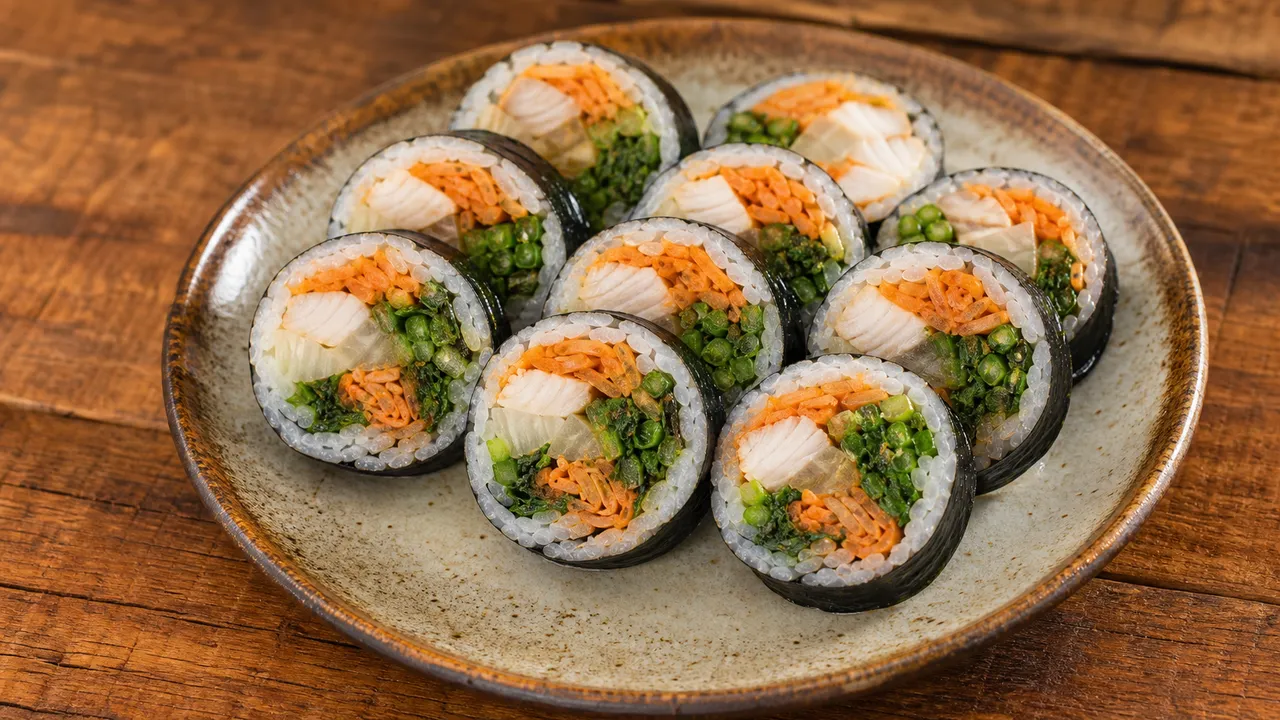
Ryu Soo-young's Doenjang-Grilled Flounder Gimbap and Super S
This recipe features Ryu Soo-young's Doenjang-Grilled Flounder Gimbap and a super simple Jeyuk-bokkeum (spicy stir-fried pork) that can be made in just 15 minutes, prepared for the LA K-Expo.
📋 2 recipes — Select to view
A special gimbap (김밥) featuring flounder grilled with a doenjang (된장) glaze, along with Korean water dropwort (미나리), pickled radish wrap (쌈무), and kimchi (김치).
📝 Editor's Notes
Doenjang-Grilled Flounder Gimbap is a special seaweed rice roll that harmoniously blends the freshness of the sea with the savory depth of fermented soybean paste.
The rich flavor of flounder marinated and grilled in salty-savory doenjang (된장) sauce, combined with fragrant Korean water dropwort (미나리), crisp pickled radish wrap (쌈무), and tangy aged kimchi (묵은지), creates a fantastic balance.
The rice is seasoned with sushi vinegar dressing and sesame oil for an enhanced umami taste, and the varied textures make every bite a delight.
It's a highly recommended delicacy for those tired of ordinary gimbap (김밥) and seeking a unique flavor.
Perfect for entertaining guests or as a picnic lunch on special occasions.
🛒 Ingredient Tips
For this gimbap (김밥), it's important to choose flounder that has firm flesh and a glossy appearance.
Using sashimi-grade fresh flounder is even better.
For Korean water dropwort (미나리), select stalks that aren't too thick, with fresh, vibrant green leaves for the best fragrance.
When choosing aged kimchi (묵은지), pick one that isn't too sour or too salty; rinsing it once with water will reduce its saltiness, making it a better match for gimbap.
For pickled radish wrap (쌈무), choose one that is crisp and not too soft to add a good crunch.
After all, delicious gimbap is made with quality ingredients!
🔄 Substitution Guide
If flounder is unavailable or not preferred, you can substitute it with other white fish like mackerel or Spanish mackerel.
In this case, it's recommended to add a bit more ginger or rice wine to reduce any fishy odors.
While the taste may not be as delicate as flounder, you'll still enjoy a unique flavor.
If Korean water dropwort (미나리) is not available, cucumber or chives can be used instead.
Cucumber will add a crisp texture, while chives will provide a fragrant taste.
If using regular napa cabbage kimchi (배추김치) instead of aged kimchi (묵은지), rinse off the seasoning with water to reduce its saltiness.
Mixing gochujang (고추장) with doenjang (된장) and ssamjang (쌈장) for a spicy kick is also a delicious alternative.
If you don't have mirim (미림), a mixture of a little vinegar and sugar can provide a similar sweetness and help remove any undesirable odors.
🥘 Ingredients
👨🍳 Cooking Points
The most crucial cooking point in this recipe is grilling the flounder.
Grill the flounder coated with doenjang (된장) sauce in a pan over low heat for 3-4 minutes.
It's important to maintain low heat to prevent the sauce from burning and allow the fish to cook gently through with residual heat.
The second point is preparing the gimbap (김밥) rice.
Let the hot rice cool slightly until it's fluffy, then add 1 tbsp sesame oil and 2 tbsp sushi vinegar dressing.
Mix well with a spatula, ensuring the rice grains don't clump together.
Adjust the sushi vinegar dressing to taste – this is the secret to a successful gimbap.
Lastly, when slicing the gimbap, wipe the knife with a damp paper towel as you cut to ensure clean, intact slices.
👨🍳 Directions
Thoroughly wash the Korean water dropwort (미나리) under running water. Remove the leafy parts and tough ends. Blanch briefly in boiling water, just until it's 'hot to the touch,' then remove.
Drain the pickled radish wrap (쌈무) and cut it in half.
Cut the flounder into rectangular strips, suitable for gimbap (김밥).
In a bowl, combine 1 tbsp doenjang (된장), 1 tbsp ssamjang (쌈장), (mirim (미림)), and minced ginger. Mix well to create the doenjang sauce.
Evenly coat the prepared flounder with the doenjang sauce, then marinate briefly to allow the flavors to soak in.
Heat oil in a pan over low heat. Grill the seasoned flounder for 3-4 minutes, then let it finish cooking through with residual heat.
Rinse the aged kimchi (묵은지) once with water and prepare.
Let the hot cooked rice cool down slightly to make it fluffy.
Make the sushi vinegar dressing: Combine 3 tbsp vinegar, 2 tbsp water, and 1 tbsp (12g) sugar. Stir well until the sugar dissolves.
Add 1 tbsp sesame oil and 2 tbsp sushi vinegar dressing to the rice. Mix well with a spatula, ensuring the rice grains don't clump together, to prepare the gimbap (김밥) rice (adjust the amount of sushi vinegar dressing to taste).
Place a sheet of dried seaweed on a bamboo rolling mat (김발). Spread the gimbap (김밥) rice evenly over the seaweed (approximately 150g of rice, slightly larger than a billiard ball).
Arrange the rinsed aged kimchi (묵은지), grilled flounder, blanched Korean water dropwort (미나리), and pickled radish wrap (쌈무) on top of the seaweed in that order.
When rolling the gimbap (김밥), hold the ingredients firmly to prevent them from shifting. Press down tightly with the bamboo mat. Moisten the end of the seaweed with a few grains of rice or water to seal it securely.
Wipe the knife with a damp paper towel as you slice the gimbap (김밥) into bite-sized pieces to finish.
💡 Tips
A generous tablespoon of thick pastes (like doenjang (된장) or ssamjang (쌈장)) is about 30g, while a full tablespoon of liquids (like vinegar or soy sauce) is about 8ml (8cc).
When seasoning meat, using salt equivalent to 1% of the meat's weight provides a basic seasoning. A pinch of salt (using one finger) is about 0.6g, and a two-finger pinch is about 1g.
When slicing gimbap (김밥), rice grains sticking to the knife can cause the roll to fall apart. Therefore, wipe the knife with a damp paper towel as you slice.
If the gimbap (김밥) tastes bland, you can reduce ssamjang (쌈장) to make a sauce to serve alongside.
📦 Storage & Reuse
Doenjang-Grilled Flounder Gimbap is best enjoyed on the day it's made.
Leftover gimbap (김밥) can be stored in an airtight container in the refrigerator and will be fine until the next day.
However, since it contains fish, it's safer to consume it as soon as possible.
Freezing is not recommended as it can alter the texture of the gimbap.
Any leftover grilled flounder can be used as a topping for rice bowls or finely chopped and added to fried rice for another delicious meal.
Leftover Korean water dropwort (미나리) can be seasoned with gochujang (고추장) dressing as a side dish or made into pancakes.
🥢 Who This Is For
Doenjang-Grilled Flounder Gimbap is an excellent dish for a special occasion brunch or for entertaining guests.
Serving it with a refreshing salad or a cool soup will create an even richer dining experience.
It's especially perfect as a picnic lunch for autumn outings, sure to earn compliments from everyone.
Enjoying it with a glass of makgeolli (막걸리) will make for an even more atmospheric meal.
🔥 Nutrition Info
One serving (approx.
2 rolls) of Doenjang-Grilled Flounder Gimbap is estimated to contain about 450-550 kcal, based on the ingredient amounts.
You can expect approximately 25-35g of protein from flounder and doenjang (된장), 60-70g of carbohydrates from rice, and 15-20g of fat from sesame oil and flounder.
Flounder is a low-fat, high-protein food rich in essential amino acids, B vitamins, and taurine, which helps with fatigue recovery.
Korean water dropwort (미나리) is rich in Vitamin K and dietary fiber, and aged kimchi (묵은지) is abundant in lactic acid bacteria, which is beneficial for gut health.
Overall, it can be considered a well-balanced and healthy meal.
💬 Comments
No comments yet. Be the first to comment!