
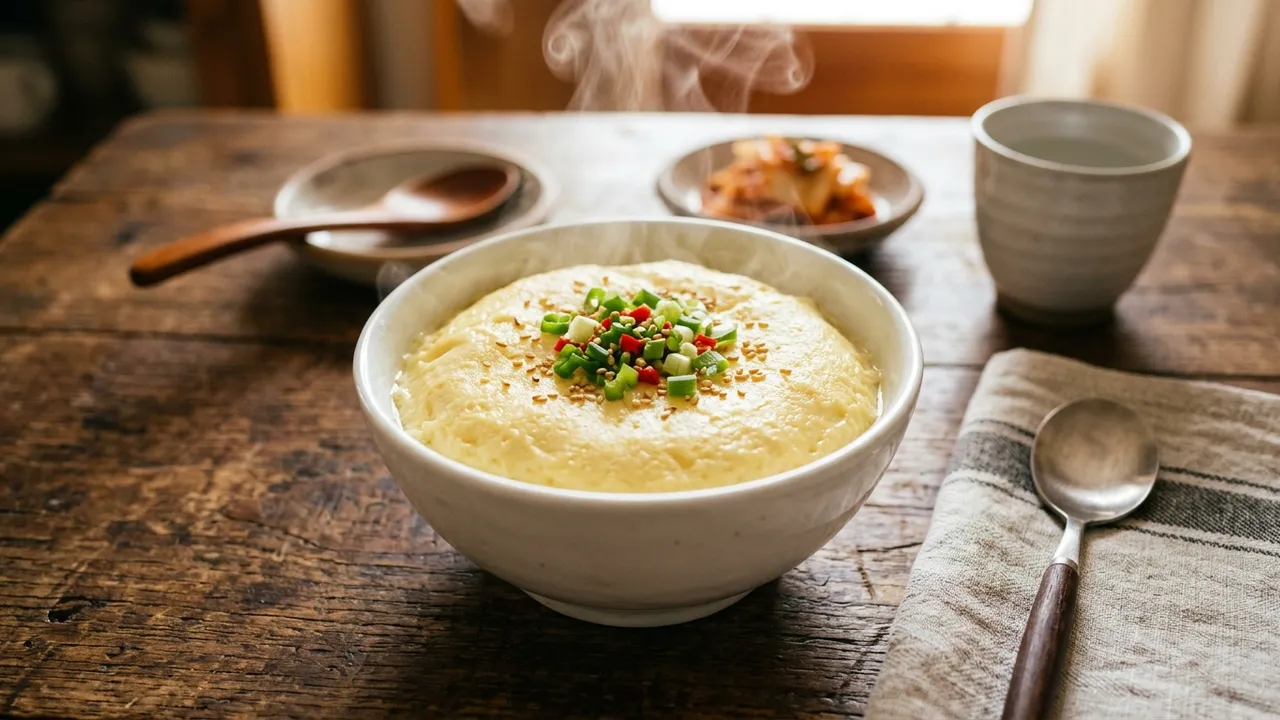
Japanese Steamed Egg Custard Chawanmushi (Chef Choi Kang-rok
* 이미지는 AI가 생성한 참고 이미지로, 실제 조리 결과물과 다를 수 있습니다.
A recipe for Japanese steamed egg custard (Chawanmushi) featuring a silky-smooth texture and a delightful harmony with rich crab roe paste sauce.
📝 Editor's Notes
Chef Choi Kang-rok's Japanese steamed egg custard, Chawanmushi, is an exquisite recipe featuring a silky-smooth texture and a savory crab roe paste (게딱지장) sauce.
The umami-rich egg custard, combined with the salty yet deeply flavorful crab roe paste and a refreshing lemon aroma, delivers a sophisticated taste experience.
While it requires a delicate touch and is rated as medium-low in difficulty, with a little care, you can create a wonderful dish.
It's great year-round, and particularly excellent for entertaining guests, as a nutritious snack for children, or as a warm accompaniment to drinks.
🛒 Ingredient Tips
Fresh ingredients are the foundation of any good dish!
First, fresh eggs have rough, heavy shells and make no sound when shaken.
Bringing them to room temperature before cooking helps reduce any fishy odor and allows them to mix better with other ingredients.
While commercially available katsuobushi dashi is fine, making it yourself will yield a much deeper flavor.
Try using about 10g of katsuobushi (가쓰오부시) in 2 cups (500ml) of water, simmering gently.
For crab roe paste (게딱지장), choose a fresh product and always check the expiration date.
Quality ingredients guarantee the best taste.
🔄 Substitution Guide
If crab roe paste (게딱지장) is difficult to find or if you have a seafood allergy, try substituting it with a mentaiko (명란젓) sauce (mentaiko + butter + kelp dashi) or a ganjang-saewujang (새우장) sauce.
Mentaiko offers a salty and savory flavor, while ganjang-saewujang adds umami, though the unique deep richness of crab roe paste may differ slightly.
Instead of imitation crab meat, you can use shrimp, clams, or shredded chicken breast.
Shrimp provides a springy texture, while chicken breast adds a clean flavor.
If you prefer to reduce the smoky aroma of katsuobushi dashi, you can use kombu (kelp) dashi or anchovy dashi for a lighter and cleaner-tasting chawanmushi, so choose according to your preference.
🥘 Ingredients
👨🍳 Cooking Points
The key to Chawanmushi is its 'smoothness'.
The first point is to strain the egg mixture through a fine-mesh sieve at least twice.
This completely removes the chalazae and foam, creating a silky-smooth texture.
Second, controlling the steamer temperature and time is crucial.
Steaming gently over low heat at 195°F (90°C) for about 10 minutes prevents holes or air bubbles from forming, ensuring a perfectly smooth Chawanmushi.
Be careful not to steam at too high a temperature, as this will create many holes and ruin the texture.
Finally, when thickening the crab roe paste (게딱지장) sauce with a cornstarch slurry, add it gradually while stirring, rather than all at once, to control the consistency.
As for the enoki mushrooms, cook them only with the residual heat of the sauce to maintain their crisp texture.
👨🍳 Directions
Crack 3 eggs into a bowl.
Add katsuobushi dashi, guk-ganjang (Korean soup soy sauce), mirin, and sake, then mix thoroughly.
Strain the well-mixed egg mixture through a fine-mesh sieve.
Place imitation crab meat into a chawan (custard bowl/cup).
Carefully pour the egg mixture into the bowls containing the imitation crab meat.
Cover with plastic wrap and steam in a steamer at 195°F (90°C) for about 10 minutes.
Put the crab roe paste (게딱지장) into a pot and bring to a boil.
Dissolve cornstarch in the boiling crab roe paste to thicken, then add enoki mushrooms and stir lightly to cook with the residual heat.
Generously spoon the crab roe paste sauce over the finished steamed egg custard.
Grate only the yellow part of the lemon peel and sprinkle it over the egg custard.
Gently break up the egg custard with chopsticks, then scoop generously with a spoon and enjoy.
💡 Tips
Straining the egg mixture helps create a silky-smooth and delicate texture for the chawanmushi.
Cook the enoki mushrooms only with the residual heat of the sauce to preserve their crisp texture.
Grate only the yellow part of the lemon peel to avoid bitterness.
📦 Storage & Reuse
It's best to store the finished Chawanmushi without the sauce in an airtight container in the refrigerator.
Consume within 2-3 days for the freshest and most delicious experience.
To reheat, gently warm in the microwave for about 1 minute or steam lightly over low heat to restore its original smooth texture.
Reheat the sauce separately by simmering briefly before spooning it over.
If you have leftover crab roe paste (게딱지장), you can freeze it and use it for fried rice or pasta sauce.
Enoki mushrooms can be added to stews or hot pots to make good use of them.
🥢 Who This Is For
Thanks to its tender texture, this Chawanmushi is excellent as a nutritious snack for children or a restorative dish for the elderly.
When hosting guests on a special occasion, serving it as an elegant appetizer will surely earn you rave reviews.
It also makes a superb accompaniment to warm sake or a cold beer.
Recommended side dishes include simple grilled white fish or a fresh seasonal salad.
Enjoy it as a special delicacy for memorable moments rather than just a side dish for rice, and you'll find it even more satisfying.
🔥 Nutrition Info
This Chawanmushi (per serving) is estimated to contain approximately 200-250 calories, with about 15-20g protein, 15-20g fat, and 10-15g carbohydrates.
The main ingredient, eggs, are rich in high-quality protein as well as various nutrients such as vitamins A, D, E, B12, iron, folate, and choline, which support brain and eye health.
Crab roe paste (게딱지장) contains taurine and the antioxidant astaxanthin, but it can be high in sodium and cholesterol, so moderation is advised.
Enoki mushrooms are rich in dietary fiber, beneficial for gut health, and the vitamin C and limonene in lemon zest can aid in antioxidant activity and fatigue recovery.
💬 Frequently Asked Questions
- Q. What ingredients do I need for Japanese Steamed Egg Custard Chawanmushi (Chef Choi Kang-rok's Recipe)?
- Main ingredients include Eggs, Katsuobushi dashi (가쓰오부시 육수), Guk-ganjang (국간장) (Korean soup soy sauce), Mirin, Sake. Fresh ingredients are the foundation of any good dish! First, fresh eggs have rough, heavy shells and make no sound when shaken. Bringing them to room temperature before cooking helps reduce any fishy odor and allows them to mix better with other ingredients. While commercially available katsuobushi dashi is fine, making it yourself will yield a much deeper flavor. Try using about 10g of katsuobushi (가쓰오부시) in 2 cups (500ml) of water, simmering gently. For crab roe paste (게딱지장), choose a fresh product and always check the expiration date. Quality ingredients guarantee the best taste.
- Q. What are the key tips for making Japanese Steamed Egg Custard Chawanmushi (Chef Choi Kang-rok's Recipe)?
- The key to Chawanmushi is its 'smoothness'. The first point is to strain the egg mixture through a fine-mesh sieve at least twice. This completely removes the chalazae and foam, creating a silky-smooth texture. Second, controlling the steamer temperature and time is crucial. Steaming gently over low heat at 195°F (90°C) for about 10 minutes prevents holes or air bubbles from forming, ensuring a perfectly smooth Chawanmushi. Be careful not to steam at too high a temperature, as this will create many holes and ruin the texture. Finally, when thickening the crab roe paste (게딱지장) sauce with a cornstarch slurry, add it gradually while stirring, rather than all at once, to control the consistency. As for the enoki mushrooms, cook them only with the residual heat of the sauce to maintain their crisp texture.
- Q. How should I store leftover Japanese Steamed Egg Custard Chawanmushi (Chef Choi Kang-rok's Recipe)?
- It's best to store the finished Chawanmushi without the sauce in an airtight container in the refrigerator. Consume within 2-3 days for the freshest and most delicious experience. To reheat, gently warm in the microwave for about 1 minute or steam lightly over low heat to restore its original smooth texture. Reheat the sauce separately by simmering briefly before spooning it over. If you have leftover crab roe paste (게딱지장), you can freeze it and use it for fried rice or pasta sauce. Enoki mushrooms can be added to stews or hot pots to make good use of them.
- Q. How many calories are in Japanese Steamed Egg Custard Chawanmushi (Chef Choi Kang-rok's Recipe)?
- This Chawanmushi (per serving) is estimated to contain approximately 200-250 calories, with about 15-20g protein, 15-20g fat, and 10-15g carbohydrates. The main ingredient, eggs, are rich in high-quality protein as well as various nutrients such as vitamins A, D, E, B12, iron, folate, and choline, which support brain and eye health. Crab roe paste (게딱지장) contains taurine and the antioxidant astaxanthin, but it can be high in sodium and cholesterol, so moderation is advised. Enoki mushrooms are rich in dietary fiber, beneficial for gut health, and the vitamin C and limonene in lemon zest can aid in antioxidant activity and fatigue recovery.
- Q. Can I substitute ingredients in Japanese Steamed Egg Custard Chawanmushi (Chef Choi Kang-rok's Recipe)?
- If crab roe paste (게딱지장) is difficult to find or if you have a seafood allergy, try substituting it with a mentaiko (명란젓) sauce (mentaiko + butter + kelp dashi) or a ganjang-saewujang (새우장) sauce. Mentaiko offers a salty and savory flavor, while ganjang-saewujang adds umami, though the unique deep richness of crab roe paste may differ slightly. Instead of imitation crab meat, you can use shrimp, clams, or shredded chicken breast. Shrimp provides a springy texture, while chicken breast adds a clean flavor. If you prefer to reduce the smoky aroma of katsuobushi dashi, you can use kombu (kelp) dashi or anchovy dashi for a lighter and cleaner-tasting chawanmushi, so choose according to your preference.
💬 Comments
No comments yet. Be the first to comment!