
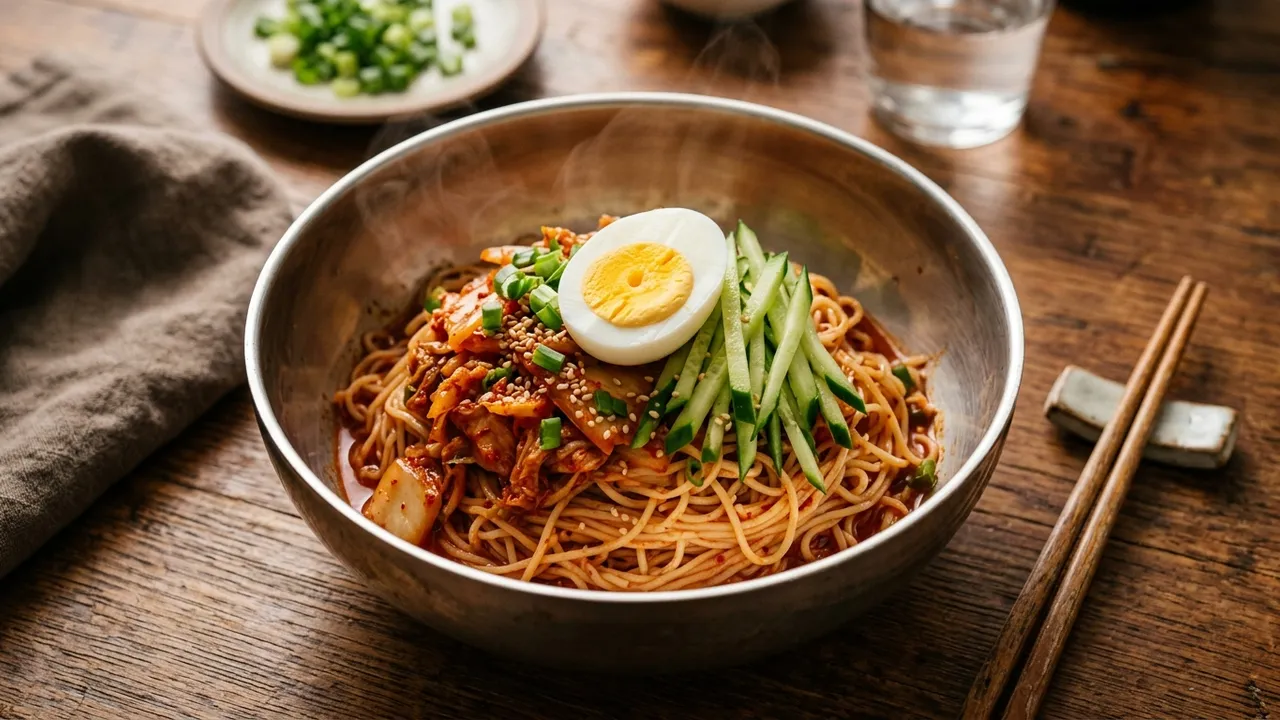
Kim Chan-woo's Kimchi Bibim Guksu (김치비빔국수) with Stir-fried Kimchi and Kalguksu Noodles
This is a recipe for Kimchi Bibim Guksu (김치비빔국수) featuring my mother's kimchi (육젓 김치), made with fermented shrimp sauce, and kalguksu (칼국수) noodles. The kimchi is lightly stir-fried in perilla oil (들기름) to enhance its umami flavor, then mixed with chewy kalguksu (칼국수) noodles.
📝 Editor's Notes
Kim Chan-woo's Kimchi Bibim Guksu (김치비빔국수) is a special recipe highlighting the harmony between stir-fried kimchi and kalguksu (칼국수) noodles. The kimchi, lightly stir-fried in perilla oil (들기름) to bring out its umami, meets chewy kalguksu (칼국수) noodles to create a deep and rich flavor. The savory, sweet, sour, and spicy seasoning, combined with the nutty aroma, makes it excellent as a full meal or a special treat. The cooking process is not complicated, making it easy for beginners to follow, and it's perfect for enjoying cool in summer or warm on a chilly day. If you're looking for a familiar yet new kind of bibim guksu, this recipe is just right. The difficulty level can be rated as intermediate.
🛒 Ingredient Tips
The key to this recipe is the 'kimchi'. Using well-fermented kimchi, like 'Mother's kimchi made with fermented shrimp sauce (육젓 김치)', will create a deep umami flavor. If the kimchi is too sour, try adding a little more sugar to balance the acidity. For perilla oil (들기름), use a generous amount of fragrant, cold-pressed domestic perilla oil for its nutty aroma. Lastly, for the kalguksu (칼국수) noodles, it's best to use fresh noodles for a chewy texture, but if using dried noodles, adjust the cooking time carefully to prevent them from becoming soggy. For the cucumber, choose a fresh and crispy seasonal cucumber for the best taste.
🔄 Substitution Guide
If fermented shrimp kimchi (육젓 김치) is difficult to find, you can use well-fermented store-bought whole kimchi (포기김치) or kimchi suitable for stir-frying. However, you may need to adjust the amounts of soy sauce, sugar, and vinegar depending on the kimchi's taste. You can use sesame oil (참기름) instead of perilla oil (들기름), but be aware that the unique nutty and fragrant flavor of perilla oil might be reduced. If kalguksu (칼국수) noodles are unavailable, somyeon (소면) or jungmyeon (중면) can be used as alternatives. Somyeon (소면) is thinner than kalguksu (칼국수) noodles, so it absorbs the sauce better, but it might be less chewy. Using udon noodles would give you a chewier and thicker noodle texture for your bibim guksu.
🥘 Ingredients
👨🍳 Cooking Points
There are two main cooking points for this bibim guksu. First, when stir-frying the kimchi, it's crucial to use a generous amount of perilla oil (들기름) and only stir-fry it 'lightly'. Over-stir-frying can make the kimchi lose its crisp texture and become mushy, so stir-fry it quickly for about 2-3 minutes over high heat to just bring out its umami. Don't forget to add small amounts of soy sauce, vinegar, and sugar at this stage to maximize the kimchi's flavor. Second, after cooking the kalguksu (칼국수) noodles, be sure to rinse them thoroughly under cold water to remove starch. This will make the noodles firm and chewy, allowing them to absorb the sauce better. Adding a pinch of salt to the boiling water when cooking the noodles can also season them for a more delicious result.
👨🍳 Directions
- 1
Roughly chop the kimchi (Mother's kimchi).
- 2
Heat a generous amount of perilla oil (들기름) in a pan.
- 3
Add the chopped kimchi to the pan and begin to stir-fry.
- 4
Add a little soy sauce, vinegar, and sugar, and stir-fry the kimchi lightly to enhance its flavor.
- 5
Chop a small amount of green onion and add it to the stir-fried kimchi. Continue to stir-fry until the green onion is slightly cooked.
- 6
Boil water in a separate pot and cook the kalguksu (칼국수) noodles.
- 7
Immediately rinse the cooked kalguksu (칼국수) noodles under cold water to remove starch and make them chewy.
- 8
Place the cooked kalguksu (칼국수) noodles in a bowl and top with the stir-fried kimchi.
- 9
Sprinkle generously with toasted sesame seeds and add black pepper to taste.
- 10
Mix all ingredients thoroughly by hand until well combined.
- 11
Garnish with shredded cucumber and half a hard-boiled egg, if desired, to complete.
💡 Tips
When stir-frying kimchi, it's important to use a generous amount of perilla oil (들기름) and add small amounts of soy sauce, vinegar, and sugar. Stir-fry lightly to enhance its umami flavor and aroma.
Using kalguksu (칼국수) noodles instead of somyeon (소면) allows the sauce to coat the noodles better and provides a chewier texture.
After cooking the noodles, rinse them thoroughly under cold water to remove starch, which prevents sticking and makes them chewier.
Instead of fully cooking the stir-fried kimchi, only heat it slightly to bring out its umami flavor, ensuring the kimchi retains its crisp texture.
📦 Storage & Reuse
This Kimchi Bibim Guksu (김치비빔국수) is best enjoyed immediately after preparation. If there are leftovers, separate the noodles and stir-fried kimchi, then store them in airtight containers in the refrigerator. Noodles can become soggy or hard over time, so it's best to consume them as quickly as possible. The stir-fried kimchi can be refrigerated for 2-3 days, but the noodles should ideally not be kept for more than one day. When reheating, gently warm the stir-fried kimchi, and either lightly blanch the noodles in hot water or cook a fresh batch to mix, to enjoy a taste similar to the original. Leftover stir-fried kimchi can also be a delicious addition to kimchi fried rice.
🥢 Who This Is For
This Kimchi Bibim Guksu (김치비빔국수) is a great dish to enjoy when you have no appetite or are craving something special. It's hearty yet not too heavy, making it an excellent lunch, weekend brunch, or light dinner. It's particularly perfect for those who enjoy spicy and sour flavors. For side dishes, we recommend a mild soup like refreshing bean sprout soup or seaweed soup. Serving it with crispy kimchi jeon (김치전) or seafood pajeon (해물파전) would complete a wonderful meal.
🔥 Nutrition Info
One serving of this Kimchi Bibim Guksu (김치비빔국수) is estimated to be approximately 550-650 kcal. Most carbohydrates will come from the kalguksu (칼국수) noodles, likely around 80-100g. Protein, from the hard-boiled egg and kimchi, will be about 15-20g, and fats, from perilla oil (들기름) and egg yolk, will be around 20-25g. Kimchi, rich in probiotics, aids gut health and provides vitamin C and dietary fiber. Perilla oil (들기름) is rich in omega-3 fatty acids, which can have positive effects on cardiovascular health. It offers a well-balanced nutritional profile for a single meal.
💬 Comments
No comments yet. Be the first to comment!