
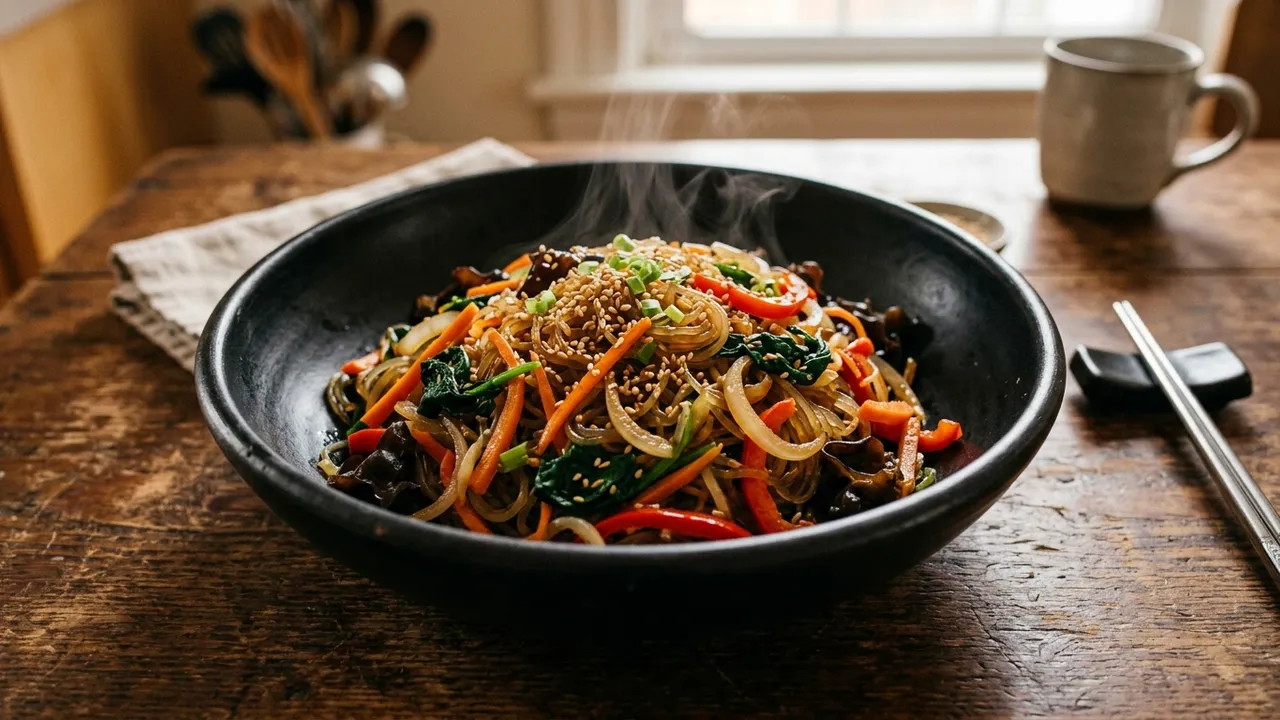
Essential Japchae
This is a simple yet deeply flavorful vegetable-focused japchae recipe.
📝 Editor's Notes
As its name suggests, this 'Essential Japchae' recipe is a healthy, vegetable-centric dish that is faithful to the basics yet offers a profound flavor. Its characteristics include cooking the cellophane noodles directly in the sauce for even seasoning, and stir-frying various vegetables separately to maintain a crisp texture. Guk-ganjang (국간장) and jocheong (조청) add the subtle yet rich sweetness and umami characteristic of Korean cuisine, creating a flavor that everyone, young and old, will enjoy. While the cooking process might seem complex, following each step carefully will allow you to complete it without difficulty, making it perfect for entertaining guests or special occasions.
🛒 Ingredient Tips
For cellophane noodles, which are a crucial ingredient for japchae's taste, choosing a domestic product with good chewiness that doesn't easily get soggy will ensure a more satisfying texture. When selecting wood ear mushrooms, pick clean, unbroken ones in their dried state, and rehydrate them sufficiently in cold water until plump and soft. For spinach, look for vibrant green leaves with reddish, fresh roots. It's in season from fall to early spring, so purchasing it during this time will offer sweeter, more nutritious spinach.
🔄 Substitution Guide
If wood ear mushrooms are unavailable for this recipe, you can substitute them with fragrant shiitake mushrooms or tender oyster mushrooms. However, the unique chewy texture of wood ear mushrooms might be slightly different. Instead of spinach, fragrant chives or crisp bok choy can be used, but this will result in a different flavor profile from spinach's sweetness. If jocheong (조청) is not available, you can use corn syrup or oligosaccharide, but it's difficult to perfectly replicate the subtle, deep sweetness and glossy finish characteristic of Korean cuisine that jocheong provides. If oyster sauce is too much, you can create an umami flavor by mixing soy sauce with a small amount of tuna extract or anchovy sauce.
🥘 Ingredients
👨🍳 Cooking Points
There are three main key cooking points. First, stir-frying the vegetables separately is crucial. By stir-frying carrots, wood ear mushrooms, onions, bell peppers, and spinach individually, you can preserve their unique textures and colors. Lightly seasoning them with salt also enhances their natural sweetness. Second, the method of cooking the cellophane noodles directly in the sauce is important: add the soaked noodles to the sauce, boil for 6 minutes, then add 1 cup (250 ml) of water halfway through and continue cooking over medium heat to prevent sticking. Lastly, the secret to evenly seasoned noodles that don't clump together is to combine the cooked noodles and stir-fried vegetables quickly while they are still warm.
👨🍳 Directions
- 1
Soak 100 g of cellophane noodles and 15 g of wood ear mushrooms in cold water for 30 minutes.
- 2
Remove the roots from ½ bunch of spinach and wash thoroughly.
- 3
Julienne ⅓ of a carrot.
- 4
Heat 1 tbsp of cooking oil in a pan over medium-low heat and stir-fry the carrots.
- 5
Julienne 1 onion and 1 bell pepper.
- 6
Add 1 g of salt to the carrots and continue to stir-fry.
- 7
Tear the rehydrated wood ear mushrooms into bite-sized pieces and stir-fry them in the pan.
- 8
Once the moisture from the wood ear mushrooms has evaporated, add the julienned onion and bell pepper and stir-fry together.
- 9
Add 2 tbsp of cooking oil to prevent burning, then add 2 g of salt and stir-fry over high heat.
- 10
Transfer the stir-fried vegetables to a large bowl.
- 11
In the same pan, add the spinach and 1 g of salt. Stir-fry until wilted.
- 12
Transfer the stir-fried spinach to the same bowl.
- 13
In the pan, add 1 cup of water (250 ml), 2 tbsp of guk-ganjang (국간장), 1 level tbsp of brown sugar, 1 tbsp of jocheong (조청), 1 tbsp of sesame oil, 1 tbsp of cooking oil, and 1 tbsp of oyster sauce. Bring to a boil over high heat to make the sauce.
- 14
Add the soaked cellophane noodles to the prepared sauce and boil for 6 minutes. Add another 1 cup of water (250 ml) halfway through to prevent sticking and continue to cook over medium heat.
- 15
Combine the cooked cellophane noodles and stir-fried vegetables in the bowl and mix well while still warm.
- 16
Add 1 heaped tbsp of sesame seeds and mix everything together.
- 17
Transfer the finished japchae to a serving dish and garnish with sesame seeds.
💡 Tips
Mixing guk-ganjang (국간장) and regular soy sauce (jin-ganjang (진간장)) in a 1:1 ratio can create a subtle yet deep flavor.
When julienning carrots, be careful to keep your wrist safe from the knife blade.
Lightly seasoning vegetables with salt while stir-frying enhances their natural sweetness and helps remove excess moisture for a better texture.
Using jocheong (조청) instead of corn syrup or allulose adds a subtle sweetness and glossy sheen characteristic of Korean japchae.
📦 Storage & Reuse
Store the finished japchae in an airtight container in the refrigerator for 2-3 days to keep it fresh. However, due to the nature of cellophane noodles, they can swell or become hard over time, so it's recommended to consume them as soon as possible. Freezing is not recommended as the texture of the noodles will change significantly. To reheat, briefly microwave or gently stir-fry in a pan over very low heat. Adding 1-2 tbsp of water at this stage will help keep the noodles moist and prevent them from drying out. Leftover japchae can also be used as a filling for gimbap (김밥) or mandu (만두) (dumplings) for a delicious twist.
🥢 Who This Is For
This japchae is especially recommended for those who love vegetables or seek a healthy meal. It will be highly praised if served as a main dish or side dish when hosting guests. It's also perfect for holidays or special family gatherings. Enjoy it as japchae-bap (잡채밥) over warm rice, or pair it with other Korean side dishes like bulgogi (불고기) or galbi-jjim (갈비찜) to create a richer, more harmonious Korean meal. It also pairs well with refreshing miyeok-guk (미역국) (seaweed soup) or clear kongnamul-guk (콩나물국) (bean sprout soup).
🔥 Nutrition Info
Based on 3-4 servings, one serving of this japchae is estimated to be approximately 250-300 kcal. Carbohydrates are primarily supplied by the main ingredient, cellophane noodles, while fats come from cooking oil and sesame oil. Protein is present in small amounts from wood ear mushrooms and other vegetables. Specifically, beta-carotene in carrots converts to vitamin A, aiding eye health, and spinach and bell peppers are rich in vitamin C, boosting immunity. Wood ear mushrooms are rich in dietary fiber, which positively impacts gut health. However, due to the use of guk-ganjang (국간장), oyster sauce, and salt, the sodium content may be somewhat high, so those who prefer less salty food should consider adjusting the seasoning.
💬 Comments
No comments yet. Be the first to comment!