
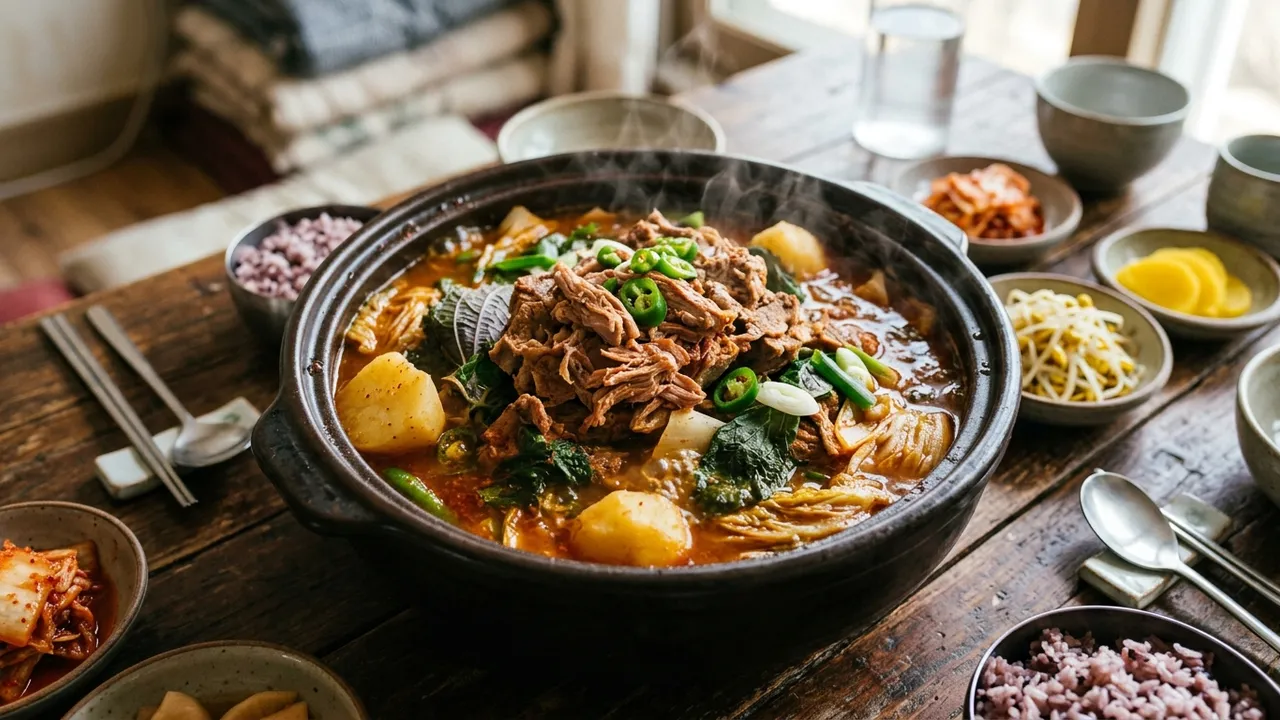
Restaurant-Style Gamjatang (감자탕) - Large Batch Secret Recipe
A golden ratio recipe for restaurant-style Gamjatang (감자탕), featuring a rich, deep broth and exceptionally tender meat.
📝 Editor's Notes
This recipe reveals the secret to making large-batch, restaurant-style Gamjatang (감자탕). With its rich, deep broth and exceptionally tender meat, you can experience the same deliciousness at home as you would in a specialty restaurant. The combination of doenjang (된장), gochujang (고추장), and freshly blended vegetables creates a savory, spicy, and refreshing umami flavor. While it requires care from de-blooding the backbones to simmering them, the effort is well worth it, making it perfect for special occasions or when you want a family feast. It's a comforting dish that warms you up on chilly days and is hearty enough for the whole family to enjoy. This Gamjatang will deliver immense satisfaction for a little effort.
🛒 Ingredient Tips
The core of Gamjatang (감자탕)'s flavor lies in the pork backbones. Korean-sourced backbones offer good freshness and less gamey odor, while imported ones have the advantage of being more affordable. Regardless of your choice, it's best to select backbones with reddish, glossy meat and thick flesh clinging to the bones. It's crucial to thoroughly remove the blood to achieve a clean broth without any off-flavors, so prioritize this step. When purchasing pre-boiled Ugeoji (우거지), choose fresh ones that are not overly mushy and retain a green hue. If boiling them yourself, cook until tender, then rinse thoroughly several times in cold water to remove any bitterness. Remember that traditional doenjang (된장) is essential for the characteristic deep, savory flavor of Gamjatang.
🔄 Substitution Guide
You can use pork neck bones or ribs instead of pork backbones. Neck bones tend to have less meat and are softer than backbones, so the texture might be slightly different, but the broth flavor won't change significantly. Using beef short ribs can create a more luxurious flavor, but be aware that cooking time and cost will increase considerably. Siraegi (시래기), dried radish greens, can be used instead of Ugeoji (우거지). Siraegi is usually more savory and chewy than Ugeoji, but it has a stronger distinct aroma, so make sure to boil it sufficiently until tender. For doenjang (된장) and gochujang (고추장), you can use homemade or different commercial brands. However, for a deep, authentic flavor, traditional doenjang is recommended. Gochujang brands vary in spiciness and sweetness, so adjust the amount to your taste.
🥘 Ingredients
👨🍳 Cooking Points
There are three crucial cooking points for this Gamjatang (감자탕) recipe. First, thoroughly removing the blood is key to eliminating any gamey odor. For Korean-sourced backbones, soak for 2-3 hours; for imported ones, soak for 8-12 hours, changing the cold water frequently. Neglecting this step can result in a less appealing taste, even with good seasoning. Second, parboiling the backbones to remove impurities is essential. Boil them for 8 minutes over high heat, skimming off all foam and fat, then rinse with cold water to ensure a clean broth. Third, when simmering the broth seasoned with blended vegetables, doenjang (된장), and gochujang (고추장), don't forget to stir occasionally with a wooden spatula to prevent it from sticking to the bottom. By following these three points, you'll be able to make delicious Gamjatang successfully.
👨🍳 Directions
- 1
Remove blood from 2 kg of pork backbones. For Korean-sourced backbones, soak in cold water for 2-3 hours; for imported backbones, soak for 8-12 hours, changing the water several times in between.
- 2
Place the de-blooded backbones in a large pot. Add enough water to cover the backbones, 5 bay leaves, and 150g (3/4 cup) of Sake (Jeongjong (정종)). Close the lid and bring to a boil over high heat. Once boiling, open the lid, skim off any foam and oily impurities, and continue to cook for 8 minutes over high heat.
- 3
Quickly rinse the parboiled backbones under cold water to thoroughly remove any bone fragments, residual blood, or other impurities. Drain well.
- 4
When placing the cleaned and drained backbones back into the pot, arrange them with the meatier side facing down and the bones facing up. (This allows the meat to be submerged in the broth and cook more tenderly, while the bones act as a 'lid' to prevent excessive air exposure.)
- 5
Pour 3,400g (3.4 L) of water into the pot, close the lid, and bring to a boil over high heat.
- 6
Finely chop 165g of Korean radish, 4 Cheongyang chili peppers (32g), and 80g of large green onion. Place them in a blender, add 150ml (2/3 cup) of water, and blend until smooth.
- 7
Once the broth starts boiling, add the blended vegetables. Rinse any remaining vegetable pulp from the blender with the remaining 150ml of water and add it to the pot. Stir occasionally with a wooden spatula to prevent sticking to the bottom.
- 8
When the broth begins to boil, add 70g (2 1/3 tbsp) of Gochujang (고추장) and 120g (4 heaping tbsp) of traditional Doenjang (된장), dissolving them well through a fine-mesh sieve.
- 9
Add 50g (2 1/2 tbsp) of minced garlic, 10g (1/3 tbsp) of minced ginger, 16g (2 tbsp) of fine gochugaru (고춧가루), 20g (2 1/2 tbsp) of coarse gochugaru (고춧가루), 15g (1 1/4 tbsp) of Dashida (다시다), 6g (1/2 tbsp) of MSG (Miwon (미원)), 20g (1 2/3 tbsp) of fine salt, and 2g (3/5 tsp) of black pepper. Stir well. Maintain high heat.
- 10
Tear 500g of boiled dried napa cabbage leaves (Ugeoji (우거지)) into bite-sized pieces and add them to the pot, pressing them down so they are submerged in the broth. Close the lid, leaving a small vent, and simmer for 50 minutes over medium heat. (Stir occasionally during cooking to prevent the backbones from sticking to the bottom.)
- 11
7 minutes before the 50-minute simmering time is complete, add 40g of perilla seed powder, 15 perilla leaves (torn into 3 pieces), and 110g (2/3 stalk) of large green onion (halved and sliced). Continue to simmer for the remaining time.
- 12
After a total of 50 minutes of cooking, check if the meat easily separates from the bones and taste the broth. Add 8g (2/3 tbsp) of Dashida (다시다) and 6g (1/2 tbsp) of fine salt to adjust the seasoning to your preference. (If the meat does not separate easily, simmer for a bit longer before adjusting the seasoning.)
💡 Tips
To prevent any gamey odor, remove blood from Korean-sourced pork backbones for 2-3 hours and from imported ones for 8-12 hours, changing the water frequently.
When simmering the seasoned broth, the bottom might stick, so stir gently with a wooden spatula occasionally.
It's important to adjust the simmering time according to the size of the bones and thickness of the meat, cooking until the meat easily separates from the bones.
For an enhanced flavor, you can add boiled potatoes or sliced large green onions according to your preference.
📦 Storage & Reuse
Leftover Gamjatang (감자탕) can be stored in an airtight container in the refrigerator for 2-3 days. When the broth cools, the fat will solidify and turn white; skim it off before reheating for a cleaner taste. For longer storage, we recommend portioning it out and freezing. It can be stored in the freezer for about a month. To reheat, thaw and gently warm in a pot over low heat. If the broth has reduced too much, add a little water or stock and adjust the seasoning. The remaining Gamjatang broth can also be used to make fried rice or enjoyed by adding ramen noodles for another delicious meal.
🥢 Who This Is For
This restaurant-style secret Gamjatang (감자탕) is a wonderful dish for the whole family to enjoy. It's an excellent choice, especially when you crave a warm soup on a chilly day, or when you want to generously host guests. The spicy and refreshing broth also makes for a fantastic hangover cure. The best side dishes to pair with it are cool, crunchy Kkakdugi (깍두기) (diced radish kimchi) or perfectly ripened napa cabbage kimchi. The harmony of hot Gamjatang and cold kimchi will further stimulate your appetite. Finally, for a perfect finish, you can make fried rice with the leftover broth or add ramen noodles to cook.
🔥 Nutrition Info
This large-batch Gamjatang (감자탕) recipe makes for a hearty meal, but it's important to consume it in moderation, considering its nutritional content. Based on 2 kg of pork backbones and an estimated 5-6 servings, the estimated calorie count per serving can range from approximately 800-1000 kcal. This can vary depending on the cut of pork and its fat content. Protein is estimated to be around 70-90g, fat around 50-70g, and carbohydrates around 20-30g. Pork backbones are rich in high-quality protein, iron, and B vitamins, which can help replenish energy. Vegetables like Ugeoji (우거지), Korean radish, and large green onions provide dietary fiber, vitamins, and minerals, contributing to nutritional balance. However, due to the inclusion of doenjang (된장), gochujang (고추장), and salt, the sodium content may be high, so it's advisable to moderate your broth intake.
💬 Comments
No comments yet. Be the first to comment!