
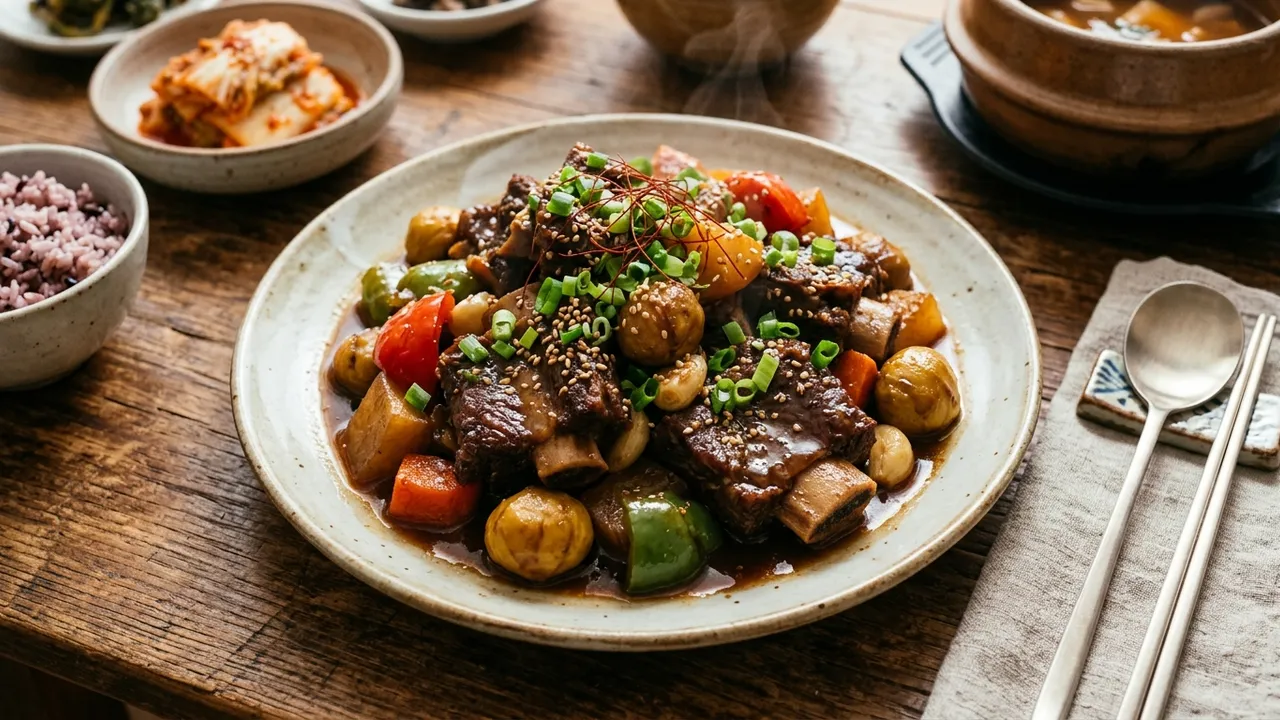
Spicy Braised Pork Ribs (Maekom Dwaeji Galbijjim)
A crowd-pleasing dish perfect for holiday tables! This recipe for delicious, melt-in-your-mouth spicy braised pork ribs (Maekom Dwaeji Galbijjim) will be an instant hit.
📝 Editor's Notes
We're introducing a spicy braised pork ribs recipe that the whole family can enjoy.
The deep flavor from the bones, natural sweetness from fruits, and the clean spiciness of cheongyang chili peppers combine to create an unforgettable taste.
Careful pre-treatment, including blood removal and impurity skimming, ensures a clean and tender meat flavor.
Braising for a long time results in a melt-in-your-mouth texture that is truly exquisite, making it a beloved dish for holiday tables or special guest dinners.
The difficulty level is intermediate, but with a bit of effort, you can definitely create a magnificent dish.
🛒 Ingredient Tips
The freshness of pork ribs is paramount.
Choose ribs with a vibrant red color and a good balance of fat.
Boneless ribs can be used, but bone-in ribs offer a deeper, richer flavor.
Select Korean radish (mu, 무) and carrots that are firm and have smooth surfaces.
Korean radish is sweetest in autumn and winter, so making this dish during these seasons will enhance its flavor.
For the seasoning sauce, use Korean pears (bae, 배) and apples that are ripe and sweet, as their natural sweetness helps reduce the amount of sugar needed.
Remember, fresh ingredients lead to the best taste.
🔄 Substitution Guide
You can use beef ribs instead of pork ribs.
Beef ribs are known for their richer meat flavor and tenderness compared to pork, but they are also typically more expensive.
Alternatively, using back ribs offers a fun eating experience but may yield less meat.
If Korean pear (bae, 배) and apple are unavailable or difficult to find for the seasoning sauce, you can add a small amount of kiwi or pineapple, or adjust the sweetness by adding a bit more oligo syrup or sugar.
Be cautious with kiwi or pineapple, as their strong tenderizing action can make the meat too soft if used excessively.
For a milder spice, substitute cheongyang chili peppers with kkari-gochu (Korean shishito peppers).
If you prefer no spice at all, you can omit the cheongyang chili peppers entirely.
🥘 Ingredients
👨🍳 Cooking Points
There are two key points to this spicy braised pork ribs dish.
First, never neglect the process of removing blood and impurities.
Soaking the ribs in cold water for at least 30 minutes to drain blood, then blanching them in boiling water with ginger and soju (소주) for 2 minutes, followed by a thorough cold water rinse, completely eliminates the pork's characteristic off-smells.
This step might seem tedious, but it's essential for a clean flavor.
Second, it's crucial to blend the seasoning sauce finely.
The Korean pear (bae, 배), apple, and onion should be blended with water until as smooth as possible to prevent the sauce from becoming thick or gritty and to achieve a smooth flavor.
Finally, the seasoned ribs must be simmered over medium-low heat for at least 40 minutes to ensure the meat becomes tender and the seasoning fully penetrates, resulting in a delicious galbijjim.
👨🍳 Directions
Place 4.4 lb of pork ribs in cold water and gently rub around the bones to remove any bone fragments from cutting. Rinse thoroughly. Then, soak them again in cold water for 30 minutes to remove blood. It's best to change the water once in between, and use water that's slightly less cold than ice water.
In a pot, add 12.5 cups of water, 0.9 oz of sliced ginger, and 0.5 tbsp of salt, then bring to a boil. Once the water is vigorously boiling, continue to boil for about 2 more minutes to allow the ginger flavor to infuse well and eliminate any off-smells.
Carefully add the blood-drained pork ribs to the vigorously boiling ginger water, making sure hot water doesn't splash. Add 0.4 cup (100ml) of soju (소주) and boil on high heat for about 2 minutes to remove impurities and any remaining blood from the bones. Strain the boiled ribs and discard the water.
Rinse the boiled pork ribs thoroughly with cold water about twice, then drain them in a colander.
Cut 1.1 lb of Korean radish (mu, 무) and 0.55 lb of carrots into large, bite-sized pieces. To prevent the edges from breaking apart during cooking, trim them into rounded shapes using a knife or peeler.
Prepare the spicy pork ribs seasoning sauce. Remove the seeds and skin from half a Korean pear (bae, 배), half an apple, and half an onion, then cut them into large pieces and place them in a blender. Add 0.85 cup (200ml) of water and blend until as smooth as possible.
To the finely blended fruit and vegetable mixture, add 0.85 cup (200ml) of brewed soy sauce, 0.4 cup (100ml) of cheongju (청주), 4 tbsp of light brown sugar, 2 tbsp of minced garlic, 2 tbsp of corn syrup, and 3 tbsp of gochugaru (고춧가루). Mix well to complete the seasoning sauce. (Medium-fine gochugaru is recommended).
In a pot of about 5-liter capacity (roughly 5.3 quarts), add the pre-treated pork ribs. Pour in the prepared seasoning sauce and mix thoroughly to coat the ribs evenly. Add 2 cups (500ml) of water, ensuring the ribs are submerged.
Add the prepared Korean radish (mu, 무) and carrots, along with 0.5 oz of sliced ginger, and bring to a boil over high heat. Once the broth boils, use a ladle to skim off the foam (clumps of gochugaru, oil, etc.) that forms on the surface, rinsing the ladle in water each time. (There's no need to constantly skim; if you don't rinse the ladle, the foam might return to the broth).
Leave the pot lid slightly ajar to allow off-smells to escape, then simmer gently for 15 minutes. (If the lid is not covered at all, the meat will not cook thoroughly).
Add 1 stalk of roughly chopped green onion and 4-5 cheongyang chili peppers (or more, or hotter peppers like Vietnamese bird's eye chilies, according to your preference). Sprinkle with 0.5 tsp of black pepper. (Black pepper is added later to preserve its aroma).
Cover the pot and simmer thoroughly over medium heat for 20 minutes. Check if the meat is tender enough; if you want it more tender, continue to simmer over medium-low heat with the lid on, or if you prefer a thicker sauce, reduce it over high heat until the liquid is almost gone.
💡 Tips
To cleanly remove bone fragments created when cutting pork ribs, rub and rinse them under running water, focusing on the bones.
Rounding the edges of Korean radish (mu, 무) and carrots prevents them from breaking apart during cooking, making the dish look neat and appealing.
When blanching pork ribs, adding ginger and soju (소주) to the boiling water beforehand effectively removes off-smells and flavors the meat. The alcohol evaporates, making it safe for children to eat.
Finely blending the Korean pear (bae, 배), apple, and onion with water in the seasoning sauce is key to achieving a smooth broth, preventing it from becoming thick or lumpy.
For the most delicious galbijjim, braise the pork ribs for a long time until they are very tender, allowing the seasoning to fully penetrate the meat.
The leftover sauce from the finished galbijjim can be enjoyed as another delicacy by stir-frying it with udon noodles or tteokbokki (떡볶이) rice cakes.
📦 Storage & Reuse
Once prepared, the spicy braised pork ribs can be stored in an airtight container in the refrigerator for 3-4 days.
For longer storage, divide into single-serving portions and freeze in airtight containers or freezer bags.
It is recommended to consume frozen ribs within 1-2 months.
To reheat frozen galbijjim, thaw it in the refrigerator first, then heat gently in a pot over medium-low heat.
If the sauce has thickened too much, you can add a little water or broth to adjust the consistency.
Leftover galbijjim can be shredded and stir-fried with rice to make fried rice, or used as a topping for rice, offering another delicious way to enjoy it.
🥢 Who This Is For
This spicy braised pork ribs dish is a perfect harmony of spicy and sweet flavors, making it an excellent meal for the whole family.
It will especially earn you rave reviews when served as a main dish during holidays or when entertaining guests.
For those who love spicy food, this will be an unparalleled choice.
It pairs wonderfully with warm white rice, and serving it with refreshing dongchimi (동치미) or bean sprout soup can help balance the spicy flavors.
It also complements mild vegetable side dishes, allowing you to prepare a rich and satisfying meal.
🔥 Nutrition Info
Based on 4-5 servings, this spicy braised pork ribs dish is estimated to be around 680-750 kcal per serving.
The main ingredient, pork ribs, provides approximately 60-70g of high-quality protein and is rich in B vitamins and iron, aiding in energy recovery and preventing anemia.
The fat content is relatively high, about 45-55g, so moderation is advised.
Carbohydrates, primarily from Korean radish (mu, 무), carrots, fruits, sugar, and corn syrup in the sauce, contribute about 45-55g.
Carrots are an excellent source of Vitamin A, and the fiber from vegetables and fruits aids digestion.
However, due to the seasoning sauce, the sodium content can be high.
It is recommended to pair this dish with other lightly seasoned side dishes to maintain a balanced intake.
💬 Comments
No comments yet. Be the first to comment!