
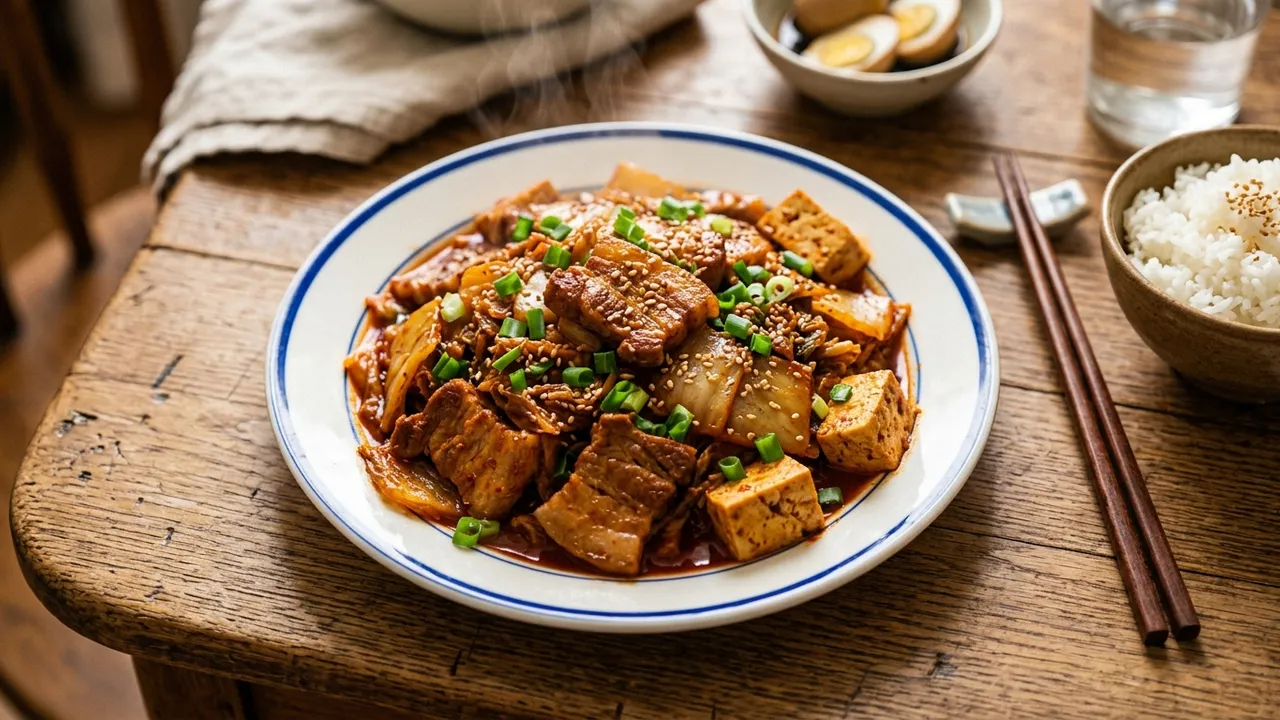
Stir-fried Muk-eun-ji (묵은지) and Beef Brisket (우삼겹)
A rich, savory, yet refreshing and addictive recipe for stir-fried aged kimchi and beef brisket.
📝 Editor's Notes
This Stir-fried Muk-eun-ji (묵은지) and Beef Brisket (우삼겹) is an exquisite recipe that harmonizes savory, rich beef brisket with refreshingly well-aged kimchi.
The deep flavor of muk-eun-ji combined with the richness of u-samgyeop creates an unforgettable and addictive taste.
The cooking process is not complicated, making it easy for beginner cooks to follow.
It's perfect for a busy weeknight dinner or a special weekend treat for the whole family.
The unique refreshing taste of muk-eun-ji combined with the umami of the meat makes it an excellent side dish for rice as well as an ideal accompaniment to drinks.
This dish will be a satisfying and warming meal that can be enjoyed any time of the year.
🛒 Ingredient Tips
The undisputed star ingredient of this dish is muk-eun-ji (묵은지).
Well-aged muk-eun-ji offers a deep and refreshing flavor, but it's best to avoid any that are excessively sour or have an off-smell.
When selecting muk-eun-ji, check that the cabbage retains its shape, the seasoning is evenly distributed, and it's not too soft.
For the beef brisket (u-samgyeop), prepare thinly sliced pieces to ensure a tender texture when stir-fried with the muk-eun-ji.
Choosing fresh u-samgyeop with good marbling will result in an even richer, savory taste.
For perilla oil (deul-gireum), use pure deul-gireum with its distinct aroma to fully enhance the flavor of the muk-eun-ji stir-fry.
🔄 Substitution Guide
If the key ingredient, aged kimchi (muk-eun-ji), is unavailable, it may be difficult to achieve a similar depth of flavor.
However, if using regular sour kimchi, try soaking it in water to reduce saltiness, then add a little more sugar or plum extract (maesil-cheong) to adjust the sourness.
This will give you a fresher taste instead of the unique deep flavor of muk-eun-ji.
If you wish to use other meats instead of beef brisket (u-samgyeop), thinly sliced pork belly (samgyeopsal) or pork shoulder (moksal) can be used.
Keep in mind that pork belly may have more fat than beef brisket, while pork shoulder might offer a leaner taste.
Using chicken breast can reduce calories, but the savory richness may be somewhat diminished.
🥘 Ingredients
👨🍳 Cooking Points
The most crucial point determining the taste of Stir-fried Muk-eun-ji (묵은지) and Beef Brisket (우삼겹) is the preparation of the muk-eun-ji itself.
It's essential to gently remove the seasoning from the muk-eun-ji and soak it in water for about 30 minutes to eliminate excess saltiness and any unwanted odors.
This process helps bring out the refreshing and clean original flavor of the muk-eun-ji.
The second point is heat control; when stir-frying muk-eun-ji, always use medium heat to prevent it from burning easily.
It's important to stir-fry until the muk-eun-ji becomes tender and its flavor deepens.
If the muk-eun-ji is too sour, don't forget to add 1 tablespoon of raw sugar (won-dang) to mellow out the tartness.
For the beef brisket (u-samgyeop), push the muk-eun-ji to one side and cook the meat separately, utilizing the rendered fat from the meat to enhance the overall flavor.
👨🍳 Directions
Take out the aged kimchi (muk-eun-ji) from the refrigerator, gently shake off the seasoning, then soak it in water for about 30 minutes to remove excess saltiness and bring out its original flavor. Cut the soaked muk-eun-ji into bite-sized pieces.
Place the muk-eun-ji in a pan, drizzle with an appropriate amount of perilla oil (deul-gireum), and stir-fry over medium heat. To reduce the characteristic sourness of muk-eun-ji, add 1 tbsp of raw sugar (won-dang, brown sugar) and continue to stir-fry, then sprinkle with sesame seeds (kkae).
Push the stir-fried muk-eun-ji to one side of the pan and add the beef brisket slices (u-samgyeop) to cook. The oil rendered from the beef brisket will be enough, so there's no need to add more perilla oil. Once the meat is cooked, cut it into bite-sized pieces with kitchen shears.
Stir-fry the muk-eun-ji and beef brisket together, then add the chopped green onion (dae-pa) for garnish and lightly mix to finish.
We recommend serving the finished stir-fried muk-eun-ji and beef brisket generously over warm rice, like a rice bowl (deopbap).
💡 Tips
Gently shaking off the seasoning from the aged kimchi (muk-eun-ji) and soaking it in water for about 30 minutes helps remove any unpleasant odors and excessive saltiness, bringing out the natural flavor of the cabbage.
When stir-frying muk-eun-ji, it's best to cook it over medium heat, as high heat can easily burn it. If the sourness is too strong, add raw sugar (won-dang) to balance the flavors with sweetness.
If you add fatty meat like beef brisket (u-samgyeop) to stir-fry, the oil rendered from the meat will be sufficient, so there's no need to add extra perilla oil (deul-gireum).
The aged kimchi (muk-eun-ji) is the key ingredient in this dish, so it's difficult to achieve the same taste without it. While you can use other ingredients like tuna or Spam instead of muk-eun-ji, the authentic flavor might differ.
📦 Storage & Reuse
The finished Stir-fried Muk-eun-ji (묵은지) and Beef Brisket (우삼겹) can be stored in an airtight container in the refrigerator for 3-4 days.
To enjoy, reheat in the microwave for 2-3 minutes or gently stir-fry in a pan over low heat to enjoy it warm, maintaining its original delicious flavor.
Leftovers are also great mixed with warm rice or used as a filling for Gimbap (김밥).
You can also add it to Kimchi Jjigae (김치찌개) or Kimchi Bokkeumbap (김치볶음밥) to enhance their savory flavor.
While freezing is possible, the texture of the muk-eun-ji and meat might change slightly upon thawing, so it's recommended to consume it fresh from the refrigerator as soon as possible.
🥢 Who This Is For
This Stir-fried Muk-eun-ji (묵은지) and Beef Brisket (우삼겹) is highly recommended for anyone looking for a hearty and delicious meal.
It's an excellent choice, especially for those who love kimchi or enjoy the fantastic combination of meat and kimchi.
Served generously over warm rice like a rice bowl (deopbap), it makes a complete meal without needing other side dishes.
Pair it with a refreshing soup like soybean sprout soup (kongnamul-guk) or seaweed soup (miyeok-guk) for an even more perfect dining experience.
It's also an ideal simple meal option for busy professionals or those living alone.
🔥 Nutrition Info
For a single serving of this Stir-fried Muk-eun-ji (묵은지) and Beef Brisket (우삼겹), you can expect approximately 450-550 calories.
This can vary depending on the fat content of the beef brisket, and the amount of perilla oil and raw sugar used.
You'll typically consume around 20-25g of protein, 35-45g of fat, and 15-20g of carbohydrates.
Beef brisket provides quality protein and iron, while muk-eun-ji contains dietary fiber, Vitamin C, and beneficial probiotics formed during fermentation.
However, both muk-eun-ji can be high in sodium and beef brisket is high in fat, so consuming in moderation is healthier.
Pairing with fresh vegetables is also a good way to achieve nutritional balance.
💬 Comments
No comments yet. Be the first to comment!