
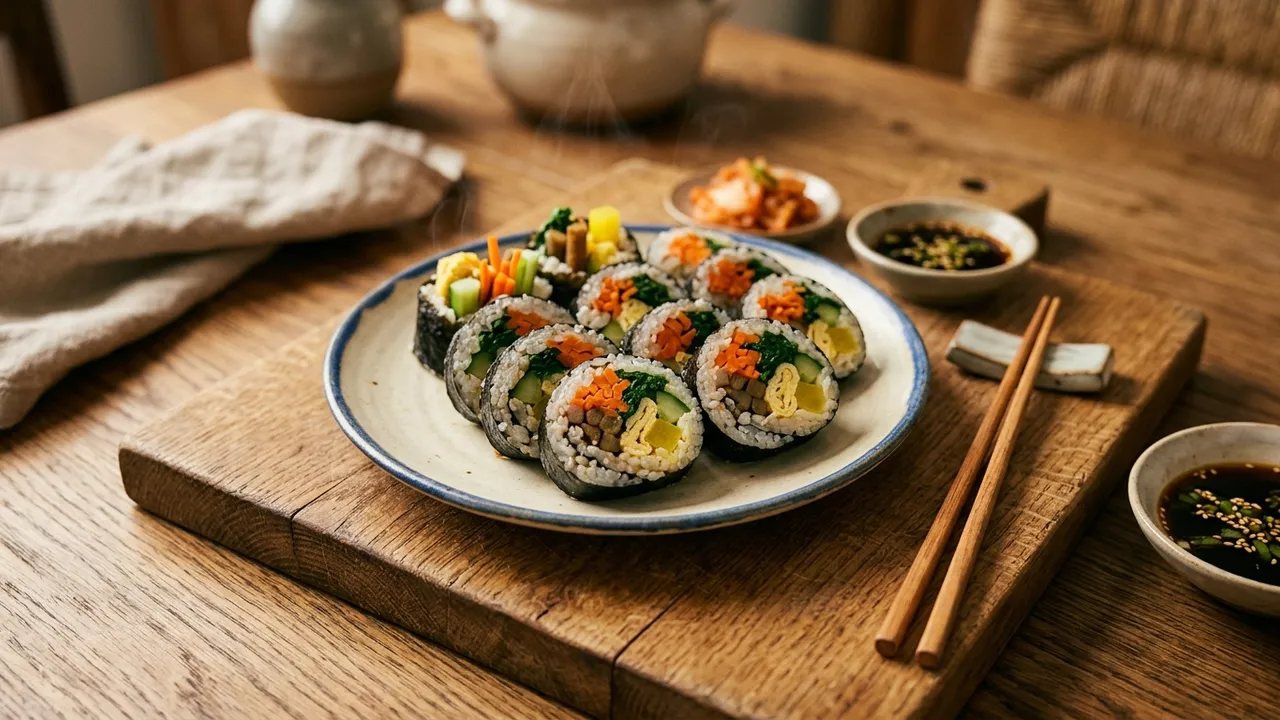
Authentic Gimbap Recipe: A Restaurant Owner's Secret Tips
This recipe reveals the secret tips from a gimbap restaurant owner, allowing you to make delicious gimbap without fail at home.
📝 Editor's Notes
This gimbap recipe's standout feature is the special secret tips from a gimbap restaurant owner, helping you make delicious gimbap without fail, even at home. Using mixed grain rice (japgokbap) makes it a healthier and more satisfying meal. The fresh vegetables like carrots and Korean chives (buchu), savory egg crepe (jidan), salty ham, and imitation crab sticks (matsal) come together to offer a rich variety of flavors and textures. The difficulty level is moderate, requiring preparation of various ingredients and careful rolling, but by following the provided tips, anyone can create impressive gimbap. It's perfect for picnics, lunchboxes, light lunches, or as a dish for entertaining guests.
🛒 Ingredient Tips
To recreate the authentic taste of a gimbap restaurant, ingredient selection is crucial. First, choose high-quality gimbap seaweed (gim) that is crisp and fragrant. Freshly cooked mixed grain rice (japgokbap) is key; it should be neither too sticky nor too dry to prevent the gimbap from breaking when rolled and to ensure a good texture. For carrots, select ones that are vibrant in color, firm, and glossy. For Korean chives (buchu), choose fresh ones with straight, un-wilted leaves to add a delightful aroma. Make sure to use fresh eggs for a savory egg crepe (jidan) without any off-flavors.
🔄 Substitution Guide
The ingredients in this recipe can be varied according to taste or situation. Instead of ham or imitation crab sticks (matsal), you can stir-fry bulgogi (beef) or chicken breast for a more substantial and luxurious flavor. Braised fried tofu (yubu) or fish cakes (eomuk) can also be added. If you're not accustomed to mixed grain rice (japgokbap), you can substitute white rice, but be aware that the nutty flavor and health benefits of mixed grain rice may be reduced. Instead of Korean chives (buchu), you can blanch and season spinach, or add julienned cucumber. Spinach will provide a softer texture, while cucumber will add a crisp crunch. If you have allergies, it is recommended to omit the offending ingredient and substitute with other vegetables or protein sources.
🥘 Ingredients
👨🍳 Cooking Points
There are three key points for success with this gimbap recipe. First, seasoning and temperature control for the rice. After mixing seasoned salt (matsogeum), sesame oil, and sesame seeds (kkae) into freshly cooked mixed grain rice (japgokbap), it is crucial to let it cool slightly. This prevents the seaweed (gim) from becoming soggy and allows the ingredients to meld well. Second, for the egg crepe (jidan), add mirin to make it soft, and after cooking, do not slice it immediately. Let it cool completely before slicing it into long strips to achieve a neat and pretty cross-section. Third, the secret tip after rolling the gimbap is to place it seam-side down for a moment. This allows moisture from the fillings to absorb into the seaweed, making it stick more firmly and preventing it from falling apart. Remember these three tips, and you'll be able to make gimbap as good as any restaurant!
👨🍳 Directions
- 1
In 260g of freshly cooked mixed grain rice, add two pinches of seasoned salt (matsogeum), drizzle with sesame oil (about two turns), and add an appropriate amount of sesame seeds (kkae). Mix well and let cool slightly.
- 2
Stir-fry about 100g of julienned carrot until its color brightens.
- 3
Finely chop about 30g of Korean chives (buchu). Lightly mix with 0.5 tbsp of sesame oil and one pinch of salt.
- 4
In 2 eggs, add a little seasoned salt (matsogeum), a little black pepper, and 1 tsp of mirin. Whisk well, then cook into a thick egg crepe (jidan). Let it cool, then slice it into long strips.
- 5
Prepare 2 imitation crab sticks (matsal), 2 strips of pickled daikon radish (danmuji), and an appropriate amount of your favorite ham (the video uses 3 slices per roll). Imitation crab sticks can be added raw, but lightly stir-frying or pan-frying them will enhance their umami and flavor.
- 6
Lay a seaweed sheet (gim) vertically. Spread 130g of rice evenly on each sheet, leaving the top quarter of the seaweed sheet empty.
- 7
Arrange the ingredients – pickled daikon radish (danmuji), imitation crab sticks (matsal), egg crepe (jidan), stir-fried carrots, seasoned Korean chives (buchu), and ham – on top of the rice, considering their colors for an appealing cross-section.
- 8
Press the ingredients firmly and roll the gimbap tightly. Once rolled, place it seam-side down for a short while. (This allows the moisture from the fillings to absorb into the seaweed, helping it seal better).
- 9
Drizzle the finished gimbap with sesame oil and slice it into bite-sized pieces to serve.
💡 Tips
Seasoning the gimbap rice with seasoned salt (matsogeum), sesame oil, and sesame seeds (kkae) makes it much more delicious.
Adding mirin to the eggs helps reduce any fishy odor and makes the egg crepe (jidan) softer.
Do not slice the egg crepe (jidan) immediately; let it cool completely before slicing for clean, neat strips.
Arranging gimbap ingredients with their colors in mind creates a much prettier cross-section.
After rolling the gimbap, place it seam-side down for a moment. This allows the moisture from the fillings to absorb into the seaweed, helping it stick firmly.
📦 Storage & Reuse
It's best to consume freshly made gimbap on the same day for optimal taste. If you need to store it, place it in an airtight container and refrigerate, consuming it by the next morning. Freezing gimbap is not recommended as the rice tends to harden. Instead of eating leftover gimbap plain, you can dip it in egg wash and pan-fry until golden brown for a different, delicious flavor. Any remaining ingredients can be used the next day to make fried rice or bibimbap. Especially the stir-fried carrots or seasoned Korean chives (buchu) can be added to other stir-fry dishes to enhance their flavor.
🥢 Who This Is For
This gimbap is a wonderful dish for the whole family to enjoy. It will be a hit, especially when prepared for children's school picnics or weekend outings. Made with healthy mixed grain rice (japgokbap), it's also highly satisfying nutritionally. Good accompaniments include a refreshing fish cake soup (eomuk-tang), spicy and sweet tteokbokki, or a hearty bowl of ramyeon. For a simpler pairing, it's also delicious with warm miso soup or a cool Korean cold soup (naengguk). It can also complete an appetizing and beautiful Korean table setting when entertaining guests.
🔥 Nutrition Info
This gimbap recipe is estimated to be approximately 380-450 kcal per serving for a 2-serving portion. Using mixed grain rice (japgokbap) results in a high carbohydrate content and is rich in dietary fiber, helping you feel full longer. Quality protein and fats can be obtained from eggs, ham, and imitation crab sticks (matsal). Carrots, in particular, are rich in Vitamin A, which aids eye health. Korean chives (buchu) are high in Vitamin K and minerals, beneficial for blood circulation. The unsaturated fatty acids from sesame oil are also healthy. Overall, this dish offers a balanced combination of grains, vegetables, and protein, making it an excellent and nutritious meal.
💬 Comments
No comments yet. Be the first to comment!