
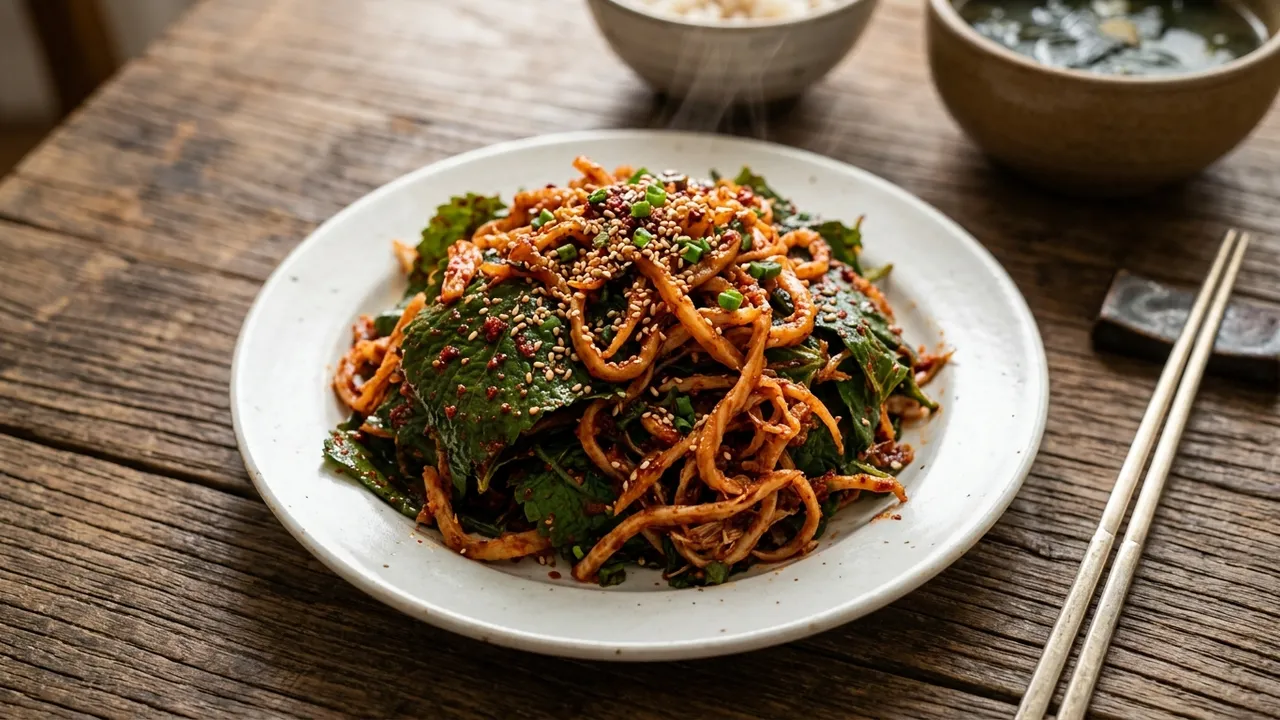
Seasoned Perilla Leaves (Yangnyeom Kkaennip-jjim)
This recipe is for Yangnyeom Kkaennip-jjim (양념 깻잎찜), a savory and addictive Korean side dish made by layering perilla leaves with a flavorful seasoning.
📝 Editor's Notes
Today, we introduce Yangnyeom Kkaennip-jjim (양념 깻잎찜), a seasoned perilla leaf side dish so irresistibly delicious that it's often called a 'rice thief.' The unique aroma of perilla leaves, the savory depth of fish sauce, and the nutty richness of perilla oil create a harmonious and unforgettable flavor. The cooking process is simple, making it accessible for even beginner cooks, and preparing it in advance provides a reliable and satisfying side dish for several days. While enjoyable year-round, it's particularly delicious when made during summer and autumn when perilla leaves are freshest and most abundant. It's truly a delight served over warm, freshly cooked rice.
🛒 Ingredient Tips
For this recipe, selecting the right perilla leaves (깻잎) is crucial. Look for ones with a vibrant green color, fresh stems, firm leaves, and a glossy sheen. Medium-sized leaves that are neither too large nor too tough will absorb the seasoning better and have a tender texture. Choose onions with thin, firm skins that aren't soft, and scallions with clean roots and vibrant green, un-wilted leaves. While store-bought flavored soy sauce (맛간장) works well, homemade versions can add even deeper flavor. For perilla oil (들기름), using fresh, domestically produced oil will allow you to fully experience its unique nutty aroma. Always remember that the freshness of ingredients dictates the final taste of your dish.
🔄 Substitution Guide
If perilla leaves (깻잎) are difficult to find or if you don't prefer their unique aroma, you can use young napa cabbage leaves or lettuce in a similar seasoned and layered style. However, the distinct fragrance and tender texture of perilla leaves are hard to replicate, so expect differences in taste and aroma. Instead of sand lance fish sauce (까나리액젓), anchovy fish sauce (멸치액젓) or tuna fish sauce (참치액젓) can be used. Anchovy fish sauce offers a deeper and richer umami flavor, while tuna fish sauce provides a cleaner taste with its own unique aroma. If perilla oil (들기름) is unavailable, you can substitute it with sesame oil (참기름). However, perilla oil is rich in omega-3 fatty acids and has a nuttier, more intense flavor, whereas sesame oil is lighter and has a stronger sesame aroma. Consider the characteristics of each substitute ingredient and adjust to your preference.
🥘 Ingredients
👨🍳 Cooking Points
The first key to a delicious Kkaennip-jjim is thorough washing of the perilla leaves. Since perilla leaves can have soil or impurities, it's important to wash them carefully, one by one, under running water. As the tip suggests, washing about ten leaves at a time can be efficient. After washing, shake off as much water as possible to prevent the seasoning from becoming watery and ensure it adheres properly. The second point is to thoroughly mix the perilla oil (들기름) and soy sauce first when making the seasoning. This allows the ingredients to blend better, creating a deeper flavor. Lastly, when spreading the seasoning on the perilla leaves, start with one leaf at a time, then layer two leaves at a time. This method ensures the seasoning is evenly distributed without making the dish too salty. By following these three points, you can make delicious Kkaennip-jjim without fail.
👨🍳 Directions
- 1
Wash 100g of perilla leaves thoroughly, one leaf at a time, under running water, then shake off excess water.
- 2
Trim off a small portion of the perilla leaf stems for a neater presentation.
- 3
Finely julienne 1/2 small onion and finely chop 5 stalks of scallions.
- 4
Prepare the seasoning sauce. In a bowl, combine 5 tbsp of flavored soy sauce (맛간장), 1 tbsp of sand lance fish sauce (까나리액젓), and 2 tbsp of perilla oil (들기름). Mix well until the soy sauce and perilla oil are thoroughly combined.
- 5
Add 1 tbsp of minced garlic, 2 tbsp of Korean chili powder (고춧가루), and 3 tbsp of partially ground sesame seeds to the sauce. Mix, then add the julienned onion and chopped scallions.
- 6
Add 1 more tbsp of Korean chili powder (고춧가루) (for a total of 3 tbsp). Mix all ingredients thoroughly to complete the seasoning sauce.
- 7
On a plate, place the perilla leaves one by one, spreading a small amount of seasoning on each.
- 8
Continue by layering two perilla leaves at a time, spreading seasoning on each layer.
- 9
Transfer the completed seasoned perilla leaves to an airtight container for storage.
💡 Tips
When washing perilla leaves, hold about ten leaves at a time and wash them one by one under running water for thorough cleaning.
Mixing perilla oil with soy sauce first in the seasoning helps the flavors blend better.
Using partially ground sesame seeds rather than whole sesame seeds enhances the flavor.
Storing the seasoned perilla leaves in an airtight container allows the flavors to meld, making them even more delicious over time.
📦 Storage & Reuse
Store the finished seasoned perilla leaves in an airtight container in the refrigerator. As the seasoning marinates the perilla leaves over time, the flavors deepen. Therefore, it tastes even better after ripening for about a day rather than consuming it immediately. It can be stored fresh in the refrigerator for about 3-5 days. Generally, seasoned perilla leaves are served cold and don't require reheating, but you can gently warm them in the microwave if you prefer. Leftover seasoned perilla leaves can be finely chopped and mixed with rice, seasoned seaweed flakes (김가루), and sesame oil (참기름), or added to steamed egg (계란찜) or soybean paste stew (된장찌개) for another delicious use.
🥢 Who This Is For
This seasoned perilla leaf dish (Yangnyeom Kkaennip-jjim) is a versatile and excellent side dish that complements any meal. It pairs especially well with warm white rice, where the aroma of perilla and the savory seasoning will make a bowl of rice disappear in no time. It's also a great option for a quick breakfast or lunchbox, and it pairs wonderfully with main dishes like grilled meat or fish. If you enjoy a spicier kick, try adding some finely chopped cheongyang chili peppers (청양고추). For children, you can reduce or omit the Korean chili powder (고춧가루) and make a soy sauce-based version. We highly recommend this healthy and delicious side dish for the whole family to enjoy.
🔥 Nutrition Info
Based on the provided ingredient quantities, this seasoned perilla leaf dish is expected to yield approximately 4-5 servings. For a single serving (approximately 20g of perilla leaves with seasoning), the estimated calorie count is around 130-150 kcal. It is estimated to contain about 10-15g of carbohydrates, 3-5g of protein, and 8-10g of fat. Perilla leaves (깻잎) are rich in vitamins A, C, and K, and contain various minerals like calcium and iron, contributing to immune system enhancement and bone health. The omega-3 fatty acids abundant in perilla oil (들기름) are also beneficial for improving blood circulation. However, due to the flavored soy sauce (맛간장) and fish sauce, the sodium content may be somewhat high, so those monitoring sodium intake should pay attention to adjusting the seasoning. It's an excellent side dish packed with healthy nutrients.
💬 Comments
No comments yet. Be the first to comment!