
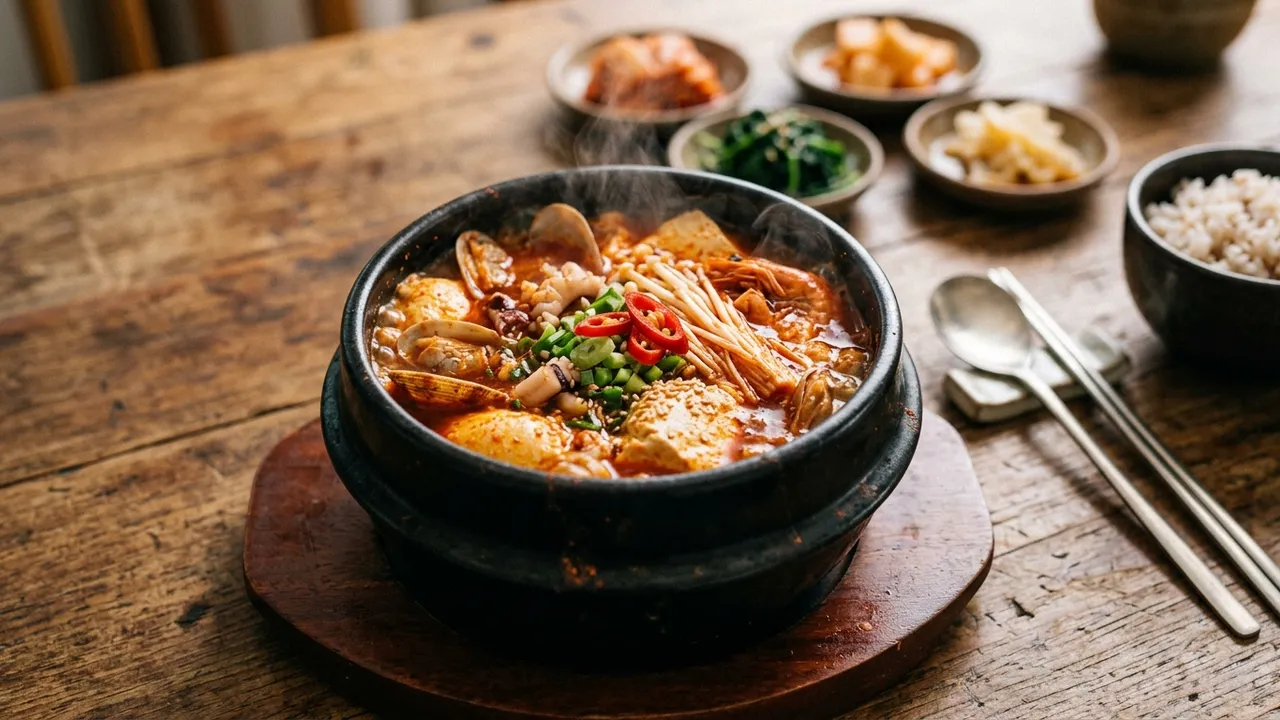
Spicy and Savory Nakji Sundubu Jjigae (Spicy Soft Tofu Stew with Octopus)
This recipe is for a spicy, hearty, and umami-rich Nakji Sundubu Jjigae (spicy soft tofu stew with octopus).
📝 Editor's Notes
Hello everyone! Today's Nakji Sundubu Jjigae (spicy soft tofu stew with octopus) is a home-style dish with an excellent spicy, hearty, and deeply savory flavor. Fresh Nakji (낙지) (small octopus) and soft Sundubu (순두부) come together to provide a satisfying meal, and you can enjoy an even richer taste with homemade chili oil seasoning. If you love spicy food, you will surely be satisfied. It's highly recommended as a warm meal on a cold day or for enjoying with family on a special occasion. The difficulty level is intermediate, but if you remember a few key points, you can achieve a taste comparable to a professional restaurant right at home.
🛒 Ingredient Tips
The key ingredients that determine the taste of this Nakji Sundubu Jjigae are Sundubu (순두부) and Nakji (낙지). Prepare the Sundubu at room temperature so it cooks smoothly without breaking. Remember to cut open the wider side of the package to carefully remove it. For Nakji (낙지), it's important to choose fresh ones; look for a glossy body and active suction cups on the legs. When cleaning, vigorously rub it with coarse salt or flour to remove impurities, then rinse thoroughly. This process is the secret to eliminating any fishy odor and enhancing its chewy texture. For the Gochugaru (고춧가루), using a mix of fine and coarse chili powder is even better for both color and spiciness.
🔄 Substitution Guide
If Nakji (낙지) is difficult to find or if you have a seafood allergy, you can substitute with squid, shrimp, or clams. Squid offers a chewier texture than Nakji, shrimp adds a sweet umami flavor, and clams create a refreshing broth. While each ingredient will subtly change the overall taste and texture of the stew, they all pair well with Sundubu (순두부). Instead of Vietnamese chili peppers, you can use Cheongyang chili peppers (청양고추) for a similar level of spiciness with a distinct Korean kick. If you don't have tuna sauce, you can substitute with anchovy sauce or sand lance fish sauce, but be aware that different types of fish sauce may have a stronger characteristic aroma, so adjust the amount accordingly. Alternatively, you can simply increase the amount of Guk-ganjang (국간장) and season with salt.
🥘 Ingredients
👨🍳 Cooking Points
Here are the three most important cooking points for delicious Nakji Sundubu Jjigae. First, the process of making chili oil. Sauté green onions, garlic, and Vietnamese chili peppers in cooking oil over medium-low heat until golden brown to sufficiently develop their aroma. When adding Gochugaru (고춧가루), reduce the heat to the lowest setting or turn it off momentarily and stir-fry briefly to prevent burning, which helps create a deep color and flavor for the chili oil. Second, Nakji (낙지) can become tough if cooked for too long, so it's crucial to add it at the very end of the cooking process and simmer only briefly. Lastly, since Sundubu (순두부) itself has very little flavor, seasoning the stew a bit stronger will make it taste better. Adjust the seasoning with tuna sauce, Guk-ganjang (국간장), and salt, and add more if you feel it's insufficient. By following these three tips, you can make delicious Sundubu Jjigae without failure.
👨🍳 Directions
- 1
Cut open the wider side of the 2 packages of Sundubu (순두부) (soft tofu) and gently remove the tofu to prevent it from breaking apart. Set aside.
- 2
Finely chop the white parts of 2 green onions, reserving the green parts for garnish upon completion.
- 3
Make an incision near the head of the 2 Nakji (낙지) (small octopuses) to remove the internal organs, and cut out the mouth located between the legs.
- 4
Rub the cleaned Nakji (낙지) vigorously with a handful of coarse salt (or flour) to remove impurities, then rinse thoroughly and set aside.
- 5
In a pan, heat 4 tbsp of cooking oil. Add the chopped white parts of green onion, 2 tbsp of minced garlic, and 10 Vietnamese chili peppers. Sauté over medium-low heat until the garlic and green onions turn golden brown and fragrant.
- 6
Reduce the heat to the lowest setting, add 4 tbsp of Gochugaru (고춧가루) (Korean chili powder), and stir-fry briefly to create the seasoning paste, being careful not to burn it. Turn off the heat and transfer the paste to a separate bowl.
- 7
In the same pan, pour 500 ml of water. Add an appropriate amount of zucchini, an appropriate amount of onion, 2 pieces of dried kelp, and a handful of dried shrimp. Bring to a boil.
- 8
Once the broth boils, remove the dried kelp. Add the 2 packages of prepared Sundubu (순두부) (soft tofu).
- 9
Add the prepared Gochugaru (고춧가루) seasoning paste, adjusting the amount to your preferred level of spiciness. Stir to combine, allowing the chili oil to rise to the surface.
- 10
Break the Sundubu (순두부) (soft tofu) into large chunks with a spoon.
- 11
Add 0.5 tbsp of tuna sauce, 1 tbsp of Guk-ganjang (국간장) (Korean soup soy sauce), a dash of black pepper (or to taste), and 0.5 tbsp of salt. Adjust the seasoning to your liking.
- 12
Add the 2 cleaned Nakji (낙지) (small octopuses) and cook briefly.
- 13
Crack 2 eggs into the stew and top with the reserved green parts of the green onions. Simmer briefly until the eggs are cooked to your preference.
💡 Tips
When opening the Sundubu (순두부) (soft tofu) package, it's best to cut the wider side to gently remove the tofu without breaking it.
When making chili oil, it's important to sauté the garlic and green onions over medium-low heat until golden brown to properly develop their fragrance. When adding Gochugaru (고춧가루) (Korean chili powder), use the lowest heat setting and stir-fry briefly to prevent burning.
Nakji (낙지) (small octopus) or squid can become tough if overcooked, so add them at the very end of the cooking process and simmer only briefly.
Sundubu Jjigae tastes better when seasoned slightly stronger. Since soft tofu itself has very little flavor, the stew might seem bland as it cooks.
If you don't have meat, adding 0.5 tbsp of beef dashida (beef seasoning powder) can create a rich, meaty flavor.
📦 Storage & Reuse
The finished Nakji Sundubu Jjigae can be deliciously enjoyed for about 2-3 days when refrigerated. However, freezing Sundubu (순두부) is not recommended as its texture can become crumbly upon thawing. When reheating leftover stew, warm it slowly over low heat, and if the broth has reduced too much, add a little more water or broth. For leftover ingredients, chopped green onions can be frozen for future use. Any remaining cleaned Nakji (낙지) can be portioned and frozen, which will be useful for future seafood dishes. If you have a small amount of Sundubu (순두부) left, don't throw it away! You can add it to Doenjang Jjigae (된장찌개) (Korean soybean paste stew) or Kimchi Jjigae (김치찌개) (kimchi stew).
🥢 Who This Is For
On a day when you crave a spicy and refreshing soup, Nakji Sundubu Jjigae will be the best choice. It's especially great for stress relief or as a hangover cure after a night out. I highly recommend it for those who love spicy food or enjoy seafood. Served with freshly cooked warm white rice, you won't need any other side dishes. To complete a richer meal, you can also serve it with crunchy Kkakdugi (깍두기) (diced radish kimchi), well-fermented Baechu Kimchi (배추김치) (napa cabbage kimchi), or plain egg rolls.
🔥 Nutrition Info
For this Nakji Sundubu Jjigae, based on 2 servings, one serving is estimated to be approximately 380-450 kcal. It typically contains about 25-30g protein, 20-25g fat, and 15-20g carbohydrates. Sundubu (순두부), Nakji (낙지), and eggs are the main protein sources. Particularly, Nakji is rich in taurine, essential amino acids, and iron, all beneficial for combating fatigue and restoring vitality. Sundubu provides easily digestible plant-based protein and calcium, while eggs supplement with high-quality protein and various vitamins and minerals. Vegetables like zucchini, onion, and green onions add dietary fiber and vitamins, making this a well-balanced and healthy meal. Although chili oil is used, leading to a slightly higher fat content, the nutritional value from the ingredients is excellent.
💬 Comments
No comments yet. Be the first to comment!