
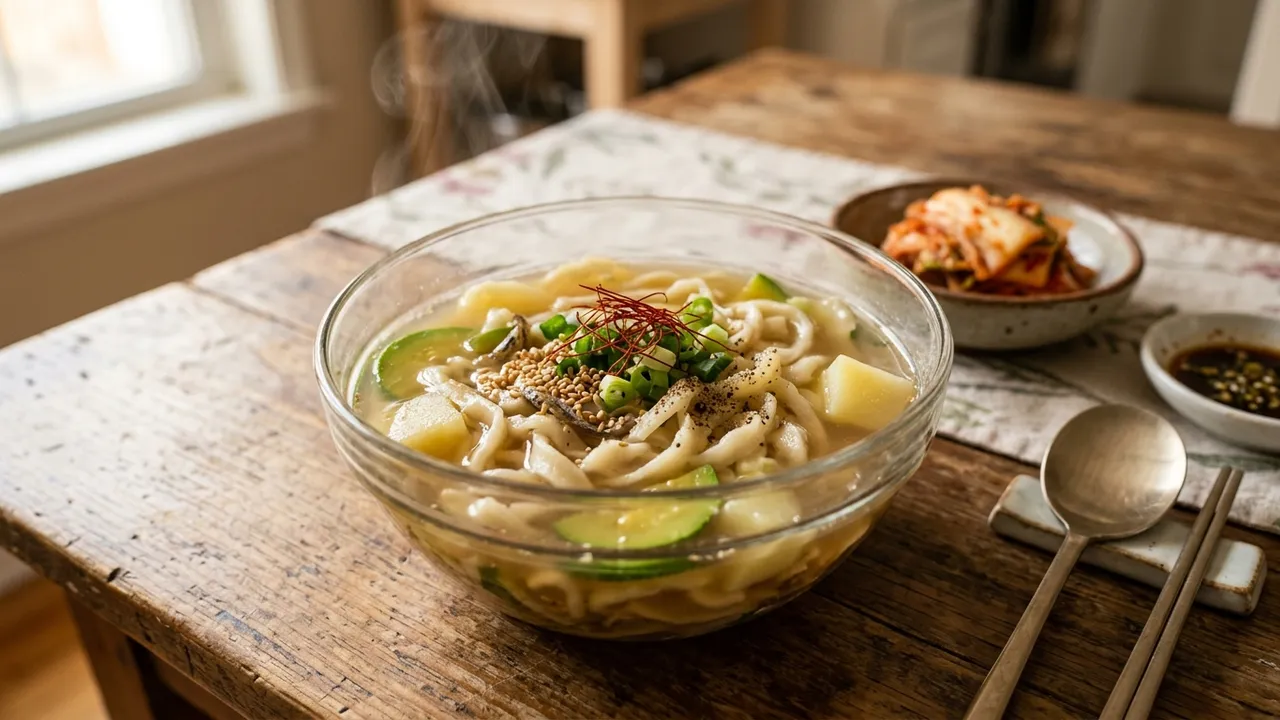
Spicy Hangover Kalguksu Noodle Soup
A spicy hangover kalguksu (칼국수) recipe featuring a deep and refreshing broth achieved by rehydrating dried vegetable flakes in cold water, browning Korean zucchini (애호박) for the Maillard reaction, and the fragrant flavor of garlic.
📝 Editor's Notes
This Spicy Hangover Kalguksu Noodle Soup, true to its name, is a special recipe designed to soothe your tired stomach with its cool and refreshing taste. The secret to its deep umami lies in soaking the dried flakes in cold water and stir-frying the Korean zucchini (애호박) over high heat until golden brown to achieve the Maillard reaction. The addition of spicy garlic and gochugaru (고춧가루) creates a complex yet harmonious flavor. While the difficulty level is moderate, following a few key cooking techniques will allow you to achieve a deep, professional-level taste at home. It's perfect as a warm and hearty meal, especially on cold days or when your stomach feels uneasy after a night of drinking. It's also great for a mood boost!
🛒 Ingredient Tips
For this recipe's key ingredient, ensure you fully soak the anchovy kalguksu dried flakes in cold water. This allows the anchovy's umami to infuse more deeply into the broth, creating a richer flavor. When choosing Korean zucchini (애호박), look for one that is firm, smooth, and glossy. A medium size is preferable to one that is too large or too small, and using fresh zucchini will bring out its unique sweetness and savory aroma when stir-fried. For garlic, it's best to grate whole cloves directly into the pot for a stronger and richer fragrance. Remember that freshly grated garlic yields a much deeper flavor than pre-minced garlic.
🔄 Substitution Guide
If anchovy kalguksu dried flakes are difficult to find, or if you prefer other types of noodles, you can use regular kalguksu noodles or fresh noodles and make a separate broth. To do this, simmer 10g of dried anchovies and one 5x5 cm piece of kelp (다시마) in 850 ml of water to create a broth. This will yield a cleaner taste, though it may lack the varied vegetable texture of the dried flakes. If you wish to substitute Korean zucchini (애호박), try slicing king oyster mushrooms or onions lengthwise and stir-frying them until golden brown. While they won't offer the same sweetness as zucchini, they can contribute a similar Maillard flavor to enhance the broth's depth. If you don't have the outer layer of green onion from the root part, a small piece of ginger (1-2 cm) or one to two tablespoons of mirin (미림) or rice wine (청주) can be used to remove the seafood's fishy smell.
🥘 Ingredients
👨🍳 Cooking Points
There are three crucial cooking points. First, thoroughly rehydrate the dried flakes in cold water for 5 to 20 minutes. This ensures that the umami from the anchovies and other ingredients is properly infused into the broth, creating a deep and flavorful soup base. Second, the key is to stir-fry the Korean zucchini (애호박) over high heat until golden brown, achieving the Maillard reaction. To develop a meaty flavor, cook the zucchini quickly over high heat until its surface turns golden, without letting it become mushy. Third, for the gochugaru (고춧가루) seasoning, first stir-fry the black pepper over low heat until fragrant, then add the gochugaru (고춧가루) and immediately remove from the heat to prevent burning and preserve its color and aroma. Adding this seasoning at the very end allows you to fully enjoy the fresh aroma of the gochugaru (고춧가루).
👨🍳 Directions
- 1
In a pot, combine 1 packet of anchovy kalguksu dried flakes and 850 ml of cold water. Let it soak for 5 to 20 minutes.
- 2
Finely grate 4 cloves of garlic and add to the pot from step (1).
- 3
Heat a pan over very low heat. Grind a suitable amount of black pepper into the pan and stir-fry until the moisture evaporates and the aroma develops.
- 4
Add 4 tsp of gochugaru (고춧가루) to the pan from step (3) and immediately remove from heat. When the gochugaru (고춧가루) turns a deep red color, transfer it from the pan and set aside.
- 5
In the same pan, add a generous amount of cooking oil. Add 1 Korean zucchini (애호박), thinly sliced lengthwise, then season with salt and black pepper to taste.
- 6
Stir-fry the Korean zucchini (애호박) over high heat until golden brown, allowing the Maillard reaction to occur for a meaty flavor.
- 7
Place the pot from step (1) over medium heat and bring to a boil. Once the broth boils, add 1 outer layer of green onion (from the root part) to remove any fishy anchovy smell.
- 8
Add 1 block of kalguksu noodles to the pot and boil for 4 minutes, separating the noodles.
- 9
Once the green onion outer layer becomes translucent, remove it. Add the stir-fried Korean zucchini (애호박) and mix well to blend its flavors into the broth.
- 10
Add the prepared gochugaru (고춧가루) seasoning from step (4) and simmer for another 4 minutes, allowing enough starch to release from the noodles.
- 11
Taste the broth, then gradually add hot water to adjust the seasoning to your preference.
- 12
Serve the hot spicy hangover kalguksu noodle soup with rice or enjoy as desired.
💡 Tips
Soaking the dried flakes in cold water beforehand, then boiling, can create a deeper and richer broth.
Seasoning the Korean zucchini (애호박) with salt and pepper and stir-frying it over high heat until golden brown will create a meaty flavor through the Maillard reaction.
If you're concerned about the fishy smell unique to seafood, adding the outer layer of green onion (from the root part) to the boiling broth can effectively remove unwanted odors.
It's best to add the gochugaru (고춧가루) seasoning at the end to maximize its aroma and flavor.
Adding hot water to adjust the broth's seasoning to your preference can lead to a more satisfying taste.
📦 Storage & Reuse
This Spicy Hangover Kalguksu Noodle Soup is best enjoyed immediately after cooking, as the noodles can become soggy. If you have leftovers, it's recommended to separate the broth and noodles, storing them in airtight containers in the refrigerator. They can be stored for about 1-2 days this way. When reheating, it's best to warm the broth separately and add freshly cooked noodles, or just briefly warm the leftover noodles. The broth itself can be frozen, but freezing the noodles is not recommended as their texture will change significantly. Any leftover Korean zucchini (애호박) can be used in other stir-fries or pan-fried dishes, and minced garlic can be portioned and frozen for long-term fresh use.
🥢 Who This Is For
Thanks to its cool and spicy flavor, this Spicy Hangover Kalguksu Noodle Soup will be the perfect hangover remedy for anyone feeling uneasy after a night of drinking. It's hearty yet refreshing, providing comfort to your stomach. It's also excellent for enjoying alone when you crave a warm soup on a chilly day or a spicy dish due to stress. It pairs wonderfully with rice, and you can enhance the flavor even more by serving it with crispy kkakdugi (깍두기) or well-fermented kimchi (김치). A refreshing dongchimi (동치미) also makes an excellent accompaniment.
🔥 Nutrition Info
For a single serving, the estimated calorie count is approximately 650-750 kcal. Energy is primarily derived from the noodles, cooking oil, and dried flakes. Protein is estimated at about 20-25g, fat at 15-20g, and carbohydrates at 100-120g. Notably, Korean zucchini (애호박) is rich in vitamins C and K, and potassium, which can aid in boosting immunity and regulating blood pressure. Garlic, with its allicin compound, offers antibacterial and potential anticancer effects. Gochugaru (고춧가루), abundant in capsaicin, helps stimulate metabolism. The anchovy flakes provide calcium and omega-3 fatty acids, positively impacting bone and cardiovascular health. It's a hearty yet nutritionally balanced meal.
💬 Comments
No comments yet. Be the first to comment!