
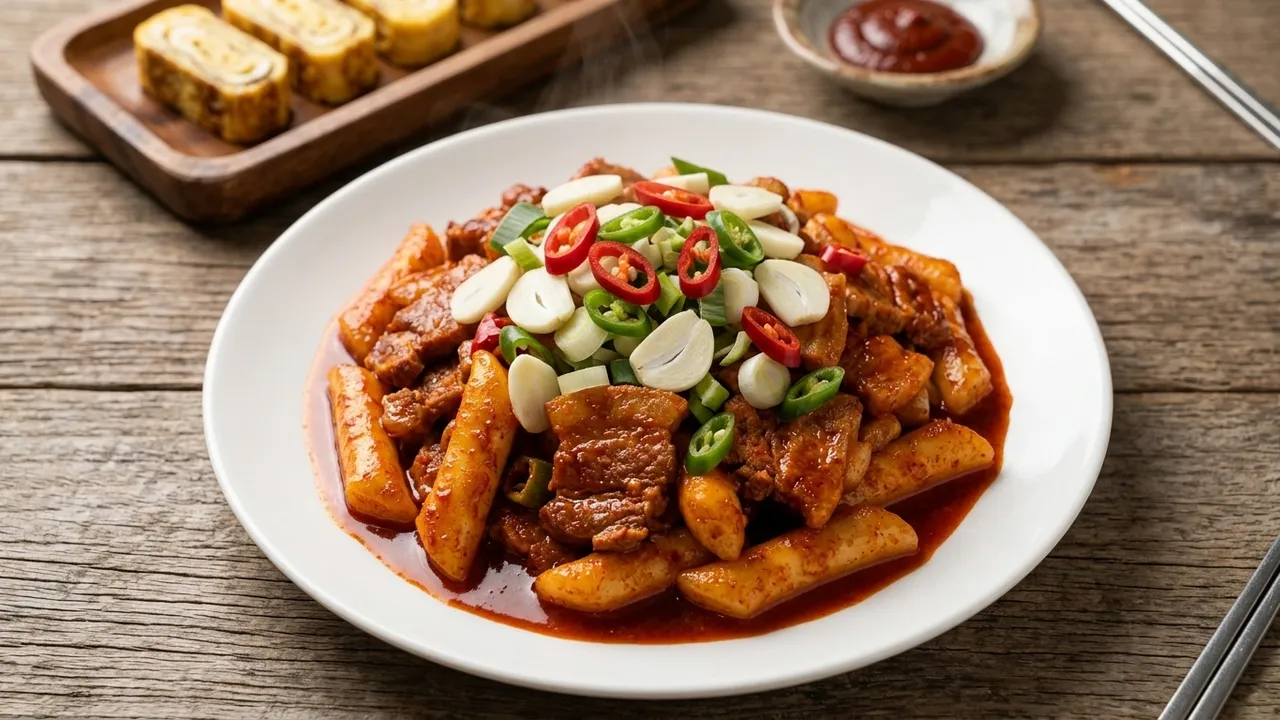
Spicy Pork Duruchigi
A pork dish stir-fried in a spicy sauce.
📝 Editor's Notes
This spicy pork duruchigi (두루치기) is a Korean soul food that perfectly harmonizes spicy seasoning with tender pork.
By boiling the pork belly (samgyeopsal) in a pressure cooker, the meat becomes exceptionally tender and juicy, making it delicious for everyone.
The spicy sauce, flavored with gochujang (고추장) and gochugaru (고춧가루), is a true "rice thief." This dish is highly recommended, especially when you crave warm and spicy food on a cold day, or when you want a hearty meal while sharing drinks with family or friends.
The difficulty level is intermediate; you can successfully make delicious duruchigi (두루치기) if you prepare the seasoning sauce well.
🛒 Ingredient Tips
For this duruchigi (두루치기), fresh pork belly (samgyeopsal) is key.
Choose meat that is bright pink with firm, white fat.
Rather than thinly sliced pork belly, a thick slab with a good balance of lean meat and fat will retain its juices better when boiled in a pressure cooker, resulting in a more tender and juicy texture.
Select firm onions with glossy skins.
For the spicy kick, ensure cheongyang chili peppers (cheongyang-gochu) are fresh with intact stems, and for color, choose fresh red chili peppers (hong-gochu).
Using fresh garlic (maneul) and green onions (daepa) with firm roots will further enhance the dish's flavor.
🔄 Substitution Guide
You can use pork shoulder (moksal) or pork front leg (apdarissal) instead of pork belly (samgyeopsal).
Pork shoulder has less fat than pork belly, offering a leaner taste, while pork front leg is affordable and has a good balance of lean meat and fat, making it excellent for duruchigi (두루치기).
However, when using pork shoulder or front leg, they might become drier than pork belly, so reduce the pressure cooking time slightly or add a little more pear juice or sugar to the sauce for tenderness.
If you dislike spicy food or are cooking for children, you can use shishito peppers (kkwarigochu) instead of cheongyang chili peppers (cheongyang-gochu), or reduce the amounts of gochujang (고추장) and gochugaru (고춧가루) and adjust the seasoning with a soy sauce base for a milder flavor.
If you don't have oyster sauce (gulsoseu), adding 1 teaspoon of doenjang (된장) can enhance the umami flavor.
🥘 Ingredients
👨🍳 Cooking Points
The first key to this recipe is boiling the pork in a pressure cooker.
Place the pork, onion, salt, and water into the pressure cooker, and once the weight valve begins to jiggle, reduce the heat to medium and simmer for about 10 minutes.
This ensures the meat becomes tender and juicy.
The second key is the seasoning sauce, which contains various ingredients like gochujang (고추장), gochugaru (고춧가루), fish sauce (aekjeot), soy sauce (ganjang), mirin (mirim), and oyster sauce (gulsoseu).
It's crucial to balance their ratios to create a deep flavor.
Don't forget to add plenty of minced vegetables for extra aroma.
Finally, when stir-frying with the sauce, it's important to cook over medium heat, stirring sufficiently until the sauce is well absorbed into the meat.
Be careful not to use too high heat, as this can burn the sauce or toughen the meat.
👨🍳 Directions
Take one slab of pork belly out of its packaging and cut it into suitable-sized pieces.
Julienne 1/2 medium onion.
Place the sliced pork belly, onion, a pinch of salt, and a suitable amount of water into a pressure cooker. Close the lid and bring to a boil over a gas stove, then begin to simmer.
Finely mince 4 cheongyang chili peppers (cheongyang-gochu), 3 red chili peppers (hong-gochu), 2 green onion stalks (daepa), and 5-6 garlic cloves (maneul).
In a bowl, combine the minced cheongyang chili peppers, red chili peppers, green onions, and garlic. Add fish sauce (aekjeot), soy sauce (ganjang), mirin (mirim), oyster sauce (gulsoseu), gochujang (고추장), gochugaru (고춧가루), black pepper, and sesame oil (chamgireum), each in suitable amounts, to make the seasoning sauce.
Once the meat is fully cooked in the pressure cooker, open the lid, mix the pork and onion well, and slightly reduce the broth.
Add all of the prepared seasoning sauce to the reduced pork and stir-fry evenly.
Add 1 additional teaspoon of gochujang (고추장) to adjust the flavor and continue to stir-fry until the sauce is well absorbed.
Serve the finished duruchigi (두루치기) on a plate, garnished with the remaining minced green onions, garlic, and chili peppers.
💡 Tips
Boiling pork in a pressure cooker ensures it cooks more tenderly and juicily.
Preparing the seasoning sauce in advance while the meat is boiling can shorten cooking time.
Adjust the amounts of gochujang (고추장) and gochugaru (고춧가루) to suit your preferred level of spiciness.
Garnishing with minced garlic, green onions, and chili peppers at the end adds fresh aroma and a crisp texture.
📦 Storage & Reuse
The finished duruchigi (두루치기) can be stored in an airtight container in the refrigerator for 2-3 days.
If you wish to store it longer, divide it into single-serving portions and freeze.
It can be kept frozen for approximately 1 month.
To reheat frozen duruchigi (두루치기), thaw it in the microwave and then heat, or reheat it in a pan over low heat, adding 1-2 tablespoons of water to maintain its moisture.
Try making a delicious fried rice by adding rice, shredded seaweed, and sesame oil (chamgireum) to the leftover duruchigi (두루치기) sauce.
🥢 Who This Is For
This spicy pork duruchigi (두루치기) is a wonderful dish for the whole family to enjoy.
Those who love spicy food will surely be satisfied.
It's excellent with a glass of makgeolli (막걸리) on a rainy day or as a hearty main course for a weekend dinner.
It makes a fantastic side dish for rice as well as a great accompaniment to alcoholic beverages.
For side dishes, we recommend refreshing soybean sprout soup, steamed egg custard (gyeran-jjim), or crisp leafy greens for wraps.
These pairings complement the spicy duruchigi (두루치기) perfectly, creating a richer dining experience.
🔥 Nutrition Info
A single serving (approx.
7 oz or 200g) of this Spicy Pork Duruchigi (두루치기) is estimated to be around 450-550 calories.
It contains approximately 20-25g of protein and 35-45g of fat from the main ingredient, pork belly (samgyeopsal).
Carbohydrates from vegetables like onions and chili peppers, along with the seasoning, are estimated to be around 15-20g.
Pork is rich in B vitamins, which are good for fatigue recovery, and iron.
Chili peppers contain plenty of vitamin C, which helps boost immunity.
Garlic (maneul) and green onions (daepa) contain allicin, which can aid in antibacterial action and improve blood circulation.
However, the sodium content can be high, so be mindful of seasoning adjustments, and it's best to eat with vegetables for a balanced meal.
💬 Comments
No comments yet. Be the first to comment!