
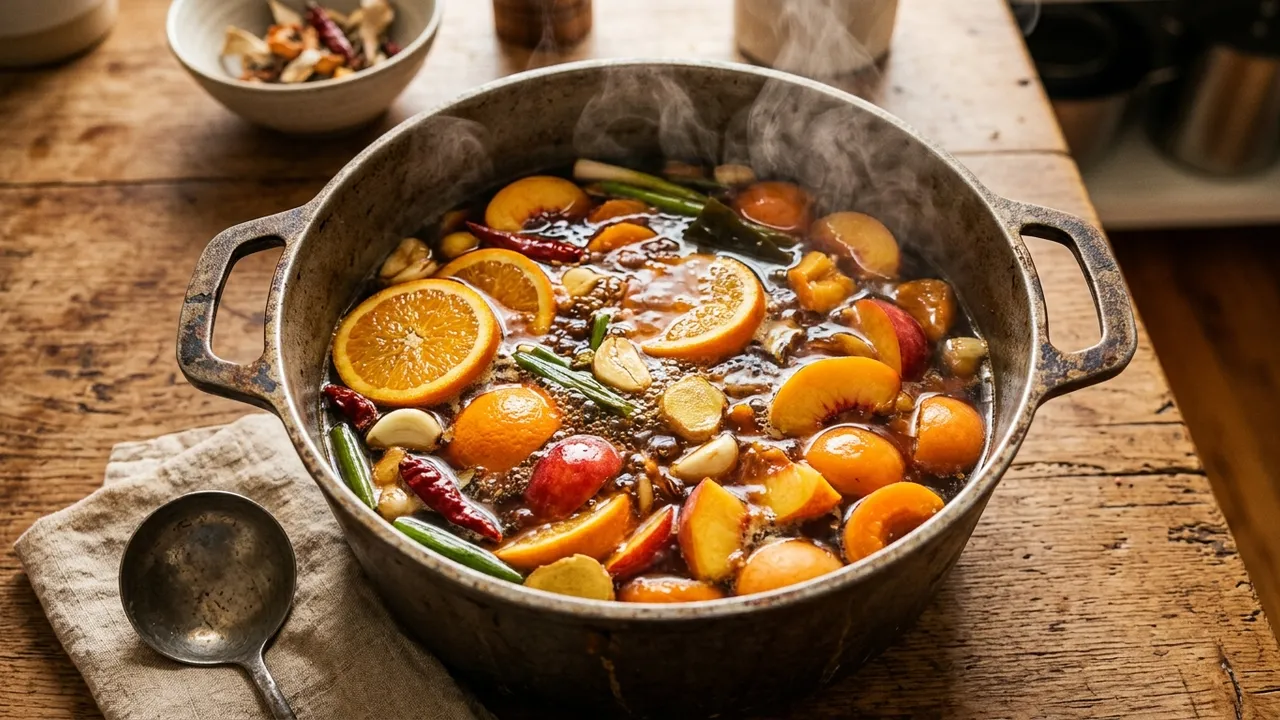
Auntie Tokkaengi's All-Purpose Seasoned Soy Sauce
This is Auntie Tokkaengi's all-purpose seasoned soy sauce recipe, which adds a deep flavor to various braised and stir-fried dishes. It boasts a clean taste without any off-flavors, as the fruit flavors are infused and the alcohol content is cooked off.
📝 Editor's Notes
Auntie Tokkaengi's All-Purpose Seasoned Soy Sauce is a secret recipe that adds deep flavor and umami to various Korean dishes.
Made with a base of soy sauce and sugar, enhanced with fresh apples, lemons, and various vegetable broths, it boasts a subtle fruit aroma and a clean finish.
The alcohol content and any off-flavors are cooked off, resulting in a deeper, more sophisticated taste.
This versatile sauce is perfect for braised, stir-fried, and steamed dishes, empowering cooks of all levels.
It will elevate the quality of your home-cooked meals throughout the year.
🛒 Ingredient Tips
Choosing good ingredients is crucial for a delicious seasoned soy sauce.
We recommend using naturally brewed soy sauce (yangjo ganjang, 양조간장) or dark soy sauce (jin ganjang, 진간장) for a deep, rich flavor.
Choose a trustworthy brand that you usually enjoy.
Select firm, fresh apples and lemons without blemishes.
For lemons, be sure to thoroughly remove the stem ends and seeds to prevent bitterness.
Fresh, firm onions and carrots for the vegetable broth will suffice.
You can use carrots with their skins on, just make sure to wash them thoroughly.
🔄 Substitution Guide
You can substitute core ingredients in this recipe depending on your situation.
First, besides organic raw sugar, you can use Korean malt syrup (jocheong, 조청) or oligosaccharide.
Jocheong adds a unique deep sweetness and color, while oligosaccharide provides a cleaner sweetness but may alter the viscosity.
As mentioned in the tips, brown sugar should be avoided as its strong color and aroma can detract from the authentic taste of the seasoned soy sauce.
If you use pears or pineapples instead of apples and lemons, the sweetness and aroma will differ, but you can enjoy new flavors.
Making it without fruit will result in a cleaner taste but with less depth of flavor.
Soju (소주) and Mirim (미림) can be substituted with Korean rice wine (cheongju, 청주) or other types of cooking wine; their role is to cook off the alcohol and remove off-flavors.
If using other cooking wines instead of Mirim, consider their sugar content and adjust the amount of sugar accordingly.
🥘 Ingredients
👨🍳 Cooking Points
Remember these three key points when making the all-purpose seasoned soy sauce!
First, it's important to reduce the vegetable broth precisely to 200ml.
Boil on high heat for 5 minutes, then reduce to medium-low and simmer for 20-25 minutes until it reaches the right consistency.
Second, when dissolving sugar in soy sauce, stir with a thin spatula to prevent it from sticking to the bottom.
Third, for safety, always turn off the heat when adding Soju (소주) and Mirim (미림).
When you turn the heat back on to cook off the alcohol for 5-6 minutes, avoid stirring the soy sauce to prevent it from boiling over.
Lastly, allowing it to mature for 24 hours to fully infuse the fruit flavors is a vital step that determines the taste of the seasoned soy sauce.
👨🍳 Directions
Prepare the ingredients for the vegetable broth: 20g ginger, 30g garlic, 1 onion, 50g carrot, 1 tbsp whole black peppercorns, 100ml Soju (소주), and 400ml water. Slice the onion and carrot as thinly as possible and place them in a pot. You can use the carrot with its skin on. Use whole black peppercorns, not ground pepper. Pour the mixed Soju (소주) and water over the vegetable ingredients. Bring to a boil over high heat for 5 minutes, then reduce to medium-low heat and simmer for another 20-25 minutes to make 200ml of vegetable broth.
Place 2 liters of soy sauce and 1 lb 12 oz (800g) of sugar in a large pot. Stir with a thin spatula until the sugar is completely dissolved, ensuring it doesn't stick to the bottom of the pot.
Wash 1 apple and 1 lemon thoroughly using baking powder or similar. Remove the seeds from the apple and slice it thinly. For the lemon, discard the stem ends and remove the seeds, then slice it slightly thicker than the apple.
Add the prepared 200ml vegetable broth to the soy sauce with dissolved sugar and bring it to a boil with the lid open. Once the soy sauce boils, turn off the heat and add 200ml Soju (소주) and 300ml Mirim (미림). (Always turn off the heat when adding additional ingredients to boiling soy sauce for safety.) Turn the heat back on and simmer for 5-6 minutes to cook off the alcohol. Do not stir the soy sauce during this time to prevent it from boiling over. Once the alcohol smell dissipates, carefully add the sliced apple and lemon. Wait until the soy sauce with the apple and lemon comes to a boil once, then turn off the heat.
With the heat off, cover the pot and let it sit for a full 24 hours to allow the fruit flavors to infuse into the soy sauce. After maturation, strain out all the solids from the soy sauce.
Divide the strained seasoned soy sauce into smaller portions and store them in the refrigerator.
💡 Tips
Any type of sugar except brown sugar can be used. For a healthier option, you can substitute organic raw sugar for the same 1 lb 12 oz (800g) amount.
When simmering the vegetable broth, boiling on high heat for 5 minutes then reducing to medium-low heat for 20-25 minutes will reduce it precisely to 200ml. (However, cooking times may vary depending on stove power, so check the broth volume at the 20-minute mark and adjust accordingly.)
Always boil the seasoned soy sauce with the lid open to prevent it from boiling over. For safety, be sure to turn off the heat when adding Soju (소주) and Mirim (미림).
To avoid bitterness from the lemon, make sure to remove both the stem ends and seeds.
For the best flavor, follow this recipe precisely without alterations to the specified amounts. The finished seasoned soy sauce must be refrigerated to prevent expansion (which could cause the lid to pop off) and can be stored for up to 1 year.
📦 Storage & Reuse
You can store your carefully made all-purpose seasoned soy sauce for a long time by placing it in an airtight container and refrigerating it.
Because it undergoes boiling and maturation processes, it has good preservation properties.
It can typically be stored fresh for over 3 months.
Occasionally, a white film may form on top, but this is a natural phenomenon of soy sauce and is safe to consume.
When using, scoop it out with a clean ladle or spoon, and there's no need to reheat the seasoned soy sauce itself.
While the fruit solids strained after maturation are difficult to reuse, having this seasoned soy sauce on hand will be very convenient for adding deep flavor to various dishes!
🥢 Who This Is For
We highly recommend this all-purpose seasoned soy sauce to anyone who enjoys Korean food or wants to add deep flavor to their cooking!
It will be an invaluable helper, especially for busy homemakers seeking healthy and delicious homemade meals.
It's excellent for dishes like bulgogi, galbi-jjim (braised short ribs), japchae (stir-fried glass noodles), jangjorim (braised beef in soy sauce), braised fish, and even simple stir-fries or fried rice.
Experience the magic of how one seasoned soy sauce can transform the quality of your cooking!
🔥 Nutrition Info
This all-purpose seasoned soy sauce is a large-batch recipe yielding about 3 liters.
Per 100ml, it contains approximately 150-180 calories.
The primary nutrients are carbohydrates (about 35-45g), mostly sugars, from the sugar, Mirim, and fruits.
Protein derived from soy sauce is approximately 4-6g, and fat content is minimal or negligible.
The most notable nutrient is sodium; as soy sauce is the main ingredient, it has a very high sodium content, exceeding 3000-4000mg per 100ml.
Small amounts of vitamin C and dietary fiber can be obtained from apples and lemons, though some may be lost during cooking.
Remember that seasoned soy sauce is a condiment to be used sparingly, and be mindful of your sodium and sugar intake.
💬 Comments
No comments yet. Be the first to comment!