
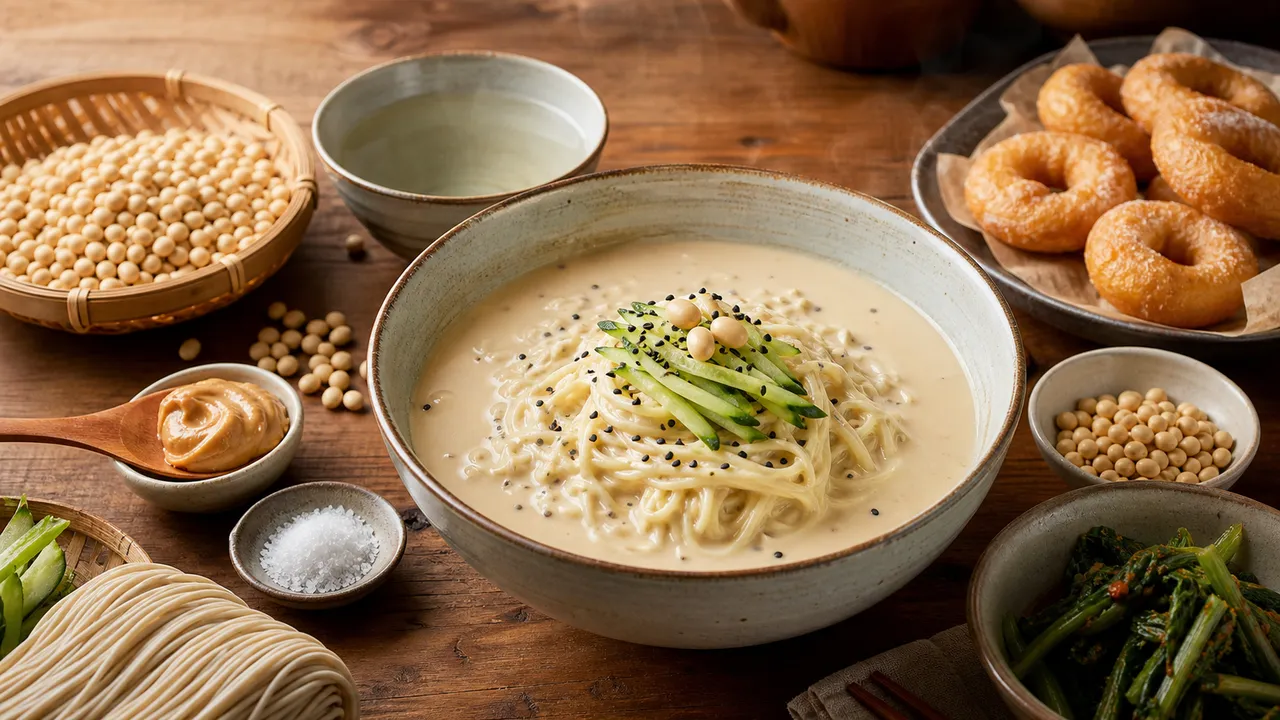
Homemade Savory and Refreshing Kongguksu (콩국수) and How to Use Leftover Soybean Milk with Glutinous Rice Donuts
📋 2 recipes — Select to view
📝 Editor's Notes
This recipe kindly guides you through making savory and refreshing homemade Kongguksu (콩국수).
The detailed instructions for soaking, boiling, peeling, and blending white soybeans make it easy for even beginners to follow.
A special charm of this recipe is using unsweetened peanut butter to enhance the rich, nutty flavor of the soybean milk.
It's a perfect specialty dish to enjoy coolly on a hot summer day, packed with nutrition, making it a satisfying and wholesome meal for the whole family.
Plus, you can even make glutinous rice donuts with the leftover soybean milk – truly a versatile recipe!
🛒 Ingredient Tips
For Kongguksu (콩국수), it's crucial to choose fresh, clean white soybeans (baektae/대두).
Look for beans that are uniform in size, shiny, and free from insect damage.
Korean-grown white soybeans are pricier than imported ones, but their unique savory flavor and aroma significantly enhance the taste of Kongguksu (콩국수).
When choosing peanut butter, always opt for unsweetened varieties to add richness without overpowering the natural taste of the soybeans.
Unsweetened peanut butter is widely available from various brands.
Besides buckwheat or corn noodles, you can freely choose other types like somyeon (소면) or kalguksu (칼국수) noodles according to your preference.
🔄 Substitution Guide
You can make black soybean Kongguksu (콩국수) by using black soybeans instead of white soybeans.
Black soybeans are richer in the antioxidant anthocyanin than white soybeans, making them healthier and offering a unique savory flavor.
However, black soybeans have thicker skins than white soybeans, so the peeling process might be a bit more tedious.
Instead of peanut butter, you can also use other nuts like cashews or almonds.
Using nuts will give the soybean milk a more exotic flavor.
However, the level of richness and aroma varies by nut type, so it's recommended to start with a small amount and adjust to taste.
For those with nut allergies, ground sesame seeds or roasted sesame seeds can also provide a nutty flavor.
🥘 Ingredients
👨🍳 Cooking Points
There are two crucial points that determine the taste of Kongguksu (콩국수).
First, when boiling the soybeans, cook them thoroughly until they are completely tender.
This prevents a raw taste and maximizes their nutty flavor.
They should be soft, with no hard core, similar to simmered soybeans.
Boiling time varies depending on the soybeans' condition, but typically, they should be boiled for at least 10 minutes after the water comes to a boil.
Second, when making soybean milk, it's important to use as little water as possible to blend it into a thick consistency.
Only add a little water if the blender struggles.
This thick soybean milk prevents separation during storage, and you can adjust its consistency with water or milk when serving to suit your taste.
👨🍳 Directions
Place 300g of white soybeans (baektae/대두) in a bowl, add enough water to cover the beans, and soak for 1 to 3 hours.
Boil the soybeans until they are completely tender. If water runs low during boiling, add more generously, and stir in 2 pinches of salt. Cook until the beans are soft, with no hard core remaining, similar to the texture of simmered soybeans.
Rinse the boiled soybeans in cold water, then rub them with your hands to remove the thin skins. Repeat this process 2-3 times.
Place the peeled soybeans in a blender. Add just enough water to cover the beans and 1 to 1.5 tbsp of unsweetened peanut butter. Blend until the mixture is as thick as possible. Shake the blender as you go, adding a little more water if it doesn't blend smoothly.
Once the soybean milk is well-blended, taste it. If the peanut flavor is too strong, adjust the amount of peanut butter when blending the remaining soybeans.
Transfer the thick soybean milk to a storage container. Blend any remaining soybeans in the same manner. Since the soybean milk may have become lukewarm from blending, chill it completely in the refrigerator.
Boil your preferred noodles (e.g., buckwheat, corn), then rinse them in cold water and drain well. (It's a good idea to put the cooked noodles in the refrigerator while you adjust the consistency of the soybean milk).
Place the cooked noodles in a bowl, pour the chilled soybean milk over them, and add ice as desired.
Garnish with black sesame seeds as desired, according to personal preference.
💡 Tips
When boiling soybeans, cook them until completely tender to prevent a raw or 'beany' smell.
When making soybean milk, use as little water as possible to blend it into a thick consistency. You can then adjust the thickness with water when serving to prevent separation.
The soybean milk may become lukewarm due to the blender's heat, so for the best taste, chill it thoroughly in the refrigerator before serving, rather than eating it immediately.
📦 Storage & Reuse
Finished soybean milk can be stored in an airtight container in the refrigerator for 2-3 days.
Soybean milk may separate over time, so shake it well before serving.
For longer storage, freezing in portions is a good option.
It can be stored frozen for about 2 weeks, and it's best to consume it immediately after thawing.
Leftover soybean milk is a versatile ingredient that can be used not only for glutinous rice donuts but also for soybean milk sujebi (수제비) (dough flakes) or soybean milk pasta, ensuring nothing goes to waste.
🥢 Who This Is For
This Kongguksu (콩국수) recipe is highly recommended for those looking for a cool and satisfying meal on a hot summer day.
It's a great dish for the whole family, from children who love savory flavors to the elderly.
Crisp Yeolmu Kimchi (열무김치) or Geotjeori (겉절이) (fresh kimchi) are excellent side dishes.
The nutty flavor of Kongguksu (콩국수) and the cool, spicy taste of kimchi create a fantastic harmony.
Serving it with mandu (만두) (dumplings) or jeon (전) (pancakes) will make your meal even more abundant.
🔥 Nutrition Info
This recipe uses 300g of white soybeans (baektae/대두) and 1 to 1.5 tbsp of peanut butter for 4-5 servings.
The estimated calories per serving are approximately 350-450 kcal.
Protein is estimated at about 20-25g, fat at 15-20g, and carbohydrates at 30-40g.
White soybeans are rich in plant-based protein, aiding muscle maintenance and growth, and high in dietary fiber, which is good for gut health.
Peanut butter is rich in unsaturated fatty acids, which can have a positive effect on cardiovascular health.
Additionally, soybeans contain various minerals such as B vitamins, iron, and calcium, contributing to overall nutritional balance.
💬 Comments
No comments yet. Be the first to comment!