
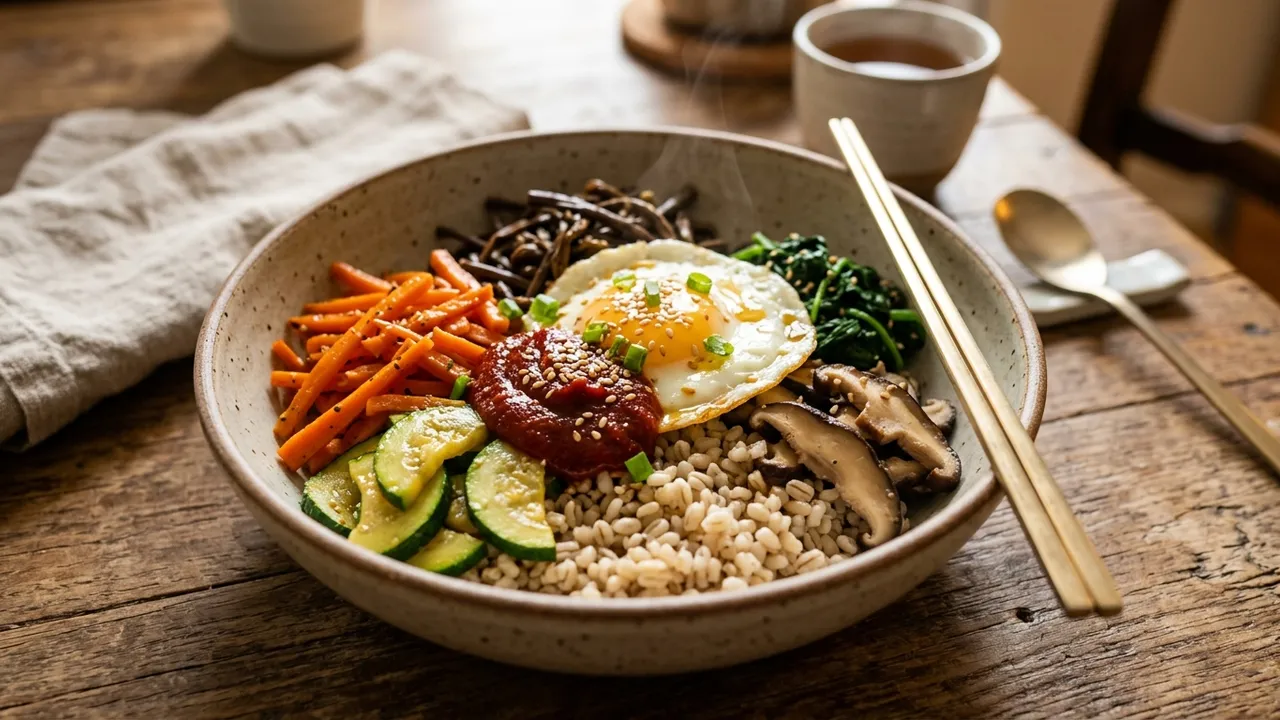
Barley Bibimbap
A healthy one-bowl meal featuring fragrant barley rice topped generously with various seasoned vegetables.
📝 Editor's Notes
This fragrant and hearty Barley Bibimbap is the essence of Korean home cooking, packed with health in a single bowl, thanks to its combination with various seasonal vegetables. The unique chewy texture of barley rice, the diverse flavors of different seasoned vegetables, fragrant sesame oil (chamgireum), and spicy Korean chili paste (gochujang) all come together to create a deep and rich flavor profile. While preparing multiple vegetable side dishes might seem like an intermediate cooking challenge, each individual step is not difficult. Enjoying it with fresh spring and summer seasonal vegetables will enhance its vibrant taste, making it a nutritionally complete meal. We highly recommend it as a warm and comforting Korean meal for the whole family.
🛒 Ingredient Tips
The key to this Barley Bibimbap lies in selecting fresh ingredients. For the barley, use 7 oz (200g) of hulled barley; choose plump, unbroken grains for a more fragrant and chewy texture when cooked. For the daikon radish, select one that is firm, unblemished, and feels heavy, which ensures a crisp texture for the mu saengchae. For perilla leaf sprouts (kkaetsun namul), aster greens (chwi namul), and other vegetables, choose ones with vibrant colors that aren't wilted. Seasonal vegetables are rich in nutrients and have a deeper aroma, which will elevate the flavor of your bibimbap. Remember, good ingredients are half the battle in cooking!
🔄 Substitution Guide
If certain ingredients are difficult to find or if you have allergies, there are several substitutions you can make. First, if hulled barley is unavailable or if you prefer a softer texture, you can cook your rice with a mix of pearl barley or brown rice. Pearl barley is softer than hulled barley, while brown rice offers a chewier texture. Next, instead of perilla leaf sprouts (kkaetsun namul) or aster greens (chwi namul), you can use spinach, bean sprouts (sukjunamul), or king oyster mushrooms. Spinach is tender and sweet, while bean sprouts add a crisp texture, enriching the bibimbap's flavor. Lastly, if tuna sauce (chamchiaek) or anchovy sauce (myeolchiaek) are hard to use, you can achieve an umami flavor by adding a little kombu broth to Korean soup soy sauce (guk ganjang) or salt. The depth of flavor might be slightly different, but you'll still enjoy a delicious and healthy bibimbap.
🥘 Ingredients
👨🍳 Cooking Points
There are a few key points for making delicious Barley Bibimbap. First, when cooking barley rice, thoroughly wash the hulled barley separately from regular rice, then soak it for at least 30 minutes. This softens the barley, greatly improving its texture and making it easier to digest. Be sure to follow the soaking time. Second, for mu saengchae, add Korean chili powder (gochutgaru) first and gently coat the radish with it before adding other seasonings. This ensures a beautiful and appetizing color for the mu saengchae. Lastly, when making stir-fried vegetables like fiddlehead ferns (gosari namul), add the perilla oil (deulgireum) at the very end after turning off the heat. This prevents the perilla oil's nutty aroma from evaporating, adding a deeper flavor. Keeping these three tips in mind will help you make delicious Barley Bibimbap every time.
👨🍳 Directions
- 1
Thoroughly wash 7 oz (200g) of hulled barley separately from regular rice. Soak it in water for about 30 minutes, then cook it in a rice cooker to make barley rice.
- 2
Julienne 10.5 oz (300g) of daikon radish. Add 1 tbsp of Korean chili powder (gochutgaru) and gently mix to coat the radish. After a light mix, add 1 tsp salt, 1/2 tbsp anchovy sauce (myeolchiaek), 1/2 tbsp minced garlic, 1/2 tbsp minced scallions, and 1/2 tbsp crushed toasted sesame seeds (kkaesogeum). Mix well to complete the seasoned daikon radish salad (mu saengchae).
- 3
Wash 7 oz (200g) of perilla leaf sprouts (kkaetsun namul) thoroughly. Blanch them briefly in boiling water with 1 tbsp coarse sea salt, then drain well. To the blanched perilla sprouts, add 1 tsp minced garlic, 1 tsp minced scallions, 1 tbsp Korean soup soy sauce (jip ganjang), 1 tbsp crushed toasted sesame seeds (kkaesogeum), and 1 tbsp perilla oil (deulgireum). Mix well to complete the seasoned perilla leaf sprouts.
- 4
Wash 7 oz (200g) of aster greens (chwi namul) thoroughly. Blanch them briefly in boiling water with 1 tbsp coarse sea salt, then drain well. To the blanched aster greens, add 1 tsp Korean soup soy sauce (jip ganjang), 1/2 tbsp tuna sauce (chamchiaek), 1 tsp minced garlic, 1 tsp minced scallions, 1 tbsp crushed toasted sesame seeds (kkaesogeum), and 1 tbsp sesame oil (chamgireum). Mix well to complete the seasoned aster greens.
- 5
Julienne 1/2 Korean zucchini (aehobak) and 1/2 carrot. Stir-fry them separately in a pan with cooking oil, adding a pinch of salt to each.
- 6
Julienne 3 shiitake mushrooms (pyogo beoseot). Stir-fry them in a pan with 1 tsp minced garlic and a pinch of salt.
- 7
To 7.7 oz (220g) of boiled fiddlehead ferns (gosari namul), add 1 tbsp cooking oil, 1 tsp minced scallions, 1 tsp minced garlic, 1/2 tbsp Korean soup soy sauce (jip ganjang), and 1/2 tbsp tuna sauce (chamchiaek). Stir-fry, then turn off the heat and finish by adding 1 tbsp perilla oil (deulgireum).
- 8
Place the fragrant barley rice in a bowl. Artfully arrange the prepared seasoned daikon radish salad (mu saengchae), perilla leaf sprouts (kkaetsun namul), aster greens (chwi namul), stir-fried Korean zucchini, carrot, shiitake mushrooms, and fiddlehead ferns on top.
- 9
Fry 1 egg and place it on top. Add Korean chili paste (gochujang), sesame oil (chamgireum), and whole toasted sesame seeds to taste. Mix everything well and enjoy your Barley Bibimbap!
💡 Tips
To enjoy softer and more fragrant barley rice, wash the barley separately from regular rice and soak it for at least 30 minutes before cooking.
For mu saengchae, coat the daikon radish with Korean chili powder (gochutgaru) first before adding other seasonings. This will give it a beautiful, even color.
When stir-frying fiddlehead ferns (gosari namul), add the perilla oil (deulgireum) at the very end after turning off the heat. This preserves its rich, nutty aroma.
📦 Storage & Reuse
Proper storage of leftover ingredients is important for your prepared Barley Bibimbap. If you're not eating the finished bibimbap immediately, store the rice and each seasoned vegetable (namul) separately in airtight containers in the refrigerator, where they will stay fresh for 2-3 days. Since vegetables can spoil easily over time, it's best to consume them as soon as possible. Freezing the entire bibimbap is not recommended as it can alter the texture of the vegetables, but you can cook and freeze the barley rice separately for convenient thawing and use later. To reheat, simply microwave briefly or stir-fry gently in a pan with a little oil. Leftover seasoned vegetables can also be used as fillings for gimbap (김밥) or made into savory pancakes (buchimgae).
🥢 Who This Is For
This Barley Bibimbap is especially recommended for those seeking a healthy meal or those on a diet. Rich in vegetables and fiber, it will leave you feeling comfortably full. It's also an excellent homemade dish for maintaining family health. For side dishes that pair well, we recommend a refreshing soybean sprout soup (kongnamulguk) or seaweed soup (miyeokguk), which will further enhance the bibimbap's flavor. A clean-tasting steamed egg (gyeranjjim) or a savory soybean paste stew (doenjang-jjigae) would also complete a wonderful meal. It's a perfect combination for both health and taste.
🔥 Nutrition Info
This Barley Bibimbap is estimated to be around 550 kcal per serving, offering a balanced intake of various nutrients, making it a healthy meal. Approximately 80g of carbohydrates come from the barley rice, a primary energy source, and various vegetables. About 20g of protein can be obtained from the fried egg and seasoned vegetables. Fats, primarily from perilla oil (deulgireum) and sesame oil (chamgireum), contribute around 18g, adding a rich, nutty flavor. Hulled barley, in particular, is much richer in dietary fiber than white rice, aiding gut health and promoting prolonged satiety. Furthermore, various vegetables like daikon radish, perilla leaf sprouts (kkaetsun namul), aster greens (chwi namul), and carrots provide an abundance of vitamins and minerals such as vitamins A and C, calcium, and iron, which are excellent for boosting immunity and combating fatigue.
💬 Comments
No comments yet. Be the first to comment!