
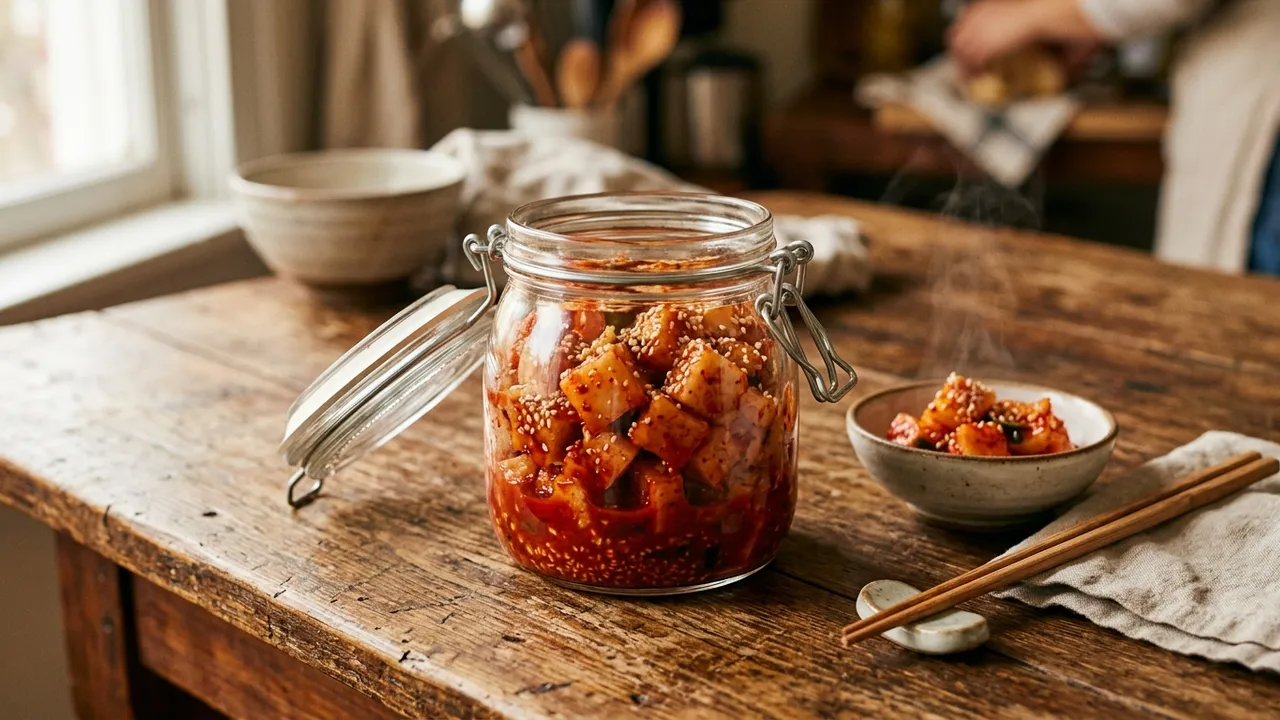
Crisp Korean Radish Kimchi
When you've lost your appetite, try making this crunchy radish kimchi.
📝 Editor's Notes
Hello everyone! Today, I'm excited to share a recipe for Korean radish kimchi with an incredibly crisp and crunchy texture. When you've lost your appetite, serving this on your table will surely bring it back. Korean radish is an ingredient readily available year-round, but its sweetness peaks especially in fall and winter. Making it with seasonal radish will allow you to experience an even deeper flavor. I've distilled this recipe down to its essentials so anyone can easily make it without complicated steps. Try making it at home to enjoy a healthy and delicious meal. Shall we make this 'rice thief' radish kimchi that the whole family will love right now?
🛒 Ingredient Tips
It's best to use the Korean radish with its skin on. The skin is rich in nutrients and adds to its unique aroma and flavor. Thorough cleaning is important, of course. When brining the radish, using coarse sea salt and sugar together helps the radish become softer and more thoroughly brined. Sugar helps to quickly draw out moisture from the radish, contributing to its crisp texture. For the green onion in the seasoning, using a mix of green and white parts adds both beautiful color and a richer aroma. Saeujeot (새우젓) and anchovy fish sauce (멸치액젓) are key ingredients that enhance the umami of the kimchi, so make sure to have them ready.
🔄 Substitution Guide
If you don't have maesil-cheong (매실청), you can slightly increase the amount of sugar or oligosaccharide syrup, or use other fruit syrups you have at home (like pear or apple syrup). However, please note that you'll miss the unique aroma and digestive enzyme benefits of maesil-cheong. If saeujeot (새우젓) is unavailable, you can add a little more anchovy fish sauce (멸치액젓) or substitute with kkanari-aekjeot (까나리액젓 - sand lance fish sauce). While you can choose fish sauce types according to personal preference, remember that each type has different salinity and aroma, so it's important to adjust the amount by tasting. For gochugaru (고춧가루), you can adjust the spiciness to your liking. If you desire a sharper, spicier kick, try adding a small amount of Cheongyang gochugaru (청양고춧가루 - spicy Korean chili powder).
🥘 Ingredients
👨🍳 Cooking Points
The most crucial points in this recipe are 'brining the radish' and 'squeezing out the water'. Brining the radish with coarse sea salt and sugar for 1 hour makes it tender and allows the seasoning to penetrate well. Don't forget to stir it occasionally. And thoroughly squeezing out the water from the brined radish is the secret to achieving its crisp texture. Sufficient moisture removal prevents the kimchi from becoming soggy and helps it stay crunchy for a long time. Lastly, when mixing the seasoning, rather than kneading it too forcefully, mix it gently by hand so the radish doesn't break apart, allowing you to enjoy its lively texture.
👨🍳 Directions
- 1
Wash the Korean radish thoroughly with the skin on.
- 2
Cut the radish into 3-4 pieces depending on its size, then slice each piece flat and cut into long, thick strips.
- 3
To the prepared radish, add 1 tbsp coarse sea salt and 3 tbsp sugar, then let it brine for 1 hour.
- 4
Stir the radish occasionally while it is brining.
- 5
Place the brined radish in a cheesecloth or clean cloth and squeeze out as much water as possible.
- 6
Slice the large green onion lengthwise and set aside.
- 7
To the squeezed radish, add 6 tbsp gochugaru (고춧가루), 1 tbsp minced garlic, 0.5 tbsp saeujeot (새우젓), 3 tbsp anchovy fish sauce (멸치액젓), and 3 tbsp maesil-cheong (매실청). Mix gently by hand.
- 8
Taste the seasoning midway and adjust to your preference.
- 9
Add the sliced green onion and mix gently again.
- 10
Finally, add 2 tbsp oligosaccharide syrup to enhance umami and shine, and mix well.
- 11
Transfer the finished radish kimchi into a container and store it in the refrigerator before serving.
💡 Tips
Adding sugar when brining the radish helps it brine more effectively.
Thoroughly squeezing out the water from the radish is key to achieving its crisp texture.
Taste the seasoning midway and adjust it to your liking.
It tastes even better when served chilled from the refrigerator.
📦 Storage & Reuse
It's best to store the finished radish kimchi in an airtight container in the refrigerator. The longer it ages chilled, the deeper its flavor will become. While it's delicious to eat right away, aging it in the refrigerator for 2-3 days allows the seasoning to permeate the radish even better, resulting in an burst of umami. It's best to consume it relatively quickly, but with proper storage, it can be enjoyed for about 1-2 weeks. To maintain the radish's crisp texture for a long time, be careful not to let any moisture get in, and it's recommended to take out only the amount you plan to eat.
🥢 Who This Is For
This crisp radish kimchi is so delicious served on hot rice that you won't need any other side dishes. Especially when paired with meat dishes, the radish's refreshing and clean taste cuts through the richness of the meat, making for a fantastic combination. It's also great as a cool side dish with noodle dishes like ramyeon or guksu, and it's perfect as a simple snack with drinks. It's easy to make, so I highly recommend it to students living alone or beginner cooks.
🔥 Nutrition Info
Korean radish is rich in diastase enzymes, which aid digestion, making it good to eat when you feel bloated. It's also abundant in Vitamin C, helping to strengthen immunity and prevent colds. Furthermore, its high fiber content is beneficial for gut health. In this recipe, sugar is used for brining the radish, and oligosaccharide syrup and maesil-cheong (매실청) are added to the seasoning, so it's best to avoid excessive consumption. However, a moderate amount of sugar helps balance the radish's bitterness and enhances umami, making this a well-balanced recipe. Saeujeot (새우젓) and anchovy fish sauce (멸치액젓) provide digestive enzymes and minerals, but they are high in sodium, so individuals with high blood pressure should be mindful of their intake.
💬 Comments
No comments yet. Be the first to comment!