
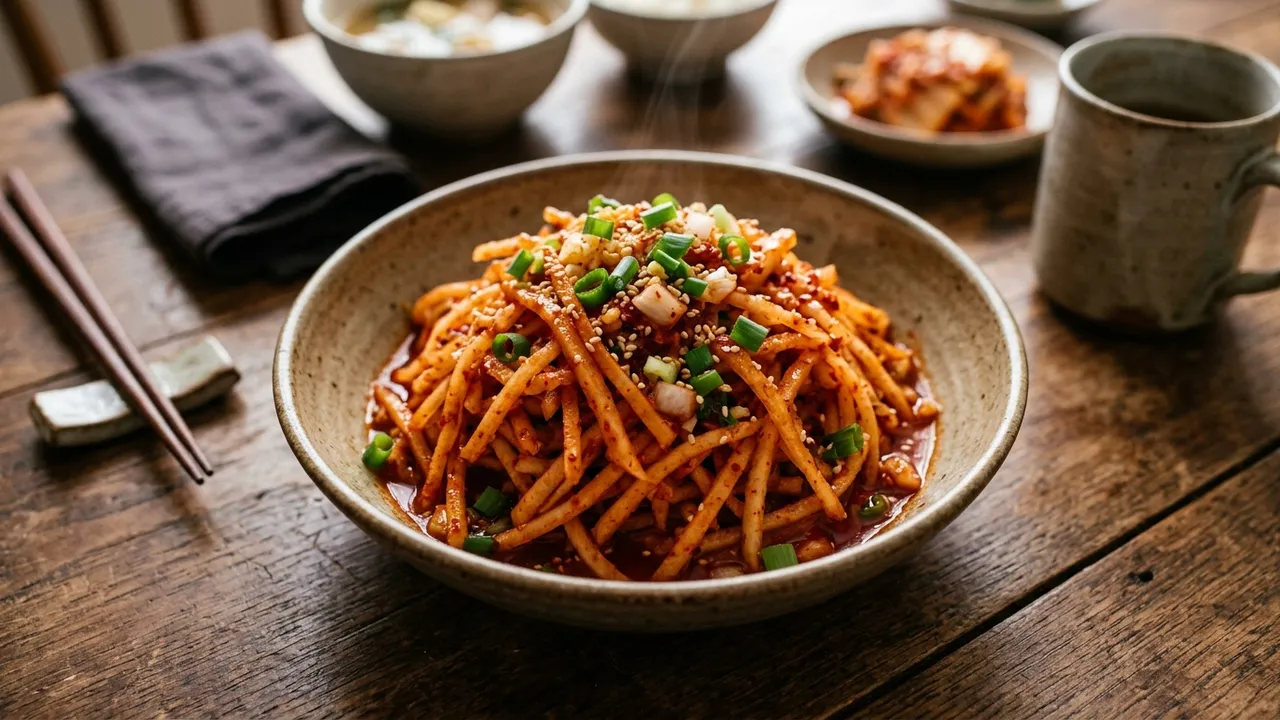
Popular Restaurant-Style Spicy Radish Salad (Mu-saengchae (무생채))
This recipe for moist and delicious restaurant-style Mu-saengchae (무생채) includes everything from how to julienne the radish and the key know-how for brining it in saltwater, to tips for using gochugaru (고춧가루).
📝 Editor's Notes
This recipe provides the secret to moist and delicious restaurant-style Mu-saengchae (무생채).
We meticulously share everything from how to julienne the radish to the key know-how of brining it in saltwater, and tips for using gochugaru (고춧가루).
The harmonious blend of sweet, sour, and spicy flavors delivers an unforgettable umami taste.
The difficulty level is intermediate, and by following a few key points, anyone can create impressive Mu-saengchae.
It will surely become a staple side dish that invigorates your dining table all year round.
🛒 Ingredient Tips
The key to delicious Mu-saengchae (무생채) starts with choosing a good radish.
It's best to select a round, attractive radish with a large white portion that feels heavy and firm when held.
If the surface is smooth with few rootlets and the radish greens are fresh, you've chosen a sweeter and crisper radish.
Radishes are sweetest and most delicious from autumn to winter, so try to use seasonal ones.
For gochugaru (고춧가루), use both fine and regular types; fine gochugaru creates a beautiful color, while regular gochugaru enhances the appetizing visual appeal of the Mu-saengchae.
Coarse sea salt is recommended for brining the radish because it's richer in minerals and has a milder saltiness than refined salt.
🔄 Substitution Guide
If Korean radish is unavailable, you can use kohlrabi or other vegetables with a similar texture.
Kohlrabi is sweeter and crisper than radish, making for a unique Mu-saengchae (무생채), but it may lack the distinct refreshing and slightly pungent taste of radish.
If you don't have both fine and regular gochugaru (고춧가루), using just one type is fine, though it might affect the color or visual appeal.
If you dislike spicy food or have an allergy, you can use paprika powder instead of gochugaru for color, but you won't get the authentic spicy flavor of Mu-saengchae.
If using regular refined salt instead of coarse sea salt, it's advisable to reduce the amount slightly as refined salt is saltier.
🥘 Ingredients
👨🍳 Cooking Points
There are two crucial cooking points for this recipe.
First, how to julienne the radish: Set the julienne peeler at a 45-degree angle and push the radish lengthwise to create long, thin strips that maintain their shape without breaking.
For safety, always wear gloves and apply firm pressure.
Second, the process of brining the radish in saltwater: Brining for 10-15 minutes is key to seasoning the radish itself and enhancing its crisp texture.
After brining, do not rinse it with water; instead, drain it thoroughly using a sieve to prevent diluting its flavor and to ensure the seasoning adheres well.
Finally, don't forget to mix the seasoning in two batches to achieve a beautiful, rich color.
The trick is to mix gently, as if handling a baby, to prevent the radish from becoming mushy if mixed too vigorously from the start.
👨🍳 Directions
Thoroughly remove any residue, foreign objects, tough core, or root parts from the radish skin using a vegetable peeler. Then, cut the radish into 4 equal parts.
Set a julienne peeler at a 45-degree angle and push the radish along its longer side to julienne it. For safety, be sure to wear gloves and apply firm pressure to ensure the radish is julienned cleanly and without breaking.
Pour enough water into a large bowl to submerge the radish, then add 0.5 cup of coarse sea salt to create a brine.
Submerge all the julienned radish in the brine and let it soak for 10-15 minutes. Once brined, do not rinse it with water; instead, drain it thoroughly using a sieve, then transfer it back to an empty bowl.
First, add 3 tbsp of fine gochugaru (고춧가루), 2 tbsp of regular gochugaru (고춧가루), 3 tbsp of sugar, 3 tbsp of vinegar, 1 tsp of ginger, and 1 tbsp of minced garlic to the radish. Gently mix the radish as if handling a baby. Do not press firmly from the beginning to achieve a darker color.
If you feel the color of the Mu-saengchae (무생채) is a bit lacking, add the remaining 3 tbsp of fine gochugaru (고춧가루) and 2 tbsp of regular gochugaru (고춧가루), then gently mix again to achieve a vibrant red color.
Finely chop the green onion. Use only a small amount so it doesn't overpower the dish.
Add the prepared chopped green onion to the Mu-saengchae (무생채) and mix one more time to complete the popular restaurant-style Mu-saengchae.
💡 Tips
Choose a round, attractive radish with a large white portion to make sweet and delicious Mu-saengchae (무생채).
When using a julienne peeler, wear safety gloves to protect your hands, and push the radish along its longer side to julienne it so it maintains its shape without breaking apart.
Brine the radish in saltwater for 10-15 minutes to season it and adjust its moisture content.
Use fine gochugaru (고춧가루) for color and regular gochugaru (고춧가루) for visual appeal. Mix the seasoning in two batches to achieve a deep, rich color.
Adding ginger enhances the flavor of Mu-saengchae (무생채) even more after one day of ripening.
For extra flavor, add toasted sesame seeds or sesame oil and enjoy it as Bibimbap (비빔밥).
📦 Storage & Reuse
Store the finished Mu-saengchae (무생채) in an airtight container in the refrigerator.
To best enjoy its crisp texture and fresh taste, we recommend consuming it within 3-5 days.
As time passes, the radish will release water and the seasoning will deepen, but leaving it too long may cause the texture to become soft.
Freezing is not recommended as it will destroy the crisp texture of the radish and make it mushy upon thawing.
For leftover Mu-saengchae, try mixing it with warm rice and sesame oil, or using it as a topping for ramyeon (라면) or Jjajangmyeon (짜장면) for a unique flavor.
It also pairs wonderfully as a topping for Bibim Guksu (비빔국수) or Bibim Naengmyeon (비빔냉면).
🥢 Who This Is For
This popular restaurant-style Mu-saengchae (무생채) is a versatile side dish with a spicy and tangy flavor that pairs well with any meal.
It's especially fantastic with greasy dishes, adding a refreshing touch, and boasts a perfect harmony with Samgyeopsal (삼겹살), Galbijjim (갈비찜), and fried foods.
A generous portion of Mu-saengchae mixed with warm rice, sesame oil, and toasted sesame seeds makes for a hearty meal.
It's also delicious as a topping for Bibimbap (비빔밥) or Bibim Guksu (비빔국수).
We highly recommend it as a 'rice thief' side dish that the whole family will love.
🔥 Nutrition Info
This Mu-saengchae (무생채) recipe is relatively low in calories, with approximately 50-70 kcal per serving (based on about 150g).
It contains about 10-15g of carbohydrates and very small amounts of protein and fat (less than 1g each).
Radish is rich in vitamin C and dietary fiber, which can help boost immunity and promote digestive health.
Additionally, diastase, a unique enzyme found in radish, aids digestion and soothes the stomach.
Capsaicin in gochugaru (고춧가루) helps stimulate metabolism, while garlic and ginger provide beneficial nutrients with antioxidant and anti-inflammatory properties.
However, due to the brining process, the sodium content may be high, so it's advisable to be mindful of serving sizes.
💬 Comments
No comments yet. Be the first to comment!