
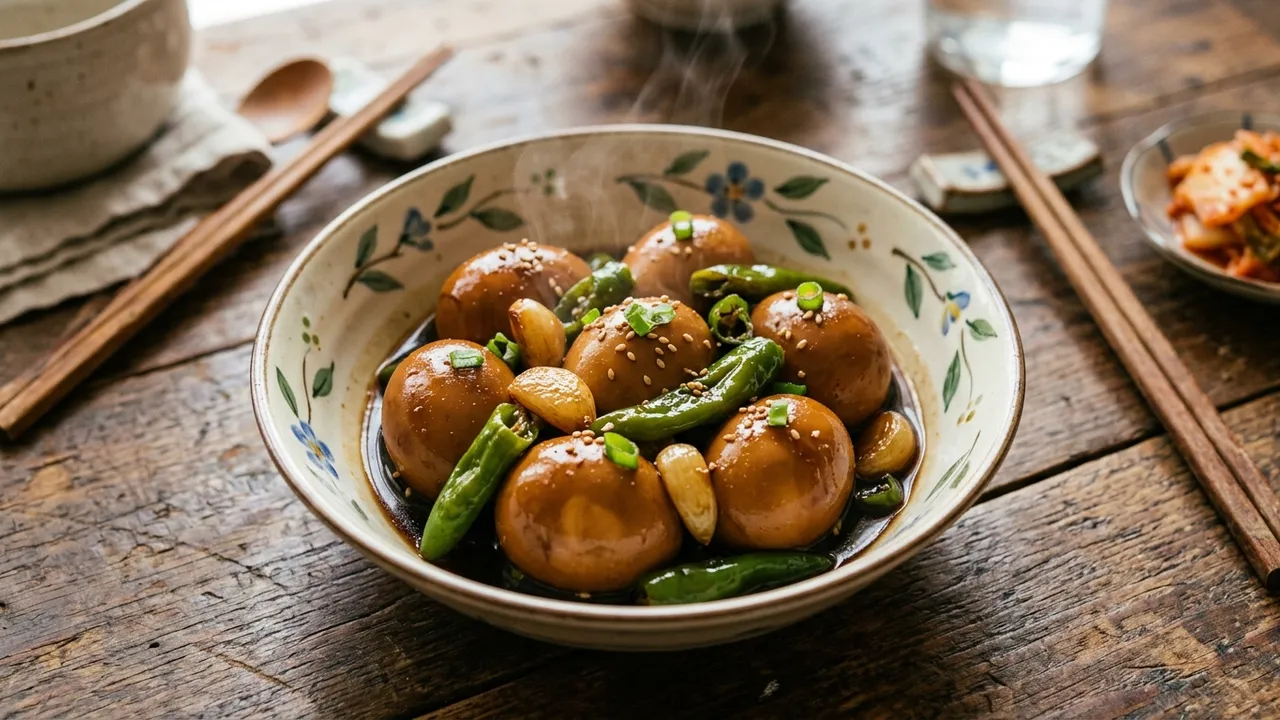
Glossy and Clean Gyeran-jangjorim (Korean Braised Eggs in Soy Sauce) - A Week's Side Dish
This is Biryong's Gyeran-jangjorim (Korean Braised Eggs in Soy Sauce) recipe, featuring a glossy, clear broth without the dullness of soy sauce, and a refreshing, crisp kkwari-gochu (꽈리고추) as a delicious highlight.
📝 Editor's Notes
This recipe holds the secret to making glossy Gyeran-jangjorim (Korean Braised Eggs in Soy Sauce) with a clean, clear broth that isn't dull. It features a prominent umami flavor over excessive saltiness from the soy sauce, and the crisp texture and refreshing taste of kkwari-gochu (꽈리고추) added at the end are a delightful highlight. With a generous quantity perfect as a side dish for a week, this is an easy-to-medium difficulty dish that the whole family can enjoy. It's a hearty and satisfying dish that can enrich your dining table any time of the year.
🛒 Ingredient Tips
It's important to choose fresh eggs. Look for eggs that don't make a sound when shaken and feel heavy; letting them sit at room temperature for a while before boiling helps them peel more easily. For dashima (다시마), good quality kelp is dark, thick, and has a moderate amount of white powder on it. This white powder is an umami-rich component, so do not wipe it off. For kkwari-gochu (꽈리고추), select those with a vibrant green color that feel firm and elastic to the touch to ensure a crisp texture. Remember that good ingredients are the foundation of delicious cooking.
🔄 Substitution Guide
If you don't have raw sugar, you can substitute it with regular sugar, jocheong (조청 - Korean malt syrup), or honey. Regular sugar might be sweeter, so try reducing the amount to about 2 tbsp. Jocheong or honey will add their unique aromas, changing the flavor profile. Instead of mirim (미림), you can use cooking sake (rice wine) or cheongju (청주 - clear rice wine). However, cooking sake tends to be sweeter, and cheongju might have a stronger alcoholic aroma, so adjust according to your preference. If kkwari-gochu (꽈리고추) is unavailable, the crisp texture will be less prominent, but you can add cheongyang-gochu (청양고추) for spiciness or use non-spicy oyi-gochu (오이고추 - cucumber peppers). You can use anchovy broth instead of dashima (다시마) broth for a richer umami flavor, but note that using plain water may result in a less profound taste.
🥘 Ingredients
👨🍳 Cooking Points
There are three crucial points for this Gyeran-jangjorim. First, you must sufficiently steep the dashima (다시마) to create a deep and clean broth. Soaking it in cold water for at least 30 minutes will enrich the umami flavor. Second, after boiling the braising liquid, remove all the vegetable solids to prevent the broth from becoming cloudy and to maintain a clean taste. This is the secret to a non-dull jangjorim. Third, to preserve the crisp texture and vibrant green color of the kkwari-gochu (꽈리고추), simmer them only for the last 3 minutes of cooking. If boiled for too long, they will become soft and turn yellow, so don't miss this 3-minute timing. By following these three points, you can make delicious jangjorim.
👨🍳 Directions
- 1
30 minutes before cooking, prepare the kelp broth by soaking 2-3 sheets of dashima (다시마) in 2 ½ cups of cold water for about 30 minutes.
- 2
Place 15 eggs in a pot with cold water and bring to a boil. Once the water starts boiling, add 2 tbsp coarse salt and 1 tbsp vinegar, then boil for 10 minutes.
- 3
Immediately transfer the boiled eggs to cold water to cool them completely, then peel them smoothly.
- 4
Pierce 1 cheongyang-gochu (청양고추) and 15 kkwari-gochu (꽈리고추) with a toothpick or fork. The cheongyang-gochu will add flavor to the braising liquid, and the kkwari-gochu will be added to the finished dish.
- 5
In a pot, combine the 2 ½ cups of kelp broth, ⅔ cup soy sauce, 3 tbsp raw sugar, 3 tbsp mirim (미림), and 1 tbsp guk-ganjang (국간장). Add 1 white part of a large green onion, ½ onion, 1 pierced cheongyang-gochu, and 2 whole shiitake mushrooms. Turn on the heat and bring to a vigorous boil.
- 6
Once the braising liquid has boiled for 10 minutes and the flavors have developed, turn off the heat and remove all the solids (green onion, onion, cheongyang-gochu, shiitake mushrooms).
- 7
Add the 15 peeled boiled eggs and 10 whole garlic cloves to the strained braising liquid. Turn the heat back on, and once it starts boiling, reduce to medium-low heat. Braise for about 20 minutes, basting the eggs frequently with the liquid, until they are beautifully colored.
- 8
When about one-third of the braising liquid remains, add the 15 pierced kkwari-gochu and simmer for another 3 minutes.
- 9
After 3 minutes, turn off the heat and drizzle in 2 tbsp oligosaccharide syrup to finish. Your glossy Gyeran-jangjorim is now complete!
💡 Tips
Using kelp broth instead of plain water for Gyeran-jangjorim will yield a deeper and more flavorful dish.
Starting eggs in cold water for boiling reduces the risk of hot water splashing and helps the shells peel more smoothly.
Piercing and adding whole cheongyang-gochu (청양고추) to the braising liquid helps to remove the dullness of the soy sauce, resulting in a cleaner-tasting broth.
Kkwari-gochu (꽈리고추) can turn yellow and tough if cooked for too long. To preserve their crisp texture and vibrant green color, it's best to simmer them only for the last 3 minutes of cooking.
After boiling the braising liquid, make sure to remove all the vegetable solids to maintain a clean and clear broth without any muddiness.
📦 Storage & Reuse
Once completed, store the Gyeran-jangjorim (Korean Braised Eggs in Soy Sauce) in an airtight container in the refrigerator for 5-7 days. Ensure there's enough braising liquid to keep the eggs from drying out and maintain their deliciousness. To serve, warm them in the microwave for 1-2 minutes or gently re-simmer in a pot over low heat for a warmer, more enjoyable experience. You can shred leftover braised eggs, mix them with warm rice, sesame oil, and gim-garu (김가루 - crumbled roasted seaweed) for a delightful Jangjorim Bibimbap. They can also be used as sandwich filling or made into a rice bowl, so feel free to explore various ways to enjoy them.
🥢 Who This Is For
This glossy Gyeran-jangjorim (Korean Braised Eggs in Soy Sauce) is highly recommended for those looking for a hearty meal even amidst a busy daily life. It's not only a great side dish for children but also pairs well as an adult snack with drinks. It's also excellent when served over warm rice as a Jangjorim-deopbap (braised egg rice bowl). A freshly cooked bowl of white rice, gim (김 - roasted seaweed), and a warm bowl of miyeok-guk (미역국 - seaweed soup) or savory doenjang-jjigae (된장찌개 - soybean paste stew) would complete a perfect Korean meal. This impressive side dish is sure to earn compliments even when served to guests.
🔥 Nutrition Info
When considering one braised egg as a single serving, this Gyeran-jangjorim (Korean Braised Eggs in Soy Sauce) is estimated to have approximately 100-120 kcal. You can get about 6-7g of high-quality protein, 5-6g of fat, and replenish about 5-10g of carbohydrates from the raw sugar and oligosaccharide syrup in the braising liquid. Eggs are a complete food containing all essential amino acids and are rich in various nutrients such as Vitamin D, Vitamin B12, and iron. Kkwari-gochu (꽈리고추) adds Vitamin C and dietary fiber, while dashima (다시마) provides iodine and calcium, making this a nutritionally balanced side dish. It will be an excellent choice for a healthy and delicious meal.
💬 Comments
No comments yet. Be the first to comment!