
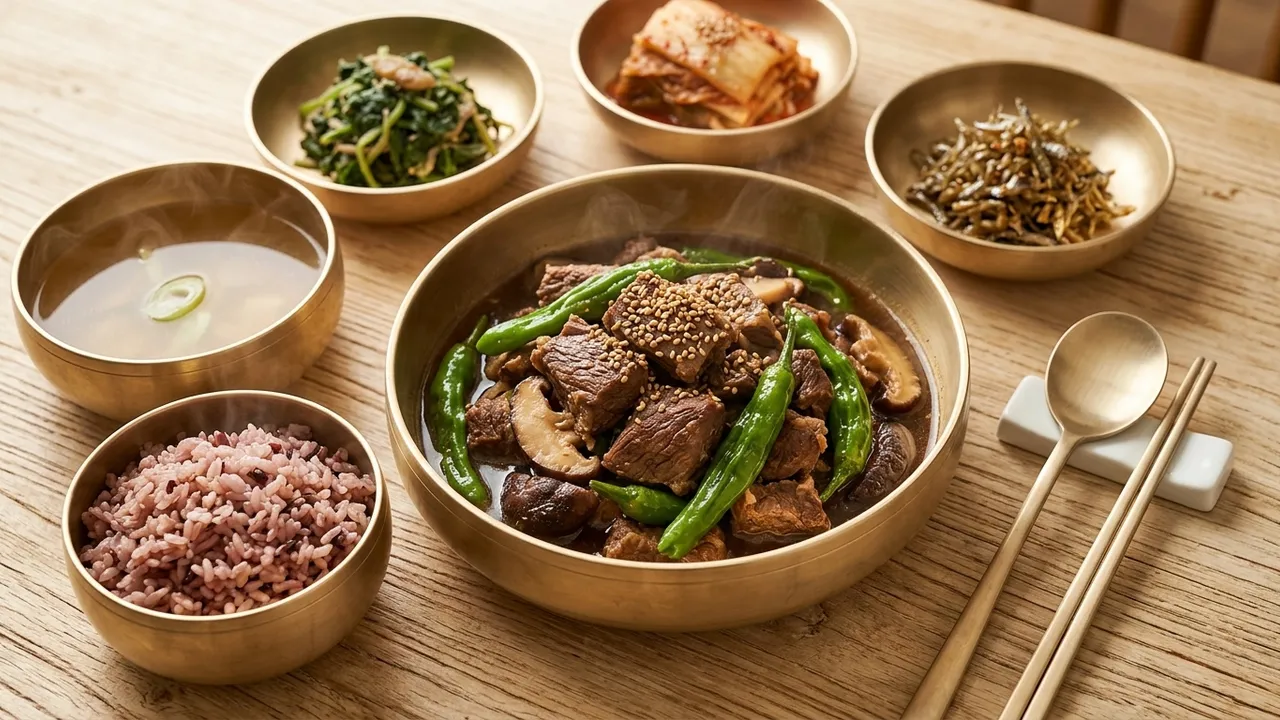
Pressure Cooker Beef Jangjorim (쇠고기장조림) Golden Recipe
This is a golden recipe for beef jangjorim (쇠고기장조림) that can be made tender and moist in a short time using a pressure cooker. With the addition of shiitake mushrooms and Korean shishito peppers (꽈리고추), it's a flavorful and nutritious side dish that's a true 'rice thief' (밥도둑), meaning it's so delicious it makes you eat a lot of rice.
📝 Editor's Notes
The recipe we're introducing today is for tender beef jangjorim (쇠고기장조림) made with a pressure cooker.
Thanks to the magic of the pressure cooker, you can make moist and tender beef jangjorim in a short amount of time.
The deep umami of shiitake mushrooms and the subtle heat of Korean shishito peppers (꽈리고추) will make you call it a 'rice thief' (밥도둑).
It's an excellent and hearty side dish for the whole family to enjoy, not just on special occasions but also on regular days.
With its uncomplicated cooking process, it's a dish even beginner cooks can easily try.
This warm Korean home-style dish is perfect for enjoying any season.
🛒 Ingredient Tips
For jangjorim (장조림), beef cuts like eye of round, top round, or shank are suitable.
Choose lean cuts with less fat for a clean flavor.
Fresh beef should have a bright red color and fine marbling.
For shiitake mushrooms, choose ones with caps that aren't too wide open, are plump, and have clear, clean gills on the underside.
Dried shiitake mushrooms can also be used, but fresh ones offer a more vibrant aroma.
For Korean shishito peppers (꽈리고추), look for ones that are not too large, glossy, and vibrant green.
Choosing peppers with fresh stems indicates good quality.
🔄 Substitution Guide
Instead of beef, you can use pork tenderloin or loin.
Pork is generally more affordable than beef and offers a tender texture.
However, pork might have a higher fat content than beef, so if you prefer a cleaner taste, trim off any excess fat.
If shiitake mushrooms are unavailable, you can substitute with king oyster mushrooms or oyster mushrooms.
While they might lack the unique deep aroma of shiitake, you'll still enjoy their chewy texture and umami flavor.
For Korean shishito peppers (꽈리고추), you can use 'asagi gochu (아삭이고추)' (Korean mild long peppers) for a subtle spiciness and a refreshing taste.
If you dislike spicy flavors, finely diced bell peppers can also be used.
🥘 Ingredients
👨🍳 Cooking Points
The most important point of this recipe is using a pressure cooker.
By simmering the beef with water, apple, and large green onion (대파) in the pressure cooker, the meat becomes significantly more tender, and any gamey odors are removed.
Don't forget to reduce the heat to medium and simmer for about 10 more minutes once the pressure cooker starts to boil again – this is the key time for tenderizing the meat.
The second point is the process of reducing the jangjorim (장조림) sauce.
Adding soy sauce (진간장), cooking rice wine (맛술), and oligosaccharide syrup (올리고당) and simmering until the sauce is well-reduced allows the flavors to fully penetrate the meat.
Finally, don't overcook the Korean shishito peppers (꽈리고추); simmer them just until they are slightly tender to maintain their crisp texture.
👨🍳 Directions
In a pressure cooker, add 1 large green onion (대파) and 1/2 apple, cut. Add 1.1 lb (500g) beef and pour in 4.2 cups (1L) of water, then bring to a boil.
Once the pressure cooker starts to boil, reduce the heat to medium and simmer for about 10 more minutes.
Remove the cooked beef and the solids (large green onion, apple). Cut the cooked beef into bite-sized pieces.
In the pressure cooker, add 3 cups of strained broth, the cut beef, and 7 shiitake mushrooms, then bring to a boil.
Add 2/3 cup soy sauce (진간장), 3 tbsp cooking rice wine (맛술), and 3 tbsp oligosaccharide syrup (올리고당). Simmer until the sauce thickens and reduces.
Add a handful of whole garlic cloves and 20 Korean shishito peppers (꽈리고추). Simmer a little longer until the shishito peppers are cooked through.
Serve the finished beef jangjorim (쇠고기장조림) in a bowl and sprinkle with a pinch of toasted sesame seeds to finish.
Store any leftover jangjorim (장조림) in an airtight container.
💡 Tips
Using a pressure cooker ensures the beef becomes incredibly tender, making it easy for anyone to make delicious jangjorim.
The deep flavor of shiitake mushrooms and the subtle spiciness of Korean shishito peppers (꽈리고추) add up to a 'rice thief' (밥도둑) side dish that will have you finishing a bowl of rice in no time.
Making a generous batch and storing it in the refrigerator is great for preparing a hearty meal even on busy days.
📦 Storage & Reuse
Once the beef jangjorim (쇠고기장조림) is completely cooled, store it in an airtight container in the refrigerator.
It will stay fresh for about 5-7 days.
If you wish to store it longer, it's a good idea to portion it into individual servings and freeze.
It can be stored in the freezer for about 1 month.
To reheat frozen jangjorim, microwave it or warm it slowly in a pot over low heat.
Don't discard the leftover jangjorim sauce; it can be deliciously used as a seasoning for bean sprout rice (콩나물밥) or bibimbap (비빔밥).
It's a versatile side dish, so feel free to make a generous batch.
🥢 Who This Is For
This beef jangjorim (쇠고기장조림) is a beloved side dish for all ages, making it perfect for any family dinner table.
It's especially good for children as the beef is very tender.
Serve it over warm rice and mix, or pair it with a fried egg for an even heartier meal.
If you enjoy spicy food, you can add a bit of Cheongyang chili pepper (청양고추).
Pairing it with a refreshing cucumber salad or a cool bean sprout soup (콩나물국) will create an even richer dining experience.
🔥 Nutrition Info
This beef jangjorim (쇠고기장조림) primarily uses protein-rich beef, aiding in energy recovery and muscle maintenance.
The estimated calories per serving are approximately 300-400 kcal, with about 30-40g protein, 15-20g fat, and 15-20g carbohydrates.
Beef is rich in iron, which is good for preventing anemia, and high in B vitamins, contributing to energy production.
Shiitake mushrooms are abundant in vitamin D and dietary fiber, supporting immune system strength and gut health.
Korean shishito peppers (꽈리고추) are rich in vitamin C, which helps with fatigue recovery.
Overall, it can be considered a healthy side dish with a well-balanced nutritional profile.
💬 Comments
No comments yet. Be the first to comment!