
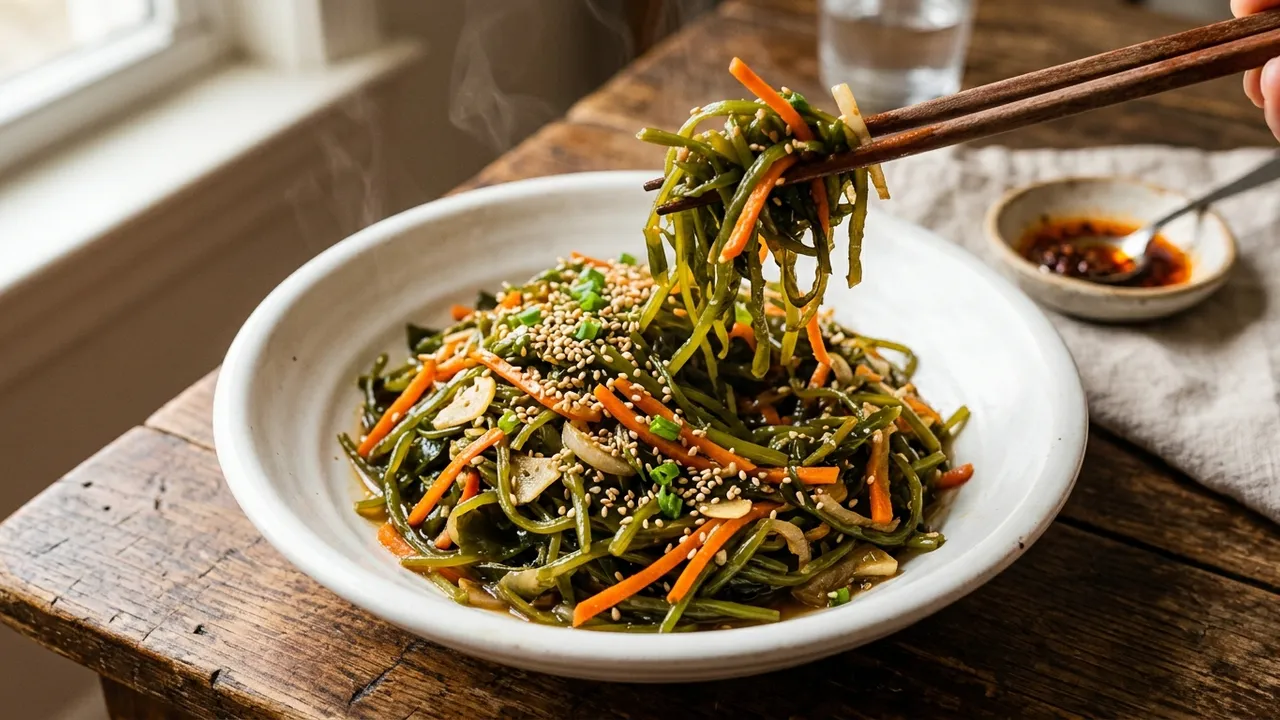
Miyeokjulgibokkeum (Stir-fried Seaweed Stems)
This recipe for chewy and savory stir-fried seaweed stems is crafted with Chef Kim Dae-seok's 34 years of expertise.
📝 Editor's Notes
✨ This Miyeokjulgibokkeum (미역줄기볶음), featuring Chef Kim Dae-seok's secret recipe, boasts an exceptional chewy texture and savory flavor. Mirin (미림) eliminates any fishiness, while anchovy fish sauce (멸치액젓) adds umami, making it a perfect side dish for rice. Although the process is delicate, anyone can achieve a deep, rich flavor by following this recipe without fail.
🛒 Ingredient Tips
🛒 Be sure to rinse the salted miyeokjulgi (미역줄기) multiple times in cold water to thoroughly remove its saltiness. If it's too salty, it won't taste good, no matter how well it's stir-fried. Mirin (미림) is a key ingredient for removing any unpleasant odors from the miyeokjulgi (미역줄기), so make sure to have it ready. If you don't have anchovy fish sauce (멸치액젓), you can substitute it with Korean soup soy sauce (국간장), but note that the unique umami flavor might be less pronounced.
🥘 Ingredients
👨🍳 Cooking Points
👩🍳 The most crucial point of this recipe is to achieve the 'chewy texture.' The key steps are to completely remove the saltiness from the salted miyeokjulgi (미역줄기), massage it with mirin (미림) to eliminate any strong odors, and then blanch it for exactly 1 minute over high heat. The blanched miyeokjulgi (미역줄기) must be immediately cooled in cold water to prevent it from becoming mushy. When stir-frying, do it quickly over high heat, and after it's done, transfer it to a plate to cool down quickly to maintain that signature chewy texture. Just remember these tips!
👨🍳 Directions
- 1
Pour 450g of salted miyeokjulgi (미역줄기) into cold water and rinse off the salt.
- 2
Fill with water and soak the miyeokjulgi (미역줄기) for about 5 minutes to remove excess saltiness.
- 3
After 5 minutes, vigorously rinse the miyeokjulgi (미역줄기) once more, then squeeze out all the water thoroughly.
- 4
Place the squeezed miyeokjulgi (미역줄기) in a bowl, add 3 tbsp of mirin (미림), and vigorously massage it in.
- 5
Bring water to a boil in a pot. Without adding anything else, add the mirin-massaged miyeokjulgi (미역줄기) and blanch on high heat for 1 minute.
- 6
After 1 minute, turn off the heat, pour the blanched miyeokjulgi (미역줄기) into cold water to cool it down. Rinse once more in cold water, then squeeze out all the water thoroughly.
- 7
Place the miyeokjulgi (미역줄기) on a cutting board, cut into 5-6 cm (approx. 2-2.5 inch) lengths, then slice them into thinner strips if they are too wide.
- 8
Place the cut miyeokjulgi (미역줄기) in a pan and taste it before stir-frying. It should taste mildly salty, not overly salty.
- 9
Add 1 tbsp of minced garlic, 3 pinches of seasoned salt (맛소금), and 1/2 tbsp of anchovy fish sauce (멸치액젓). Mix well to season before stir-frying.
- 10
Finely julienne 1/4 of an onion and 30g of carrot, then add them to the pan with the miyeokjulgi (미역줄기).
- 11
Drizzle in 1-2 tbsp of cooking oil. Turn the heat to high and quickly stir-fry until the miyeokjulgi (미역줄기) becomes chewy and firm, ensuring it doesn't get soggy.
- 12
Once it's well stir-fried, immediately turn off the heat, add 1 tbsp of sesame oil and 1 tbsp of toasted sesame seeds, and mix gently.
- 13
Quickly transfer the finished miyeokjulgibokkeum (미역줄기볶음) to a plate to cool it down, which helps maintain its chewy texture.
💡 Tips
Mirin (미림) effectively removes the fishy odor from the miyeokjulgi (미역줄기).
It's best to add sesame oil at the end of the stir-frying process to enhance its savory and nutty aroma.
Salted miyeokjulgi (미역줄기) is very salty, so make sure to thoroughly rinse and remove the salt before cooking.
Stir-fry the miyeokjulgi (미역줄기) quickly over high heat, and after cooking, immediately transfer it to a plate to cool down to preserve its chewy texture.
🥢 Who This Is For
💖 With its savory and mildly salty flavor, this is an unbeatable side dish for rice. It's a popular banchan (밑반찬) that even children enjoy, making it perfect for the whole family. It also makes an excellent addition to lunchboxes, so be sure to give it a try!
💬 Comments
No comments yet. Be the first to comment!