
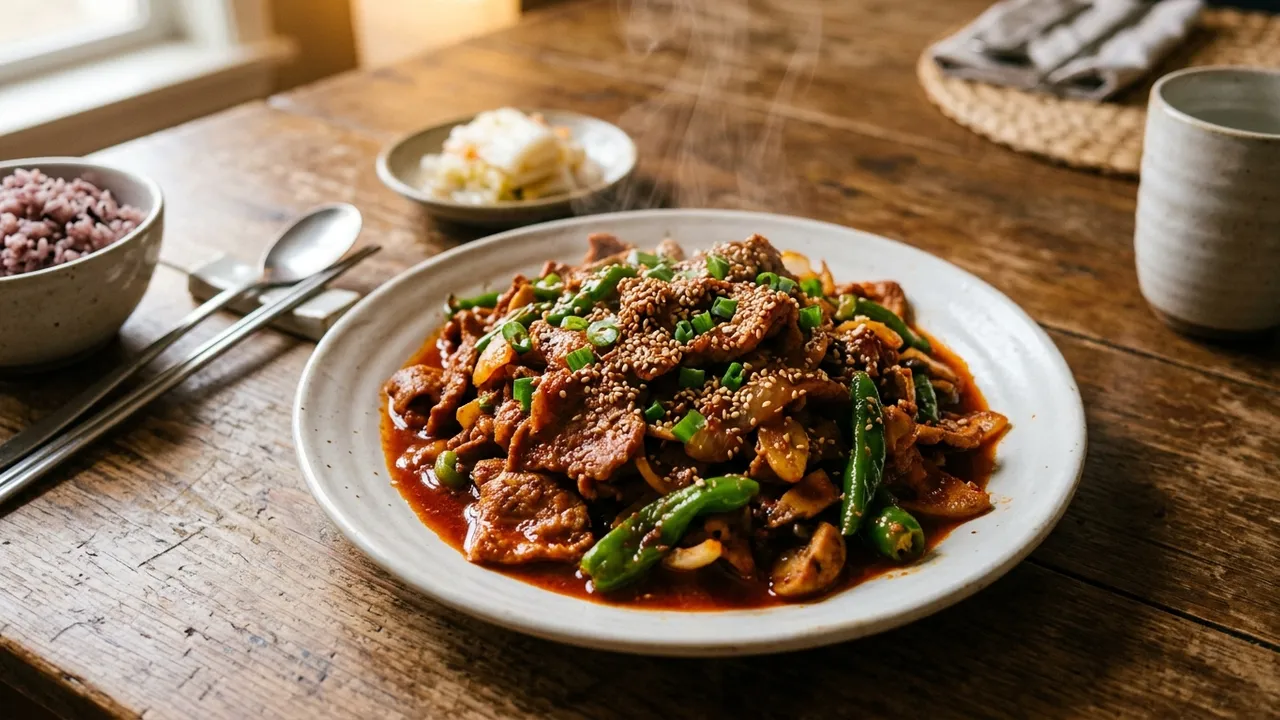
Super Simple Chewy and Rich Jeyuk-bokkeum (Spicy Pork Stir-fry)
An easy golden recipe for Jeyuk-bokkeum (Spicy Pork Stir-fry) that boasts an excellent chewy and rich flavor.
📝 Editor's Notes
True to its name 'Super Simple,' the main feature of this recipe is that it allows you to create a chewy and rich Jeyuk-bokkeum (Spicy Pork Stir-fry) without complicated steps. The process of thoroughly stir-frying the green onion oil and seasoning sauce to extract chili oil brings out a deep flavor, boasting an excellent taste even with its simplicity. With its typically spicy, sweet, and umami-rich flavor, it can be said that this is one of the most beloved dishes in Korea. Its easy-to-follow difficulty makes it perfect for cooking beginners, and it's an ideal menu for busy weeknight dinners or weekend family meals.
🛒 Ingredient Tips
For pork, 300g of pork shoulder butt (front leg meat) is used. Slightly thicker slices are better than very thin ones for achieving a chewy texture. Choosing a cut with a good balance of fat and lean meat will further enhance the flavor. Prepare both white and green parts of the green onion; using the white part for green onion oil and the green part as a finishing garnish is a tip for maximizing aroma. Choose fresh, firm onions, and adjust the amount of cheongyang chili pepper (청양고추) according to your preference. Using fresh, high-quality gochujang (고추장) and gochugaru (고춧가루) will significantly improve the color and taste of the Jeyuk-bokkeum.
🔄 Substitution Guide
Instead of pork shoulder butt (front leg meat), you can use pork neck meat. Pork neck meat has less fat and more lean meat than shoulder butt, making it a good choice if you prefer a leaner taste. However, it may have less of the unique chewy texture of shoulder butt. If you want a richer and softer taste, try using pork belly. However, pork belly has a higher fat content, which may increase the calorie count. If you don't have maesil-cheong (매실청) or allulose, you can substitute with sugar or oligosaccharide. If using sugar, adjust the amount as the sweetness may be stronger, while oligosaccharide can provide a similar level of sweetness to maesil-cheong. If you don't have soju (소주) or mirin, you can use cooking wine (mat-sul) or rice wine (cheongju) to remove gamey odors, or even omit it without significant issues.
🥘 Ingredients
👨🍳 Cooking Points
There are three key points to this Jeyuk-bokkeum. First, the process of thoroughly stir-frying the green onion oil and seasoning sauce to extract chili oil. You need to stir-fry patiently over low heat until it's thick and glossy for the deep flavor of the sauce to develop and the savory aroma of chili oil to be added. Turning off the heat briefly when the pan gets too hot is also a good method. Second, don't rush stir-frying the pork. It's important to stir-fry over medium heat until the meat is fully cooked and the fat slightly melts, bringing out the umami flavor. Third, add the vegetables at different times. Add the onion after the meat is somewhat cooked, and add the green onion and cheongyang chili pepper (청양고추) when the onion becomes translucent. This is key to preserving the vegetables' texture and preventing excessive moisture.
👨🍳 Directions
- 1
Heat a generous amount of cooking oil in a pan, add the julienned white part of the green onion, and stir-fry over low heat to make green onion oil.
- 2
While the green onion oil is being made, combine 2 tbsp of gochujang (고추장), 2 tbsp of soy sauce, 1 tbsp of minced garlic, 1 tbsp of gochugaru (고춧가루), 1 tbsp of soju or mirin, and 1 tbsp of maesil-cheong (매실청) or allulose to make the seasoning sauce.
- 3
Once enough green onion oil has rendered, add the prepared seasoning sauce and stir-fry until thick and glossy, taking care not to burn it, to extract chili oil. (If the pan gets too hot, you can turn off the heat briefly and then turn it back on.)
- 4
When enough chili oil has extracted and the sauce changes color, it's well-cooked. Add 300g of pork shoulder butt (front leg meat) and gently stir-fry over medium heat. (If the heat feels too high, reduce it to low and stir-fry slowly and gently.)
- 5
When the meat is almost cooked through, add 1 julienned medium onion (or about half if it's large) and stir-fry together.
- 6
When the onion becomes translucent, add the sliced green onion and cheongyang chili pepper (청양고추) and continue to stir-fry.
- 7
When the added vegetables have softened and are somewhat cooked, finish by adding black pepper as needed, about 1 tbsp of sesame oil, and sprinkling with sesame seeds. Mix well to complete.
💡 Tips
Don't rush the cooking process; be patient and allow the flavors to fully develop.
When stir-frying the seasoning sauce, it's crucial to stir-fry it slowly over low heat, or by turning the pan off and on, until it becomes thick and glossy without burning, to extract chili oil.
As the fat in the meat melts, the flavor and richness deepen. Therefore, stir-fry the meat sufficiently to enhance its taste, but not until it burns black.
📦 Storage & Reuse
Store the finished Jeyuk-bokkeum in an airtight container in the refrigerator for 2-3 days. If you want to store it longer, divide it into single-serving portions and freeze. It can be stored in the freezer for about 1-2 weeks. When reheating after thawing, you can stir-fry it again in a frying pan over low heat or microwave it. Lightly stir-frying it in a frying pan allows the seasoning to re-absorb into the meat, making it even more delicious. Leftover Jeyuk-bokkeum can be stir-fried with kimchi to make kimchi fried rice, or placed over rice to transform into a wonderful one-dish meal.
🥢 Who This Is For
This chewy and rich Jeyuk-bokkeum (Spicy Pork Stir-fry) is a dish that anyone, from cooking beginners to experienced cooks, can enjoy. It is especially highly recommended when you want to quickly prepare a hearty and delicious meal in a busy daily life. It's even more delicious when served generously over hot white rice, like a rice bowl, or wrapped in fresh ssam (쌈) vegetables. Pairing it with refreshing kongnamul-guk (콩나물국) (bean sprout soup) or soft gyeran-jjim (계란찜) (steamed egg) will complete a perfect Korean meal. It also makes an excellent anju (안주) (drinking snack) for makgeolli (막걸리) or soju (소주).
🔥 Nutrition Info
This Jeyuk-bokkeum recipe is estimated to be approximately 450-550 kcal per serving, based on 2 servings. Since 300g of pork shoulder butt (front leg meat) is used, you can consume abundant protein, approximately 30-35g. Fat is estimated to be around 20-25g, and carbohydrates, considering sugars in onion and seasoning, are expected to be around 25-30g. Pork is rich in B vitamins (especially B1) and iron, which helps with fatigue recovery and anemia prevention. Onions, green onions, and cheongyang chili peppers (청양고추) provide dietary fiber and vitamin C, balancing the nutrition. Using maesil-cheong (매실청) or allulose can help reduce sugar intake by decreasing the amount of sugar used.
💬 Comments
No comments yet. Be the first to comment!