
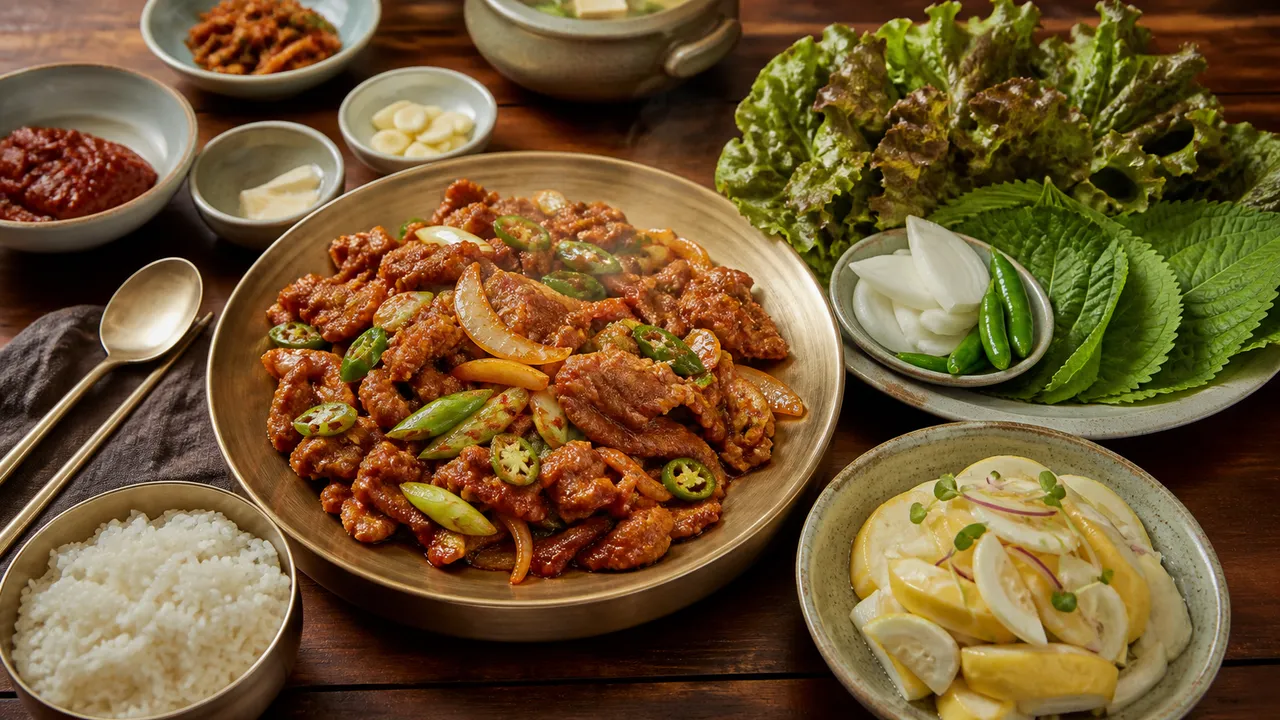
Jeyuk Ssam-bap (제육쌈밥) with New Season Onions and Korean Melon Salad Recipe
This recipe features Jeyuk Ssam-bap (제육쌈밥), a spicy pork stir-fry wrap that utilizes seasonal new season onions for a crisp texture, paired with a unique Korean Melon Salad (참외 샐러드) dressed with perilla oil for a refreshing complement.
📋 2 recipes — Select to view
This Jeyuk-bokkeum (제육볶음), or spicy pork stir-fry, features seasonal fresh spring onions to create a delightful crispy texture.
📝 Editor's Notes
Jeyuk Ssambap (제육쌈밥) with fresh seasonal onions is a Jeyuk-bokkeum (제육볶음) recipe that boasts the excellent crispy texture and sweet flavor of seasonal onions.
The spicy gochujang (고추장) seasoning harmonizes wonderfully with the onion's sweetness, creating a flavor profile that appeals to all ages.
With a relatively short cooking time of about 30 minutes and no special skills required, it's highly recommended for beginner cooks.
It's especially delicious when made in spring to early summer when seasonal onions are abundant.
Served generously with ssam (쌈) vegetables, it's a satisfying meal perfect for any occasion.
🛒 Ingredient Tips
Pork shoulder butt is the key ingredient that determines the flavor of Jeyuk-bokkeum (제육볶음).
It has a good balance of lean meat and fat, providing a tender yet chewy texture, and absorbs the seasoning well to enhance the umami.
Fresh pork shoulder butt should be bright pink, glossy, and firm.
Seasonal onions are characterized by their high moisture content and strong sweetness compared to regular onions; choose ones that are firm, heavy, and have un-dried outer skins.
Seasonal onions add a delightful crisp texture and flavor to the Jeyuk-bokkeum.
For green onions, choose ones that are fresh down to the root and have vibrant green parts, as they will release a stronger aroma when making green onion oil.
🔄 Substitution Guide
Pork neck or pork belly can be used instead of pork shoulder butt.
Pork neck is leaner and offers a milder flavor, while pork belly, being fattier, provides a softer texture and richer taste.
However, note that pork belly will result in a higher calorie count due to its fat content.
If seasonal onions are not available, regular onions can be used, but they might be less crisp and sweet than seasonal ones.
When using regular onions, reduce the stir-frying time over high heat slightly.
Instead of Cheongyang chili peppers (청양고추), you can use Kkari-gochu (꽈리고추, Korean shishito peppers) to reduce the spiciness while adding a fragrant aroma.
If you don't have oyster sauce, you can add 1 more tablespoon of soy sauce or a splash of mirin (맛술) to enhance the umami.
🥘 Ingredients
👨🍳 Cooking Points
There are two key cooking points for this Jeyuk Ssambap (제육쌈밥) recipe.
First, marinate the seasoned pork in the refrigerator for at least 30 minutes.
This resting period allows the sauce to deeply penetrate the meat, resulting in a richer flavor.
Second, the timing of adding the seasonal onions is crucial.
Seasonal onions have a high moisture content, and adding them too early or stir-frying them for too long can make them soggy and lose their crispness.
The key is to add them at the very end when the meat is almost fully cooked, and then stir-fry them briefly over high heat for 1-2 minutes.
This preserves their crisp texture and sweetness.
Finally, making enough green onion oil before stir-frying the meat adds a fragrant aroma, making the dish even more delicious.
👨🍳 Directions
Combine 2 tbsp gochujang (고추장), 2 tbsp gochugaru (고춧가루), 1 tbsp soy sauce, 1 tbsp oyster sauce, 1 tbsp minced garlic, 1 tbsp sugar, and a pinch of ground black pepper to make the Jeyuk-bokkeum sauce.
Add the sauce to 14 oz (400g) of pork shoulder butt, mix well, and marinate in the refrigerator for about 30 minutes.
Slice 1 seasonal onion into 0.4-inch (1cm) thick strips. Diagonally slice 1 green onion and 1 Cheongyang chili pepper (청양고추), and set aside.
Heat a pan with cooking oil, then add the diagonally sliced green onion to make a fragrant green onion oil.
Add the marinated pork and stir-fry until almost cooked through. Then add the sliced seasonal onion and diagonally sliced Cheongyang chili pepper (청양고추), and stir-fry again over high heat.
Finally, add a bit of sesame oil to taste, toss, and remove from heat.
Garnish the finished Jeyuk-bokkeum (제육볶음) with toasted sesame seeds.
💡 Tips
Seasonal onions have a higher moisture content and are crispier and sweeter than regular onions. To maintain their crisp texture, it's best to add them when the meat is almost cooked and stir-fry briefly over high heat.
For Jeyuk-bokkeum (제육볶음), pork shoulder butt is recommended as it has a good balance of lean meat and fat, is affordable, and offers a pleasant texture.
Marinating the pork in the refrigerator for 30 to 40 minutes allows the flavors to deepen.
If you want to add more umami, it's good to add one more tablespoon of oyster sauce.
📦 Storage & Reuse
Store leftover Jeyuk-bokkeum (제육볶음) in an airtight container in the refrigerator for 2-3 days.
For longer storage, portion it out and freeze.
It can be kept frozen for about 2 weeks; simply reheat in a microwave or pan after thawing.
When reheating, stir-fry briefly over medium heat to maintain its original flavor.
Leftover Jeyuk-bokkeum can also be used as a rice bowl topping or stir-fried with kimchi to make Jeyuk-bokkeum-bap (제육볶음밥), a delicious fried rice.
Ssam (쌈) vegetables can be wrapped in newspaper and stored in the refrigerator's vegetable drawer to keep them fresh longer.
🥢 Who This Is For
Jeyuk Ssambap (제육쌈밥) with fresh seasonal onions is a delightful dish for the whole family.
It's highly recommended for those who enjoy spicy food or ssam (쌈) wraps.
It's also perfect for housewarming parties or camping meals.
It makes a satisfying main course and pairs wonderfully with a refreshing makgeolli (막걸리) or beer.
Serving it with a cool kongnamul-guk (콩나물국, soybean sprout soup) or miyeok-guk (미역국, seaweed soup) would complete the meal.
Mild side dishes like steamed egg (계란찜) or pan-fried tofu (두부부침) would also complement it well.
🔥 Nutrition Info
The estimated nutritional values per serving of Jeyuk Ssambap (제육쌈밥) with fresh seasonal onions are approximately 550-650 calories.
Protein is estimated at 30-35g, fat at 25-30g, and carbohydrates at 40-50g.
Pork shoulder butt is rich in high-quality protein and B vitamins (especially B1), which help with fatigue recovery.
Seasonal onions are abundant in Vitamin C and dietary fiber, and contain the antioxidant quercetin, beneficial for boosting immunity and cardiovascular health.
Cheongyang chili peppers (청양고추) have a high Vitamin C content, aiding in antioxidant activity, and gochujang (고추장), a fermented food, contains small amounts of probiotics and dietary fiber.
Lettuce, used for ssam (쌈) wraps, is rich in Vitamin A and calcium, helping to maintain overall nutritional balance.
❓ FAQ
What are some ingredient substitutions?
Instead of pork shoulder, you can use pork neck or pork belly. Pork neck offers a softer texture than pork shoulder, while pork belly provides a richer, fattier flavor. However, keep in mind that pork belly has a higher fat content, which may increase the calorie count. If new season onions are unavailable, regular onions can be used, though they might be slightly less crisp and sweet. When using regular onions, keep the stir-frying time over high heat brief, around 1 minute, to maintain some crispness. If Cheongyang chili peppers (청양고추) are too spicy, you can substitute them with kkwari-gochu (꽈리고추) or ah-sak-yi-gochu (아삭이고추) to adjust the spiciness. If oyster sauce is not available, you can add about 1/2 tbsp more soy sauce, but the umami flavor might be slightly reduced.
How should I store this?
The cooked Jeyuk-bokkeum (제육볶음) can be stored in an airtight container in the refrigerator for 2-3 days. For longer storage, divide into portions and freeze for up to a month, though the texture may change slightly upon thawing. To reheat, microwave for 2-3 minutes or stir-fry again in a pan over low heat. Leftover Jeyuk-bokkeum is also great as a topping for rice bowls or as an ingredient for kimchi fried rice. Finely chop cold Jeyuk-bokkeum and stir-fry with kimchi and rice for a fantastic meal. Wrap lettuce leaves in newspaper and store in the refrigerator's vegetable drawer to keep them fresh longer.
💬 Comments
No comments yet. Be the first to comment!