
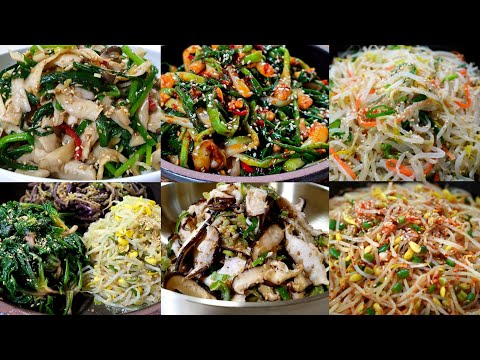
Seasoned King Oyster Mushrooms with Garlic Chives
This King Oyster Mushroom and Garlic Chive Salad boasts an incredibly chewy texture.
📝 Editor's Notes
Today's recipe for mung bean sprout salad (sukju-namul (숙주나물)) is a staple on Korean dinner tables, known for its crisp texture and savory taste.
By steaming the mung bean sprouts, nutrient loss is minimized, and the addition of fresh garlic chives, carrots, and cheongyang chili peppers (cheongyang-gochu (청양고추)) creates a balanced flavor.
A distinctive feature of this recipe is the use of kelp broth (dasima-mul (다시마물)) to enhance umami and bring out the mung bean sprouts' inherent savory notes.
The simple cooking process makes it easy for beginner cooks to follow, and it serves as a light and versatile side dish that complements any Korean meal.
It's an excellent choice when you desire a light and healthy meal, or a clean side dish to accompany a main course.
🛒 Ingredient Tips
It's important to choose mung bean sprouts (sukju (숙주)) with plump stems, few fine roots, and clean, intact heads.
A pale ivory color, rather than pure white, indicates freshness.
For garlic chives, select ones with vibrant green leaves that are not wilted and not too thick.
Avoid those with dry or yellowed tips.
For carrots, look for ones that are firm, smooth, and bright in color.
A deeper orange hue generally signifies a higher beta-carotene content.
The freshness of all three ingredients is crucial for taste, so it's recommended to cook them as soon as possible after purchase.
🔄 Substitution Guide
You can use soybean sprouts (kongnamul (콩나물)) instead of mung bean sprouts (sukju (숙주)) to make a crisp soybean sprout salad.
Soybean sprouts have a firmer texture and a stronger savory taste than mung bean sprouts, and like mung bean sprouts, they should be blanched for a short time to retain their crispness.
If garlic chives are unavailable, finely chopped scallions (jjokpa (쪽파)) can add a fresh aroma.
Since scallions have a stronger fragrance than garlic chives, it's best to use a slightly smaller amount.
Using fish sauce instead of Korean soup soy sauce (guk-ganjang (국간장)) can deepen the umami flavor, or you can simply season with salt.
Those with seafood allergies should be cautious with fish sauce, and if you have a soy allergy, substituting Korean soup soy sauce with salt is safer.
Please note that each substitute ingredient may introduce subtle differences in taste, aroma, and texture.
🥘 Ingredients
👨🍳 Cooking Points
The most important points in this mung bean sprout salad (sukju-namul (숙주나물)) recipe are the 'steaming time for the mung bean sprouts' and the 'mixing method.' First, steaming the mung bean sprouts for 3 minutes over high heat, then adding the garlic chives and briefly turning them over to wilt, is key to preserving their crisp texture.
Remember to stick to 3 minutes, as over-steaming will make them soft and increase nutrient loss.
Second, after cooking the mung bean sprouts and garlic chives, immediately spread them out on a colander to cool.
This prevents them from cooking further with residual heat and helps maintain their crispness.
Third, when mixing all the seasonings, it's important to use a light hand and mix gently to avoid crushing the mung bean sprouts.
Mixing too vigorously can cause the mung bean sprouts to release water and lose their desirable texture.
👨🍳 Directions
Cut off the caps of 6 king oyster mushrooms and julienne them. Slice the bodies thinly with a mandoline or vegetable peeler.
Chop a handful of garlic chives. Finely chop a small amount of the white part of a green onion.
Halve 1 red chili pepper, remove the seeds, and julienne it.
Once water boils in a steamer pot, place a steamer basket with the julienned king oyster mushrooms inside, cover, and steam for 1 minute.
After 1 minute, add the garlic chives on top of the mushrooms in the steamer basket, cover, and steam for another 1 minute (total 2 minutes). Transfer the steamed mushrooms and chives to a colander and let them cool.
Prepare the seasoning sauce. Combine 1 tbsp soy sauce, 1 tbsp myeolchi-aekjeot (멸치액젓), 1 tbsp minced garlic, and 1 tbsp maesil-aek (매실액) and mix well.
Gently squeeze out excess water from the steamed king oyster mushrooms and garlic chives (be careful not to squeeze too much).
In a large bowl, combine the squeezed king oyster mushrooms and garlic chives, prepared green onion and red chili pepper, seasoning sauce, 1.5 tbsp kkaesogeum (깨소금), and 1.5 tbsp sesame oil. Mix gently by hand.
Transfer to a serving dish and serve.
💡 Tips
Do not squeeze too much water from the king oyster mushrooms and garlic chives to maintain their moist texture.
Steaming the king oyster mushrooms in a steamer pot helps preserve their chewy texture and nutrients.
📦 Storage & Reuse
The finished mung bean sprout salad (sukju-namul (숙주나물)) can be stored in an airtight container in the refrigerator for about 2-3 days while remaining fresh.
Since mung bean sprouts have high water content, they can become soft and lose flavor if stored for too long, so it's best to consume them as soon as possible.
Freezing is not recommended as it will cause the crisp texture of the sprouts to disappear and become mushy.
Leftover mung bean sprout salad can be used as an ingredient for bibimbap, or added to kimchi jjigae or doenjang jjigae for a delightful twist.
Especially when cooking ramyeon, adding it can enhance a cool and refreshing taste.
For the crispiest and most delicious experience, it's best to eat it cold without reheating.
🥢 Who This Is For
Thanks to its light and clean taste, this mung bean sprout salad (sukju-namul (숙주나물)) is a delightful side dish for people of all ages.
It is especially recommended for those on a diet or striving for a healthy eating plan.
It pairs wonderfully when added to bibimbap, or served alongside stews (jjigae) or stir-fries.
It also serves as a refreshing vegetable side to balance heavier main dishes like bulgogi or spicy pork stir-fry (jeyuk-bokkeum).
Its mild flavor is even appealing to young children, making it a dish that won't get tiresome even if served daily.
It is truly a fundamental and indispensable side dish for a hearty Korean meal.
🔥 Nutrition Info
Based on 500g of mung bean sprouts (sukju (숙주)), considered approximately 2-3 servings, the estimated calories per serving are about 70-90kcal.
Protein is estimated at about 4-6g, fat at 3-5g, and carbohydrates at 7-9g.
Mung bean sprouts are rich in Vitamin C and Asparagine, which aid in fatigue relief and detoxification.
Garlic chives are high in Vitamin A and iron, beneficial for anemia prevention and boosting immunity, while carrots, rich in beta-carotene, contribute to eye health and antioxidant effects.
Overall, it can be described as a low-calorie, nutritious side dish rich in dietary fiber, beneficial for gut health.
Sodium content may vary depending on the seasoning, so it is advisable to adjust the amount of Korean soup soy sauce (guk-ganjang (국간장)) or myeolchi-aekjeot (멸치액젓) (fish sauce) used.
💬 Comments
No comments yet. Be the first to comment!