
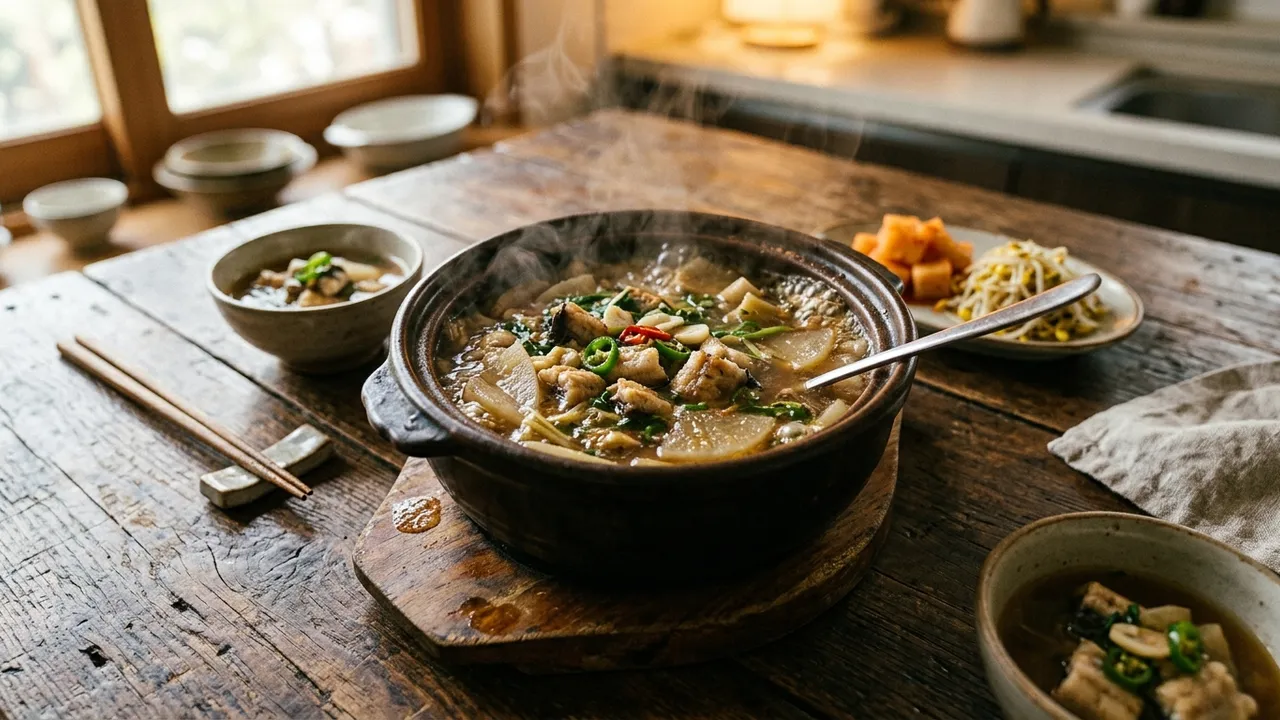
An Analysis of Chef Choi Kang-rok's Jorim (Braised Dish) Technique
This video analyzes Chef Choi Kang-rok's jorim (조림) cooking technique and philosophy, which maximizes the inherent flavors of ingredients and pursues delicate balance by using plain water instead of broth.
📝 Editor's Notes
Chef Choi Kang-rok's jorim (조림) technique is characterized by using plain water instead of broth to maximize the inherent flavors of the ingredients.
This allows you to fully appreciate the pure and delicate tastes of each component, such as eel, daikon radish, and tofu.
Through an exquisite balance of additional ingredients like soy sauce, mirin, and chungju (청주), it delivers a clean taste that is neither dull nor overly salty, creating a refined jorim (조림) dish akin to fine dining.
The difficulty level is upper-intermediate, requiring focused attention on delicate flavor adjustments, but it promises a uniquely profound gourmet experience.
It's an excellent choice for a healthy and elegant meal any time of year, or for entertaining esteemed guests.
🛒 Ingredient Tips
The key to this jorim (조림) lies in choosing fresh, high-quality ingredients.
First, for the main ingredient, eel, it's crucial to select fresh ones with firm, glossy flesh that have no fishy odor.
Good quality eel will maintain a chewy texture and won't fall apart after cooking.
For daikon radish, choose one that is firm, has a smooth surface, and feels heavy when lifted.
Daikon radish from autumn to winter is best, offering strong sweetness and a refreshing taste.
For tofu, select a product that retains the savory taste of soybeans, and for braising, a slightly firm pan-frying tofu is better than very soft varieties to help it keep its shape.
Always remember that good ingredients form the foundation for creating the best flavor.
🔄 Substitution Guide
If eel, the main ingredient, is not suitable, you can substitute it with lean white fish (e.g., cod, sea bream) or chicken thigh meat.
While white fish offers a clean and tender taste different from the rich and savory flavor of eel, chicken thigh will provide a richer meaty flavor and a chewy texture.
Sea urchin roe can be expensive or polarizing; in this case, you can omit it or finely chop shrimp or clam meat to add umami.
Although the unique oceanic aroma and rich flavor of sea urchin roe will be reduced, it can be replaced by the umami of other seafood.
For mirin or chungju (청주), you can use cooking wine (rice wine) or non-alcoholic chungju (청주) to achieve a similar umami without worrying about alcohol consumption.
However, cooking wine may be sweeter, so adjust the amount accordingly.
🥘 Ingredients
👨🍳 Cooking Points
The most crucial point in Chef Choi Kang-rok's jorim (조림) technique is the use of 'plain water.' Using plain water instead of broth allows the inherent flavors of the ingredients to emerge purely, without interference.
It's important to adjust the amount of water so that the ingredients are just barely submerged, concentrating their flavors.
Next, delicately balancing soy sauce, mirin, and chungju (청주) is the absolute core! This is the real key.
Instead of adding a large amount at once, you should add a little at a time, tasting and adjusting to find the optimal golden ratio that enhances the ingredients' flavors without making the dish dull or overly salty.
Finally, it's also important to adjust the cooking time for each ingredient according to its characteristics.
Daikon radish should be cooked until tender but not mushy, and eel should be cooked carefully to prevent the flesh from breaking apart.
For heat control, start by bringing to a boil over medium heat, then reduce to low heat and simmer gently.
👨🍳 Directions
For the base liquid of the jorim (조림), use plain water instead of broth to create a foundation that doesn't interfere with the ingredients' inherent flavors.
Select main ingredients such as eel, daikon radish (with perilla oil), and tofu, and cook them delicately so that the pure flavors of each ingredient are preserved.
Carefully adjust the overall flavor balance using additional ingredients like soy sauce, mirin, and chungju (청주), making sure the dish is neither dull nor overly salty.
Complete a fine-dining level jorim (조림) dish, where the flavors of each ingredient harmoniously burst in your mouth.
💡 Tips
Chef Choi Kang-rok's jorim (조림) is characterized by cooking with plain water instead of broth, emphasizing the clean and pure inherent flavors of the ingredients.
It's crucial to delicately balance additional ingredients such as soy sauce, mirin, and chungju (청주); if the balance is off, the dish might taste dull or overly salty.
This cooking technique can be applied to various ingredients (e.g., eel, daikon radish, gyeran-jjim (계란찜), mushi-sushi, tofu nabe), with the key being to draw out the maximum flavor from each ingredient.
📦 Storage & Reuse
The finished jorim (조림) dish can be stored in an airtight container in the refrigerator for 2-3 days while remaining fresh.
If you wish to store it longer, it's a good idea to divide it into single-serving portions and freeze it with its broth.
However, please note that vegetables like daikon radish may become slightly soft in texture after thawing from frozen.
It's best to consume frozen portions within a month.
When reheating, warm gently over low heat to prevent ingredients from burning, and if using a microwave, cover with plastic wrap to prevent drying.
The leftover jorim (조림) broth is also delicious mixed with rice, or you can add mushrooms or other vegetables to create a rice bowl.
🥢 Who This Is For
This jorim (조림) dish is perfect for enjoying with loved ones on special occasions.
Its delicate flavors and refined aroma make it an excellent choice for entertaining guests.
We highly recommend it to those who value gourmet experiences or desire a healthy yet clean meal.
Recommended accompaniments include a clear clam soup or a fresh vegetable salad, served with rice.
It's also great as a side dish, but it will pair wonderfully as an exquisite appetizer with wine or sake.
🔥 Nutrition Info
The nutritional content of Chef Choi Kang-rok's jorim (조림) dish varies depending on the main ingredients, but by utilizing protein-rich ingredients like eel, tofu, and eggs, you can create a high-protein, nutritious meal.
For a single serving, the estimated calorie count can range from approximately 400-550 kcal.
Protein will be around 30-40g, fat 25-35g, and carbohydrates 10-20g.
Particularly, eel is rich in omega-3 fatty acids, which benefit cardiovascular health, and is abundant in vitamins A and E, good for boosting immunity and skin health.
Tofu provides plant-based protein, calcium, and isoflavones, while daikon radish is rich in vitamin C and digestive enzymes.
However, it's important to be mindful of sodium and sugar intake from soy sauce and mirin to maintain a balanced diet.
💬 Comments
No comments yet. Be the first to comment!