
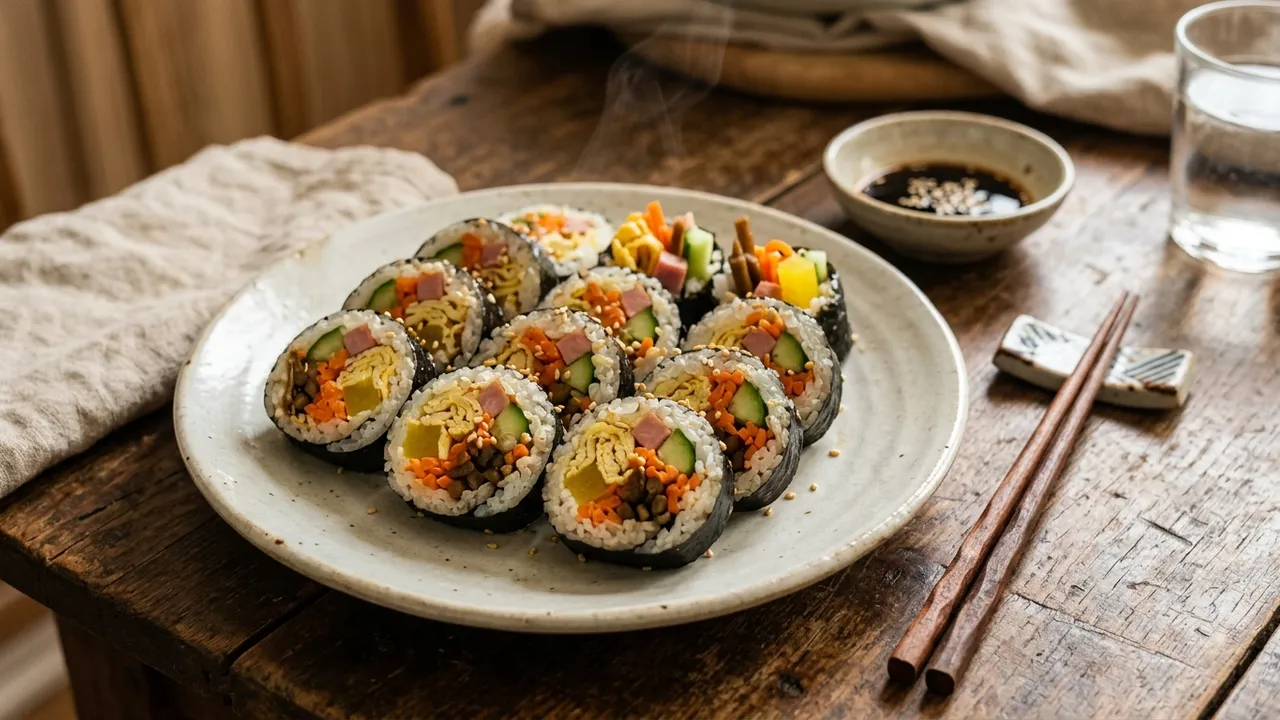
Fail-Proof Gimbap
This is a key recipe for anyone to easily make firm, delicious gimbap (김밥) that doesn't fall apart. It provides essential tips for preparing each ingredient like rice, egg omelet strips, cucumber, carrot, fish cake, ham, pickled radish, and burdock, along with instructions on how to roll gimbap tightly.
📝 Editor's Notes
The most distinguishing feature of this recipe is its detailed key tips for making firm, fail-proof gimbap (김밥) that anyone can master. It meticulously covers everything from achieving the perfect chewy rice texture to ingredient preparation and the art of rolling gimbap, empowering even beginners with confidence. The flavor delivers the familiar savory and slightly salty umami of classic gimbap, with the freshness and balanced seasoning of each ingredient creating a harmonious taste. While some ingredient preparation is involved, the clear instructions make this recipe of low-intermediate difficulty. It's particularly ideal for picnics, sports days, or outings, and also makes a perfect busy morning breakfast or light dinner. This is truly a wonderful dish for the whole family to gather, make, and share.
🛒 Ingredient Tips
The journey to delicious gimbap (김밥) begins with selecting good ingredients. For rice, using new crop rice or high-quality short-grain rice will result in stickier and fluffier grains, which helps prevent the gimbap from unraveling when rolled. Soaking the rice for 30 minutes to 1 hour is ideal. For nori, it's better to choose slightly thicker, roasted sheets rather than thin ones that tear easily, as they provide better structural support when rolling. Use fresh eggs to make savory and soft omelet strips (jidan) without any off-flavors. For vegetables like cucumber and carrot, choose fresh, vibrantly colored, and firm ones to ensure a crisp texture. Utilizing seasonal vegetables will make your gimbap even healthier and more delicious.
🔄 Substitution Guide
Gimbap (김밥) ingredients can be varied to suit your preferences. If you don't eat ham or prefer a vegetarian diet, try substituting it with seasoned fried tofu (yubu), braised tofu, or stir-fried shiitake mushrooms for a light yet deep flavor. For egg allergies, instead of egg omelet strips, you can add long julienned yellow bell peppers or use rice cooked with a pinch of turmeric powder for color. If you dislike cucumber, blanched and squeezed spinach or perilla leaves are good alternatives. You could also add more burdock root (우엉) or lotus root for extra crunch. When substituting ingredients, it's important to consider changes in taste and texture and choose carefully to maintain the overall harmony of the gimbap.
🥘 Ingredients
👨🍳 Cooking Points
The most crucial cooking points in this gimbap (김밥) recipe revolve around the 'rice' and 'egg omelet strips (jidan).' First, remember the secret to cooking rice: add one tablespoon of salt when cooking to prevent the grains from spreading too much, resulting in a firm and chewy texture. Once the rice is done, season it immediately while hot with seasoned salt, sesame oil, and sesame seeds so that the flavor permeates every grain. Before placing the seasoned rice on the nori, ensure it has cooled down to just warm and all steam has escaped to prevent the nori from tearing. Second, making soft egg omelet strips is key. Whisk the eggs gently to avoid foam, then spread a very thin layer of cooking oil in a frying pan and cook the eggs over low heat with a lid until about 70% done. Be mindful that cooking on high heat or with too much oil can make the omelet tough. Finally, after marinating the cucumber and carrot, thoroughly squeeze out any excess water before adding them to the gimbap to prevent it from becoming soggy and to maintain its firmness.
👨🍳 Directions
- 1
Place 3 cups of pre-soaked rice, 3 cups of water, and 1 tbsp of salt into an electric rice cooker and cook the rice. (Pro tip: Cooking rice with salt prevents the grains from spreading too much, resulting in a chewy and fluffy texture.)
- 2
Once the rice is cooked, while it's still hot, season it immediately with a pinch of seasoned salt, a generous amount of sesame oil, and plenty of sesame seeds. Seasoning cold rice will only season the surface, making it taste overly salty, so it's crucial to season it while hot for the flavors to penetrate thoroughly.
- 3
Let the rice cool down to a warm temperature, allowing all the steam to escape. It should be warm, not cold. (If hot rice is placed on the nori, the nori will shrink, become soggy, and tear easily.)
- 4
Do not use the 'keep warm' function of the rice cooker for the cooled rice, as it will become hot again. Instead, keep the rice in the cooker with the power cord unplugged to prevent it from drying out.
- 5
Lightly season 7 eggs with salt, then whisk them gently to avoid creating foam. Foam can make the egg omelet strips (jidan) crumbly.
- 6
Lightly grease a frying pan with a thin layer of cooking oil and preheat it over low heat. (Using too much oil will fry the egg omelet strips like a regular fried egg, making them tough.)
- 7
Pour all the egg mixture into the preheated pan, cover it with a lid, and cook until about 70% done. (Cooking on high heat will burn the bottom while leaving the inside undercooked.)
- 8
Once the bottom of the egg omelet is cooked, flip it and cook for just a short while longer.
- 9
After the cooked egg omelet has cooled slightly, cut it into strips about 1 cm (0.4 inches) wide, matching the length of the danmuji (단무지).
- 10
Cut off the ends of the cucumber and quarter it lengthwise to match the length of the danmuji (단무지). Remove the seeds, then julienne the cucumber into 3 long strips.
- 11
In a bowl, mix the prepared cucumber with 1 tbsp of salt, 1 tbsp of sugar, and 1 tbsp of vinegar. Marinate for 20 minutes, then place it on a sieve to drain the excess water naturally.
- 12
Peel and julienne the carrot.
- 13
Mix the julienned carrot with 1 tbsp of salt and 2 tbsp of corn syrup (물엿). Marinate for about 20 minutes.
- 14
Rinse the marinated carrot once with water and squeeze out all the excess moisture. (If you stir-fry it immediately, it might be too salty due to the retained moisture from the carrot.)
- 15
Lightly coat a frying pan with cooking oil. Once preheated, add the squeezed carrot and stir-fry quickly for only about 1 minute.
- 16
Thinly julienne 7 sheets of fish cake (어묵).
- 17
In a frying pan, add the julienned fish cake (어묵), 1 tbsp of soy sauce, 2 tbsp of corn syrup (물엿), and 2 tbsp of water. Cook until the fish cake becomes soft and tender. (If you stir-fry without water, the fish cake will become stiff and chewy.)
- 18
Cut the gimbap ham into strips matching the size of the danmuji (단무지).
- 19
Without adding oil, place the ham in a frying pan over medium-low heat and cook slowly until the surface moisture evaporates. (Since no oil is used, high heat can burn it quickly.)
- 20
Lightly rinse store-bought danmuji (단무지) and burdock root (우엉) once with water and shake off the excess moisture before using. (Store-bought versions often have strong flavors and aromas.)
- 21
Place a sheet of gimbap nori (김밥 김) vertically with the shiny side facing down.
- 22
Spread one bowl of rice evenly from left to right edges of the nori, leaving about two finger-widths of space at the top. (If the rice isn't spread to the edges, the ends of the gimbap will burst.)
- 23
Arrange the prepared ingredients aesthetically, avoiding overlapping colors. Ensure that the ingredients are placed so that the top and bottom edges of the rice are still visible. (If ingredients protrude beyond the rice, the gimbap will burst when sliced.)
- 24
To roll the gimbap, lift the bottom edge of the nori to completely enclose the ingredients. Roll inward from both sides towards the center, pulling tightly, and repeat this rolling and pulling motion twice to ensure it's firmly rolled. (This step is crucial. If rolled loosely, the gimbap will burst when sliced.)
- 25
Once the gimbap is tightly rolled, rub a little sesame oil on your gloved hands and apply it to the gimbap. Lightly dampen the top edge of the nori with water and place it seam-side down to prevent it from unraveling when sliced.
- 26
When slicing gimbap, you won't need to oil the knife; it will cut cleanly without bursting.
💡 Tips
To achieve chewy and fluffy rice for gimbap, cook it with salt while it's hot. Also, season the cooked rice immediately while it's still hot for the flavors to penetrate thoroughly.
For gimbap rice, it's best to let all the steam escape and cool it to a warm temperature; this prevents the nori from becoming soggy or tearing. Do not use the 'keep warm' function of the rice cooker; unplug it for storage.
To make tender and soft egg omelet strips, grease the pan very lightly with oil, cover, and cook over low heat to prevent them from becoming tough.
Marinating cucumber with salt, sugar, and vinegar, and carrot with salt and corn syrup (물엿) helps remove excess moisture while enhancing flavor and texture. Adding a little water when stir-frying fish cake (어묵) will keep it from becoming stiff and make it chewy.
Stir-frying ham over medium-low heat without oil to evaporate moisture enhances its flavor and helps prevent the gimbap from spoiling quickly. Lightly rinsing store-bought danmuji (단무지) and burdock root (우엉) once will help them blend harmoniously with other ingredients.
To roll gimbap tightly, spread the rice evenly to both ends of the nori, place ingredients so the top and bottom edges of the rice are visible, and completely enclose the ingredients, pulling and rolling several times to prevent it from bursting.
📦 Storage & Reuse
For the best taste, consume finished gimbap (김밥) as soon as possible. If there are leftovers, they can be refrigerated. Wrap them tightly in plastic wrap to prevent air exposure or store them in an airtight container in the refrigerator for 1-2 days. Freezing is not recommended as it alters the texture of the rice. Refrigerated gimbap can be enjoyed cold, or if you prefer it warm, microwave it briefly for about 1 minute. Alternatively, dip the gimbap slices in egg wash and pan-fry them until golden brown to create 'Gimbap-jeon (김밥전),' offering a delightful new flavor. Leftover ingredients can be stored separately and used in dishes like fried rice or bibimbap (비빔밥), ensuring nothing goes to waste.
🥢 Who This Is For
This gimbap (김밥) recipe is a perfect dish for the whole family to enjoy, especially as a lunchbox item for children, or for picnics and outings. With the secret tips for rolling gimbap tightly, you won't have to worry about it falling apart during transport. It's also great for a busy weekend lunch or a light dinner, and makes an excellent finger food for birthday parties or home gatherings. Good accompanying dishes include warm fish cake soup (eomuk-tang), ramyeon (라면), or refreshing bean sprout soup (kongnamul-guk), which all pair wonderfully with gimbap. Fresh fruit salad, kkakdugi (깍두기) (diced radish kimchi), or danmuji (단무지) (pickled radish) also make excellent side dishes that enhance the gimbap's flavor.
🔥 Nutrition Info
Estimating the nutritional information for one serving of gimbap (김밥) made with this fail-proof recipe, it is expected to contain approximately 400-500 kcal. Carbohydrates will be around 50-60g, primarily from the rice. Protein intake will be about 15-20g from eggs, ham, and fish cake (어묵). Fats will contribute about 15-20g, coming from egg yolks, sesame oil, cooking oil, and ham. Gimbap is a balanced meal that provides dietary fiber from various vegetables (cucumber, carrot, burdock root), Vitamin A (from carrots), B vitamins (from rice, eggs), and iron (from ham), among other micronutrients. Please note that the sodium content might be relatively high, so it is recommended to prepare other side dishes with less salt.
💬 Comments
No comments yet. Be the first to comment!