
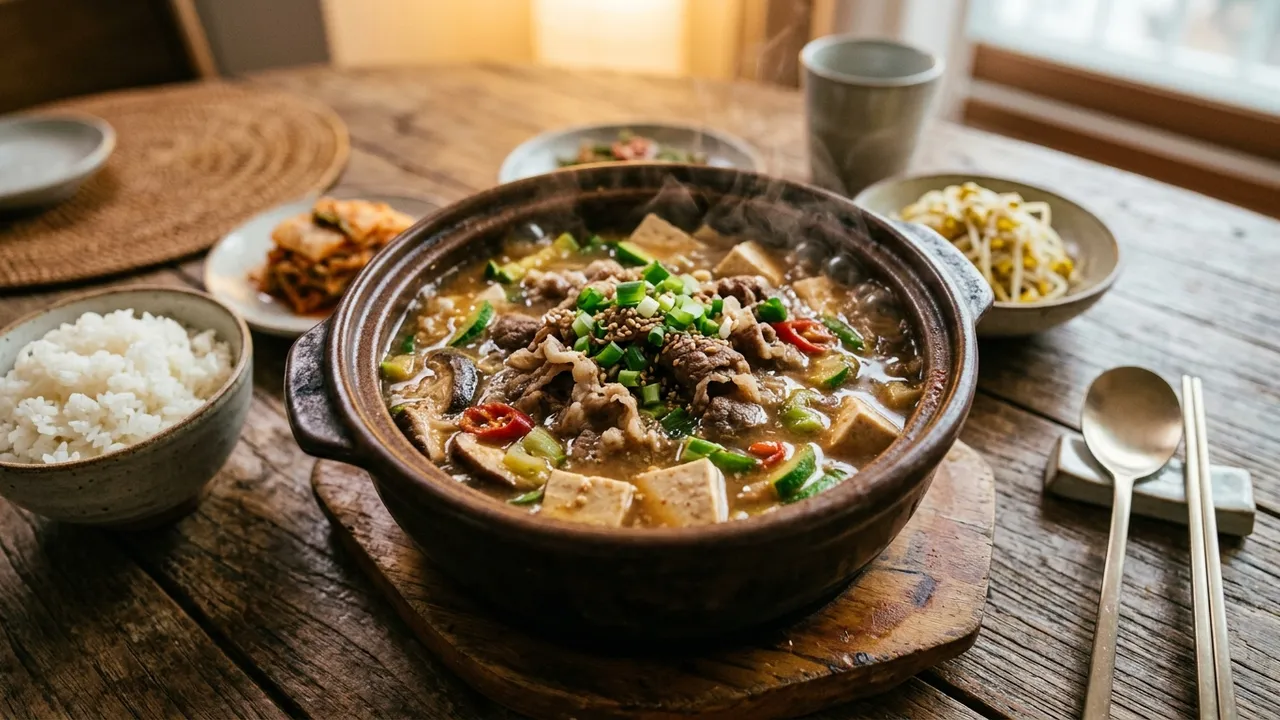
Beef Brisket Point Doenjang-jjigae (차돌 된장찌개)
A 'rice thief' that needs no side dishes, this is a recipe for Chadol Doenjang-jjigae with a rich, savory flavor that isn't greasy.
📝 Editor's Notes
Unlike typical Korean soybean paste stews, this Beef Brisket Point Doenjang-jjigae (차돌 된장찌개) recipe features stir-frying beef brisket point (chadol) and Korean soybean paste (doenjang) directly in oil, which brings out a deep, savory flavor. This technique results in a clean yet rich broth, free from any muddy taste. It's such a 'rice thief' that you won't need any other side dishes, and the short cooking time makes it ideal for a hearty meal even on busy days. Thanks to its spicy and refreshing taste, it's a beloved dish all year round, especially comforting on rainy days or chilly evenings. The straightforward cooking method makes this a low-to-medium difficulty recipe, perfect for beginner cooks.
🛒 Ingredient Tips
The key ingredients for this Beef Brisket Point Doenjang-jjigae are, of course, the beef brisket point (chadol, 차돌박이) and Korean soybean paste (doenjang, 된장). For fresh beef brisket point, choose meat with a bright red color and evenly distributed white fat layers. If using frozen beef brisket point, thaw it thoroughly in the refrigerator before cooking to minimize juice loss. For the Korean soybean paste (doenjang), a mix of traditional homemade doenjang and commercial doenjang can yield both deep flavor and umami. Traditional doenjang offers a robust, earthy taste, while commercial doenjang tends to be less salty and milder, making them a great combination. For Korean zucchini (a-ehobak, 애호박), select ones that are firm, glossy, and feel heavy for their size. Seasonal Korean zucchini are sweeter, which will enrich the stew's flavor even more.
🔄 Substitution Guide
If beef brisket point (chadol, 차돌박이) is unavailable or you prefer an alternative, you can substitute it with beef short plate (usamyup, 우삼겹) or thinly sliced pork belly (daepae samgyeopsal, 대패삼겹살). Beef short plate has a similar fat content to beef brisket point, offering a savory taste, but its texture may be softer. Thinly sliced pork belly is a good choice for those who prefer a lighter flavor, though the meaty richness might be less pronounced than with beef brisket point. For the Korean soybean paste (doenjang), you can also try using Makjang (막장) in addition to homemade or commercial doenjang. Makjang offers a sweeter and more robust savory flavor, creating a distinct taste, but be mindful of adjusting the saltiness. Garlic chives (부추) can be replaced with green onions (jjokpa, 쪽파) or larger green onions (daepa, 대파). These will add a different refreshing and pungent aroma, though they might alter the unique fragrance and tender texture of garlic chives.
🥘 Ingredients
👨🍳 Cooking Points
The 'stir-frying process' is the most crucial aspect that determines the flavor of this Beef Brisket Point Doenjang-jjigae. First, it's important to add the beef brisket point to the dolsot or pot first, stir-fry until it sizzles and is halfway cooked, then add 1 tbsp of minced garlic and continue to stir-fry thoroughly. This effectively eliminates any gamey odor from the meat and allows the garlic aroma to infuse, significantly deepening the flavor. Second, do not skip stir-frying 2 tbsp of Korean soybean paste (doenjang) directly in the rendered meat fat. As the doenjang absorbs the oil, its color deepens, and its savory richness explodes—this is the secret to removing the muddy taste of doenjang-jjigae and creating a rich flavor. Finally, after stir-frying all ingredients, pour in water and boil for exactly 10 minutes. Remember that boiling doenjang for too long can bring out a bitter taste, so a quick and vigorous 10-minute boil is key to the most delicious Beef Brisket Point Doenjang-jjigae.
👨🍳 Directions
- 1
Heat a dolsot (stone pot) or a pot. Add the beef brisket point and stir-fry until sizzling and about halfway cooked.
- 2
Add 1 tbsp of minced garlic and continue to stir-fry thoroughly with the beef brisket point.
- 3
If too much oil has rendered, gently dab some away with a paper towel, leaving only a suitable amount.
- 4
Scoop 2 tbsp of Korean soybean paste (doenjang) and stir-fry until it is evenly mixed with the beef brisket point. As the doenjang absorbs the oil, its color will deepen, and it will become more savory.
- 5
Add the onion and Korean zucchini (a-ehobak) and stir-fry again until the vegetables release their moisture.
- 6
Pour in enough hot water to cover the ingredients and boil for exactly 10 minutes.
- 7
Add Korean chili powder (gochugaru) to taste and mix well.
- 8
Add the tofu and garlic chives, and bring to a boil once more to finish.
💡 Tips
Adding minced garlic and stir-frying it with the beef when it's halfway cooked eliminates any gamey odor and significantly deepens the flavor.
Stir-frying the Korean soybean paste (doenjang) directly in the meat's rendered fat removes any raw or muddy taste from the doenjang-jjigae, allowing the deep, savory richness of the beef brisket point to infuse the stew, enhancing its flavor.
Boiling for too long can bring out a bitter taste from the Korean soybean paste (doenjang), so it's best to stir-fry the ingredients first and then boil vigorously for only 10 minutes.
Following the order of stir-frying beef brisket point -> garlic -> Korean soybean paste (doenjang) -> vegetables ensures a doenjang-jjigae that is rich yet not greasy.
📦 Storage & Reuse
Once cooked, let the Beef Brisket Point Doenjang-jjigae cool, then transfer it to an airtight container and refrigerate for 2-3 days. However, vegetables like tofu and Korean zucchini (a-ehobak) may become soft or change in flavor over time, so it's best to consume it as soon as possible. Freezing is not recommended, as tofu becomes crumbly when thawed, and the texture of vegetables changes significantly. When reheating, warm it slowly over low heat. If the stew has thickened too much, you can add a little hot water to adjust the consistency. You can also enjoy leftover stew by adding rice, sesame oil, and shredded seaweed to make a 'stew rice', or by adding a bit more broth and serving it like a hot pot.
🥢 Who This Is For
This Beef Brisket Point Doenjang-jjigae is highly recommended for those looking for a hearty and satisfying meal. It's perfect as a dinner option on busy days, as one bowl of this stew is enough to finish a whole bowl of rice, even without other meat side dishes. It's also a great, convenient, and filling meal for camping or outdoor activities. Its spicy and savory flavor makes it an excellent hangover remedy as well. It pairs wonderfully with warm white rice. To complete a perfect Korean meal, serve it alongside crunchy kimchi, simple seasoned vegetables, or soft steamed eggs.
🔥 Nutrition Info
For a single serving (approx. 500g) of this Beef Brisket Point Doenjang-jjigae, the estimated calorie count is about 450-550 kcal. It is estimated to contain approximately 30-40g of fat from the beef brisket point, 25-35g of protein from the Korean soybean paste (doenjang), tofu, and beef brisket point, and about 20-30g of carbohydrates from vegetables like onion and Korean zucchini (a-ehobak), as well as the doenjang. Beef brisket point is rich in B vitamins and iron, aiding in energy recovery. Korean soybean paste (doenjang) and tofu are abundant in plant-based protein and isoflavones, beneficial for health. Additionally, vegetables like Korean zucchini, onion, and garlic chives provide dietary fiber and various vitamins and minerals, ensuring nutritional balance. However, due to the nature of doenjang-jjigae, it can be high in sodium, so it's advisable to moderate broth consumption.
💬 Comments
No comments yet. Be the first to comment!